



Quinfamide

Based on 1 Customer Validation
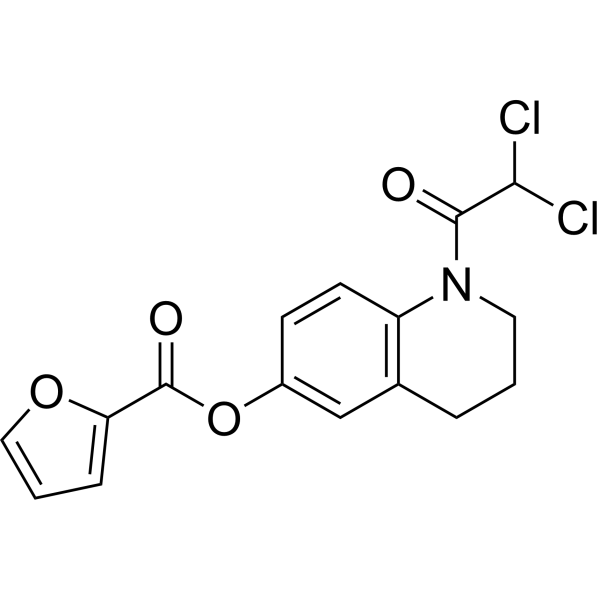
Quinfamide (WIN-40014) is an orally active class of dichloroacetyl derivative with significant anti-intestinal protozoan, particularly mmoeba histolytica activity. Quinfamide exhibits antiamoebic activity under solvent-free conditions with an IC50 of 28.15 μg/mL in a suspension condition. Quinfamide particles are actively engulfed by the amoebas, then cells are affected, and finally, amoebas are killed and lysed, and this process directly relies on the physical intake of the drug particles. Quinfamide can be used in the research of tropical parasitic infections such as amoebiasis and helminthiasis.
For research use only. We do not sell to patients.
- Purity : 99.69%
- CAS No.: 62265-68-3
- Formula: C16H13Cl2NO4
- Molecular Weight:354.18
-
Storage:Powder -20°C, 3 years , 4°C, 2 years ; In solvent -80°C, 6 months , -20°C, 1 month

To place orders, for customer services and technical support, please contact: MedChemExpress USA
Tel: 609-228-6898 E-mail: [email protected] [email protected]


-
 Biological Activity
-
Chemical Information
-
Solvent & Solubility
- Purity & Documentation
- References
-
 Help & FAQs



All Parasite Isoforms
More

Biological Activity
Description
IC50 & Target
|
Amebae |
In Vitro
Quinfamide inhibits propagation of E. histolytica in vitro at a concentration of 20 μg/mL[2].
Quinfamide (0-72 h) granules are actively engulfed by the amoeba, and subsequently the amoeba's trophozoite cells become round, lose their motility, undergo cell lysis, and the integrity of the cell membrane is lost[3].
Quinfamide has an IC50 value against pathogenic strain of Trichomonas vaginalis (strain GT-13) of 214.7 μg/mL[3].
MedChemExpress (MCE) has not independently confirmed the accuracy of these methods. They are for reference only. .
In Vivo
Quinfamide (p.o.) exhibits ED50 values against E. cricetid of 0.25 mg/kg/day (total dose 0.75 mg/kg) in multiple doses for 3 days and 0.9 mg/kg after a single dose[2].
Quinfamide (p.o.) protect hamsters from re-infection with E. cricetid and has no significant toxicity in rodents (10 g/kg, single dose), monkeys (500 mg/kg, for 37 days), dogs (2 g/kg, single dose) and rats (500 mg/kg, for 31 days)[2].
MedChemExpress (MCE) has not independently confirmed the accuracy of these methods. They are for reference only.
-
Animal Model:Coccidial infection induced by E. acervuline, E. maxima and E. tenella established in one-day old broiler chickens[1]
-
Dosage:30 mg/kg alone or with 0.1% Carbopol
-
Administration:Oral administration (p.o.), prepared as small pellets and mixed with feed, for 49 days
-
Result:Increased the weight of the broiler chickens, reduced the amount of egg sacs excreted, and alleviated intestinal lesions but that the combined inhibition was more remarkable.
Clinical Trial
| NCT Number | Sponsor | Condition | Start Date |
Phase

|
|---|---|---|---|---|
| NCT01329991 | Plexxikon| | 2011-05 | PHASE1 |


Chemical Information
-
CAS No. 62265-68-3
-
Appearance Solid
-
Molecular Weight 354.18
-
Formula C16H13Cl2NO4
-
Color Off-white to light yellow
-
SMILES
O=C(OC1=CC2=C(C=C1)N(CCC2)C(C(Cl)Cl)=O)C3=CC=CO3
-
Synonyms
WIN-40014
-
Shipping
Room temperature in continental US; may vary elsewhere.
-
Storage
Powder -20°C 3 years 4°C 2 years In solvent -80°C 6 months -20°C 1 month


Solvent & Solubility
In Vitro:
DMSO : ≥ 125 mg/mL (352.93 mM; Hygroscopic DMSO has a significant impact on the solubility of product, please use newly opened DMSO)
* "≥" means soluble, but saturation unknown.
Please refer to the solubility information to select the appropriate solvent. Once prepared, please aliquot and store the solution to prevent product inactivation from repeated freeze-thaw cycles.
Storage method and period of stock solution: -80°C, 6 months; -20°C, 1 month. When stored at -80°C, please use it within 6 months. When stored at -20°C, please use it within 1 month.
Please refer to the solubility information to select the appropriate solvent. Once prepared, please aliquot and store the solution to prevent product inactivation from repeated freeze-thaw cycles.
Storage method and period of stock solution: -80°C, 6 months; -20°C, 1 month. When stored at -80°C, please use it within 6 months. When stored at -20°C, please use it within 1 month.
Concentration (start) × Volume (start) = Concentration (final) × Volume (final)


Purity & Documentation
-
Data Sheet (276 KB)
-
SDS (254 KB)
- English - EN (254 KB)
- Français - FR (254 KB)
- Deutsch - DE (254 KB)
- Norwegian - NO (254 KB)
- Español - ES (254 KB)
- Swedish - SV (254 KB)
- Italian - IT (254 KB)
- Korean - KR (254 KB)
- Portuguese - PT (254 KB)
-
Handling Instructions (2659 KB)
References
[2]. Slighter RG, et al. Activity of quinfamide against natural infections of Entamoeba criceti in hamsters: a new potent agent for intestinal amoebiasis. Parasitology. 1980 Aug;81(1):157-68. [Content Brief]
[3]. Anaya-Velázquez F, Morales-Fuentes L. Phagocytosis of quinfamide particles by Entamoeba histolytica. Arch Med Res. 2000 Jul-Aug;31(4 Suppl):S10-1. [Content Brief]


Complete Stock Solution Preparation Table
Please refer to the solubility information to select the appropriate solvent. Once prepared, please aliquot and store the solution to prevent product inactivation from repeated freeze-thaw cycles.
Storage method and period of stock solution: -80°C, 6 months; -20°C, 1 month. When stored at -80°C, please use it within 6 months. When stored at -20°C, please use it within 1 month.
| Optional Solvent | Concentration Solvent Mass | 1 mg | 5 mg | 10 mg | 25 mg |
|---|---|---|---|---|---|
| DMSO | 1 mM | 2.8234 mL | 14.1171 mL | 28.2342 mL | 70.5856 mL |
| 5 mM | 0.5647 mL | 2.8234 mL | 5.6468 mL | 14.1171 mL | |
| 10 mM | 0.2823 mL | 1.4117 mL | 2.8234 mL | 7.0586 mL | |
| 15 mM | 0.1882 mL | 0.9411 mL | 1.8823 mL | 4.7057 mL | |
| 20 mM | 0.1412 mL | 0.7059 mL | 1.4117 mL | 3.5293 mL | |
| 25 mM | 0.1129 mL | 0.5647 mL | 1.1294 mL | 2.8234 mL | |
| 30 mM | 0.0941 mL | 0.4706 mL | 0.9411 mL | 2.3529 mL | |
| 40 mM | 0.0706 mL | 0.3529 mL | 0.7059 mL | 1.7646 mL | |
| 50 mM | 0.0565 mL | 0.2823 mL | 0.5647 mL | 1.4117 mL | |
| 60 mM | 0.0471 mL | 0.2353 mL | 0.4706 mL | 1.1764 mL | |
| 80 mM | 0.0353 mL | 0.1765 mL | 0.3529 mL | 0.8823 mL | |
| 100 mM | 0.0282 mL | 0.1412 mL | 0.2823 mL | 0.7059 mL |


Quinfamide Related Classifications
HY-119826 Related Classifications
 Powered by Bioz