



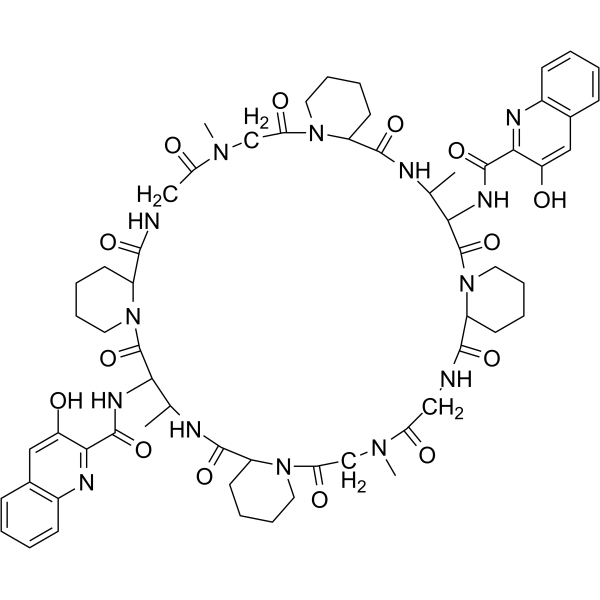
Quinaldopeptin
Quinaldopeptin, a quinomycin antibiotic isolated from the culture of Streptoverticillium album strain, is highly active against Gram-positive bacteria and anaerobes and strongly cytotoxic against cultured B16 melanoma cells.
商品は「研究用試薬」です。人や動物の医療用・臨床診断用・食品用の製品ではありません。
研究用途以外に使用した場合、当社は一切の責任を負いかねます。
- CAS 番号: 130743-07-6
- 分子式: C62H78N14O14
- 分子量:1243.37
-
保管条件:
Please store the product under the recommended conditions in the Certificate of Analysis.

To place orders, for customer services and technical support, please contact: MedChemExpress USA
Tel: 609-228-6898 E-mail: [email protected] [email protected]


-
 生物活性
生物活性
-
化学情報
- プロトコル
- 純度とドキュメンテーション
- 参考文献
-
 Help & FAQs


Antibiotic アイソフォーム固有の製品をすべて表示
More

生物活性
製品説明
体外実験
Quinaldopeptin is quite active against B16-F10 cells with IC50 values approximately 3-fold superior to that of chromomycin A3[1].
MedChemExpress (MCE) has not independently confirmed the accuracy of these methods. They are for reference only. Further protocols information, click here.
体内実験
MedChemExpress (MCE) has not independently confirmed the accuracy of these methods. They are for reference only.


化学情報
-
CAS 番号 130743-07-6
-
分子量 1243.37
-
分子式 C62H78N14O14
-
SMILES
O=C(C(C(NC(C(CCCC1)N1C(CN(C(CNC(C2N3CCCC2)=O)=O)C)=O)=O)C)NC(C4=NC(C=CC=C5)=C5C=C4O)=O)N6C(C(NCC(N(CC(N(CCCC7)C7C(NC(C(C3=O)NC(C8=NC(C=CC=C9)=C9C=C8O)=O)C)=O)=O)C)=O)=O)CCCC6
-
輸送条件
Room temperature in continental US; may vary elsewhere.
-
保管条件
Please store the product under the recommended conditions in the Certificate of Analysis.

プロトコル
-
Gram Staining of Tissue Sections
Gram staining of tissue sections is a histochemical technique used to differentiate Gram-positive and Gram-negative bacteria within histological specimens based on differences in bacterial cell wall structure and dye retention, adapted from classical bacteriological Gram staining into tissue-compatible “histological Gram stain” variants. In tissue applications, modifications of the Brown-Hopps and Brown-Brenn methods are commonly used to improve differentiation of microorganisms embedded within host connective tissue and to reduce overstaining or loss of Gram-negative signal, which are known limitations of earlier approaches. The principle relies on crystal violet-iodine complex retention in Gram-positive organisms and subsequent decolorization and counterstaining steps that allow contrast visualization of Gram-negative organisms against tissue background.
-
Cell Viability Determination by MTT Colorimetric Assay
The following protocol uses the MTT colorimetric assay as a classic literature-established method for assessing cell viability/metabolic activity in cultured mammalian cells. MTT[3-(4,5-dimethylthiazol-2-yl)-2,5-diphenyltetrazolium bromide] is reduced by metabolically active cells to a colored formazan product; the amount of formazan is quantified spectrophotometrically and provides an indirect measure of metabolically active viable cells. Importantly, MTT reduction reflects cellular oxidoreductase/metabolic activity rather than an absolute direct count of living cells, so changes in cellular metabolism can alter the signal independently of cell number.


純度とドキュメンテーション
参考文献

Calculators
濃度 (開始) × 体積 (開始) = 濃度 (終了) × 体積 (終了)


Quinaldopeptin 関連分類
HY-136295 関連分類
 Powered by Bioz