



Onalespib
Based on 11 publication(s) in Google Scholar
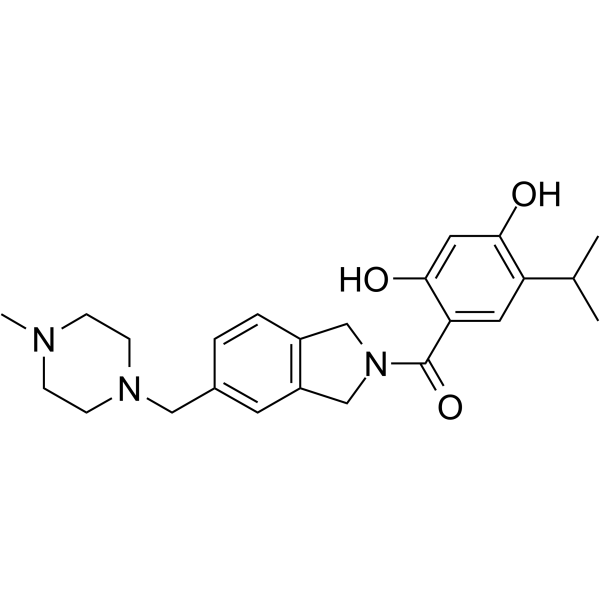
Onalespib (AT13387) is a potent and cross the blood-brain barrier heat-shock-protein-90 (Hsp90) inhibitor. Onalespib inhibits the proliferation, survival and migration. Onalespib decreases the expression of EGFR, p-EGFR, AKT, P-AKT, ERK1/2, P-ERK1/2, S6, P-S6 protein. Onalespib shows antitumor activity. Onalespib has the potential for the research of non-small cell lung cancer (NSCLC).
연구목적의 판매만을 진행합니다. 환자를 대상으로 한 판매는 하지 않습니다.
- Purity : 99.11%
- CAS No.: 912999-49-6
- 화학식: C24H31N3O3
- 분자량:409.52
-
보관:Powder -20°C, 3 years , 4°C, 2 years ; In solvent -80°C, 2 years , -20°C, 1 year

To place orders, for customer services and technical support, please contact: MedChemExpress USA
Tel: 609-228-6898 E-mail: [email protected] [email protected]


-
 Biological Activity
-
Chemical Information
-
용액&용해도
- Protocol
- 순도&문서
- References
-
 Help & FAQs


-
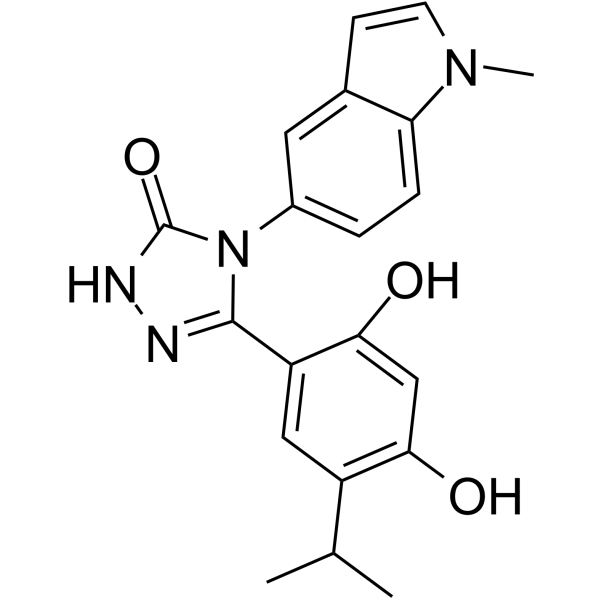
HY-15205
GanetespibHSP90 Inhibitor -
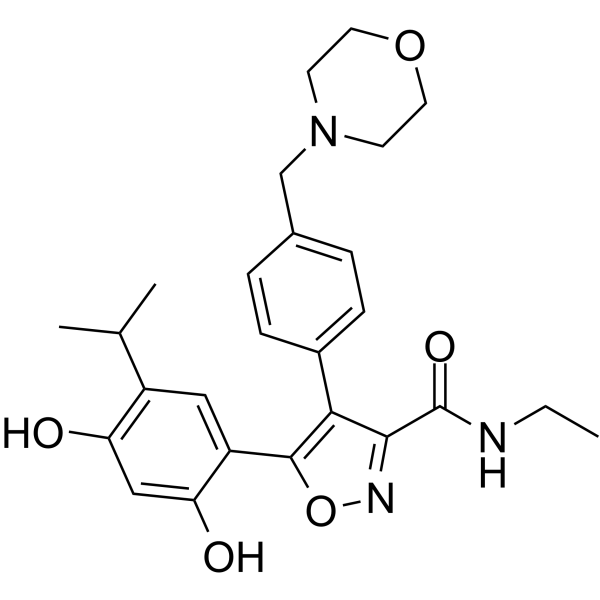
HY-10215
LuminespibHSP90 Inhibitor -
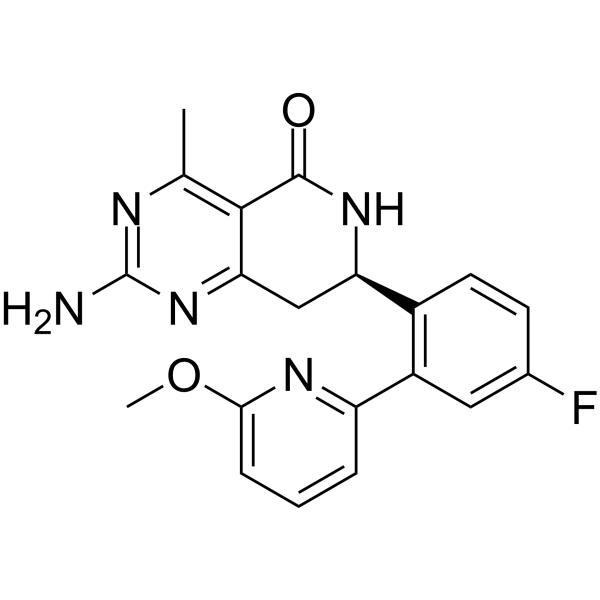
HY-15190
NVP-HSP990Apoptosis Inducer -
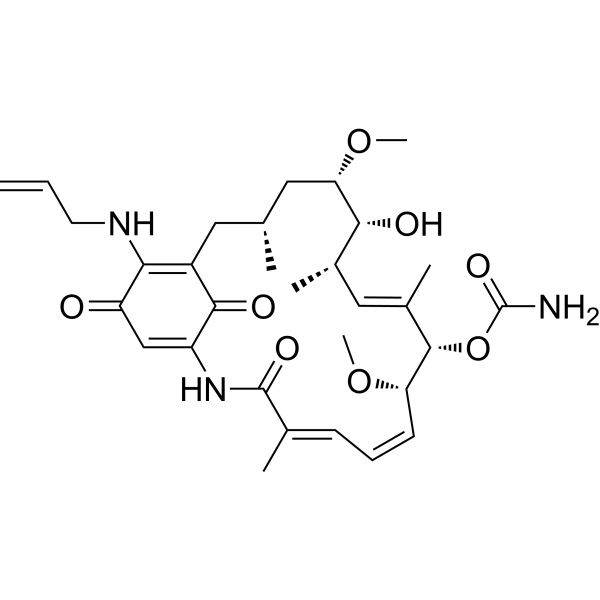
HY-10211
TanespimycinHSP90 Inhibitor -
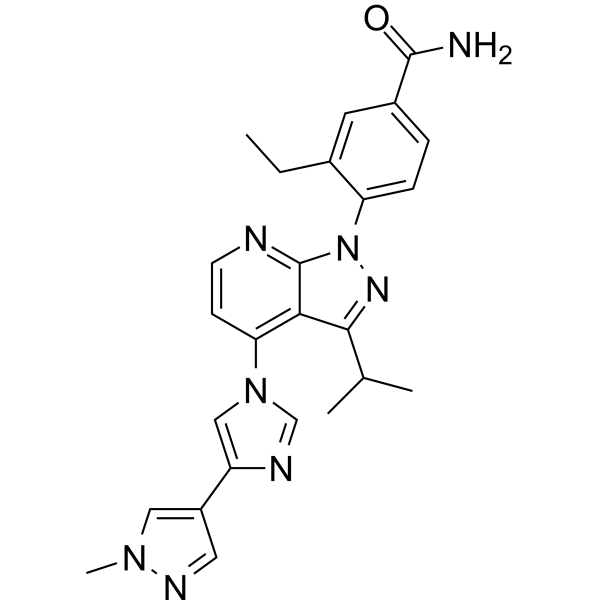
HY-15785
PimitespibHSP90α/HSP90β Inhibitor -
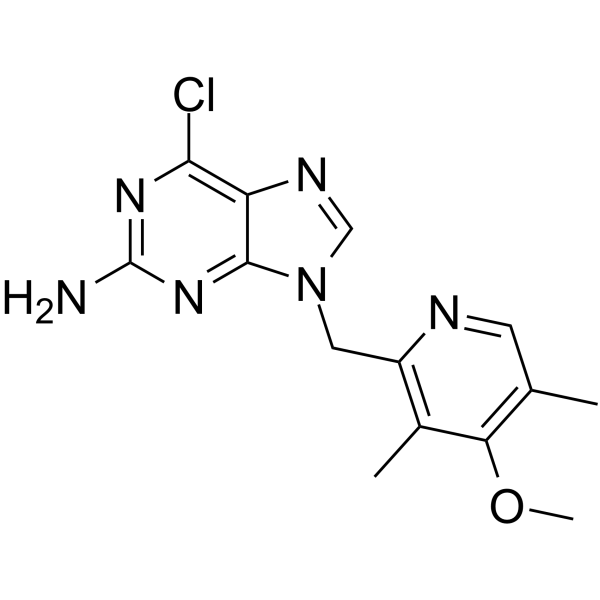
HY-10212
BIIB021HSP90 Inhibitor -
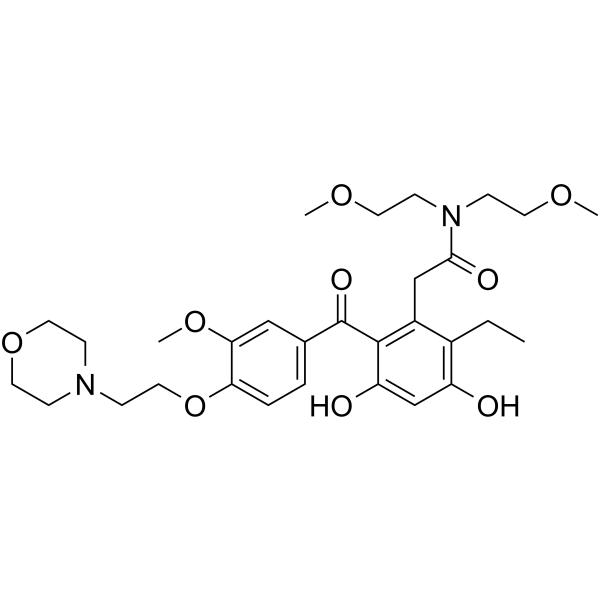
HY-13468
KW-2478 -
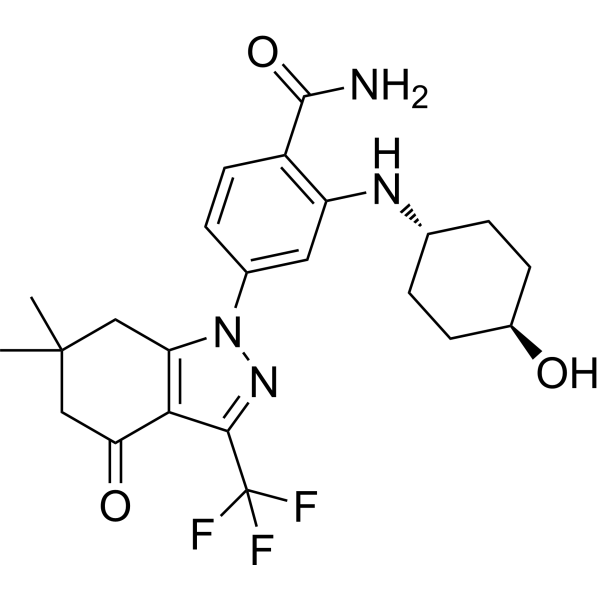
HY-10214
SNX-2112 -
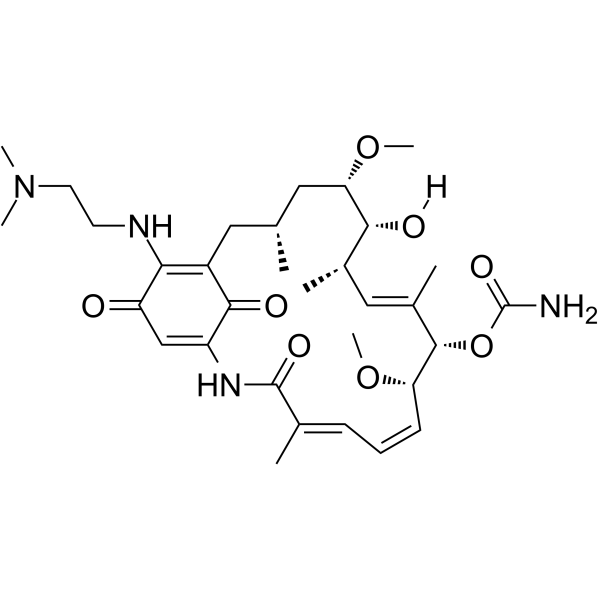
HY-10389
AlvespimycinHsp90 Inhibitor -
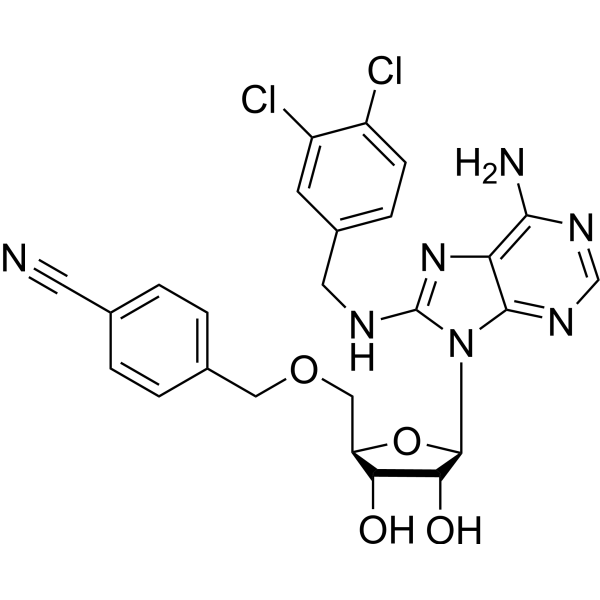
HY-10941
VER-155008Hsp70 Inhibitor -
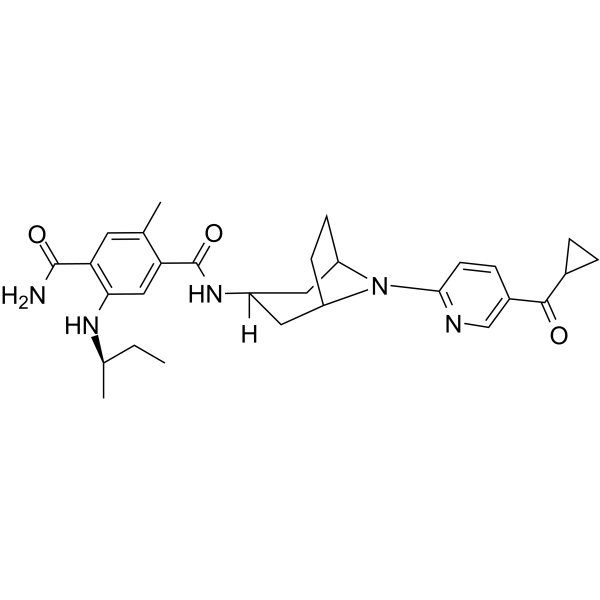
HY-13313
XL888HSP90 Inhibitor -
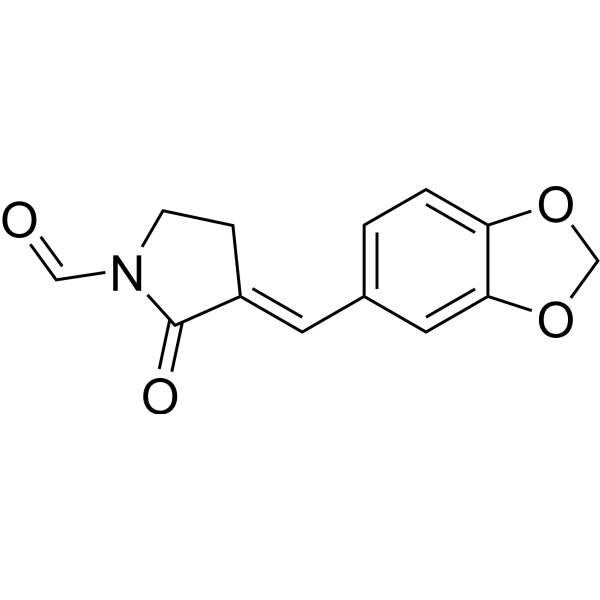
HY-100110
KNK437HSP Inhibitor
Publications Citing Use of MedChemExpress (MCE) Onalespib
More- Theranostics. 2019 Aug 12;9(20):5769-5783. [Abstract]
- Nano Res. 07 May 2022.
- Immunology. 2021 Jan;162(1):84-91. [Abstract]
- Sci Rep. 2017 Mar 15;7(1):201. [Abstract]
- J Appl Toxicol. 2017 Nov;37(11):1325-1332. [Abstract]
- Prostate. 2022 Jun;82(8):917-932. [Abstract]
- J Labelled Comp Radiopharm. 2025 Apr;68(4):e4144. [Abstract]
- Research Square Preprint. 2024 Oct 10.
- Research Square Print. December 12th, 2022.
- Oncotarget. 2020 Nov 3;11(44):3921-3932. [Abstract]
- Methods Mol Biol. 2018:1711:351-398. [Abstract]
 Customer Validation & Images

-
Histological Imaging/Staining
-
Bio/Physico-chemical Assay
-
Apoptosis Analysis
-
Cell Proliferation/Viability Assay
-
Cell Proliferation/Viability Assay


Biological Activity
제품 설명
IC50 & Target
[1]|
HSP90 0.71 nM (Kd) |
Cellular Effect
|
Cell Line

|
Type | Value | Description | References |
|---|---|---|---|---|
| A549 | IC50 |
0.05 μM
Compound: 8; AT13387
|
Antiproliferative activity against human A549 assessed as reduction in cell viability incubated for 72 hrs by MTT assay
Antiproliferative activity against human A549 assessed as reduction in cell viability incubated for 72 hrs by MTT assay
|
[PMID: 27933959] |
| A549 | IC50 |
0.44 μM
Compound: AT13387
|
Antiproliferative activity against human A549 cells after 72 hrs by MTT assay
Antiproliferative activity against human A549 cells after 72 hrs by MTT assay
|
[PMID: 30784881] |
| BT-474 | IC50 |
0.032 μM
Compound: 8; AT13387
|
Antiproliferative activity against human BT-474 assessed as reduction in cell viability incubated for 72 hrs by MTT assay
Antiproliferative activity against human BT-474 assessed as reduction in cell viability incubated for 72 hrs by MTT assay
|
[PMID: 27933959] |
| GIST430 | IC50 |
34 nM
Compound: 8; AT-13387
|
Cytotoxicity against imatinib-resistant human GIST430 cells assessed as decrease in cell viability after 7 days by alamar blue assay
Cytotoxicity against imatinib-resistant human GIST430 cells assessed as decrease in cell viability after 7 days by alamar blue assay
|
[PMID: 26844689] |
| GIST48 | IC50 |
55 nM
Compound: 8; AT-13387
|
Cytotoxicity against imatinib-resistant human GIST48 cells assessed as decrease in cell viability after 7 days by alamar blue assay
Cytotoxicity against imatinib-resistant human GIST48 cells assessed as decrease in cell viability after 7 days by alamar blue assay
|
[PMID: 26844689] |
| HCT-116 | IC50 |
0.07 μM
Compound: 8; AT13387
|
Antiproliferative activity against human HCT-116 cells assessed as reduction in cell viability incubated for 72 hrs by MTT assay
Antiproliferative activity against human HCT-116 cells assessed as reduction in cell viability incubated for 72 hrs by MTT assay
|
[PMID: 27933959] |
| HCT-116 | IC50 |
0.08 μM
Compound: AT-13387
|
Antiproliferative activity against human HCT116 cells after 48 hrs by MTT assay
Antiproliferative activity against human HCT116 cells after 48 hrs by MTT assay
|
[PMID: 24763261] |
| HCT-116 | IC50 |
48 nM
Compound: 35
|
Cytotoxicity against human HCT116 cells by Alamar blue assay
Cytotoxicity against human HCT116 cells by Alamar blue assay
|
[PMID: 20662534] |
| HCT-116 | IC50 |
78.49 nM
Compound: AT13387
|
Antiproliferative activity against human HCT-116 cells assessed as inhibition of cell proliferation incubated for 72 hrs by CCK8 assay
Antiproliferative activity against human HCT-116 cells assessed as inhibition of cell proliferation incubated for 72 hrs by CCK8 assay
|
[PMID: 39145509] |
| HepG2 | IC50 |
0.018 μM
Compound: 8; AT13387
|
Antiproliferative activity against human HepG2 assessed as reduction in cell viability incubated for 72 hrs by MTT assay
Antiproliferative activity against human HepG2 assessed as reduction in cell viability incubated for 72 hrs by MTT assay
|
[PMID: 27933959] |
| K562 | IC50 |
0.038 μM
Compound: 8; AT13387
|
Antiproliferative activity against human K562 assessed as reduction in cell viability incubated for 72 hrs by MTT assay
Antiproliferative activity against human K562 assessed as reduction in cell viability incubated for 72 hrs by MTT assay
|
[PMID: 27933959] |
| L02 | IC50 |
11.64 μM
Compound: 8; AT13387
|
Cytotoxicity against human L02 cells assessed as reduction in cell viability incubated for 72 hrs by MTT assay
Cytotoxicity against human L02 cells assessed as reduction in cell viability incubated for 72 hrs by MTT assay
|
[PMID: 27933959] |
| MCF7 | IC50 |
0.02 μM
Compound: 8; AT13387
|
Antiproliferative activity against human MCF7 cells assessed as reduction in cell viability incubated for 72 hrs by MTT assay
Antiproliferative activity against human MCF7 cells assessed as reduction in cell viability incubated for 72 hrs by MTT assay
|
[PMID: 27933959] |
| MCF7 | IC50 |
0.032 μM
Compound: AT13387
|
Antiproliferative activity against human MCF7 cells incubated for 72 hrs by MTT assay
Antiproliferative activity against human MCF7 cells incubated for 72 hrs by MTT assay
|
[PMID: 29028527] |
| MCF7 | IC50 |
0.28 μM
Compound: AT-13387
|
Antiproliferative activity against human MCF7 cells after 48 hrs by MTT assay
Antiproliferative activity against human MCF7 cells after 48 hrs by MTT assay
|
[PMID: 24763261] |
| MCF7 | IC50 |
0.29 μM
Compound: AT13387
|
Antiproliferative activity against human MCF7 cells after 72 hrs by MTT assay
Antiproliferative activity against human MCF7 cells after 72 hrs by MTT assay
|
[PMID: 30784881] |
| MCF7 | IC50 |
0.84 μM
Compound: AT13387
|
Antiproliferative activity against human MCF7 cells assessed as inhibition of cell proliferation incubated for 72 hrs by MTT assay
Antiproliferative activity against human MCF7 cells assessed as inhibition of cell proliferation incubated for 72 hrs by MTT assay
|
[PMID: 37619298] |
| MDA-MB-231 | IC50 |
0.038 μM
Compound: 8; AT13387
|
Antiproliferative activity against human MDA-MB-231 assessed as reduction in cell viability incubated for 72 hrs by MTT assay
Antiproliferative activity against human MDA-MB-231 assessed as reduction in cell viability incubated for 72 hrs by MTT assay
|
[PMID: 27933959] |
| MDA-MB-231 | IC50 |
2.6 μM
Compound: AT13387
|
Antiproliferative activity against human MDA-MB-231 cells assessed as inhibition of cell proliferation incubated for 72 hrs by MTT assay
Antiproliferative activity against human MDA-MB-231 cells assessed as inhibition of cell proliferation incubated for 72 hrs by MTT assay
|
[PMID: 37619298] |
| MDA-MB-468 | IC50 |
0.066 μM
Compound: 8; AT13387
|
Antiproliferative activity against human MDA-MB-468 assessed as reduction in cell viability incubated for 72 hrs by MTT assay
Antiproliferative activity against human MDA-MB-468 assessed as reduction in cell viability incubated for 72 hrs by MTT assay
|
[PMID: 27933959] |
| MDA-MB-468 | IC50 |
3.31 μM
Compound: AT13387
|
Antiproliferative activity against human MDA-MB-468 cells assessed as inhibition of cell proliferation incubated for 72 hrs by MTT assay
Antiproliferative activity against human MDA-MB-468 cells assessed as inhibition of cell proliferation incubated for 72 hrs by MTT assay
|
[PMID: 37619298] |
| MKN-28 | IC50 |
0.129 μM
Compound: 8; AT13387
|
Antiproliferative activity against human MKN-28 assessed as reduction in cell viability incubated for 72 hrs by MTT assay
Antiproliferative activity against human MKN-28 assessed as reduction in cell viability incubated for 72 hrs by MTT assay
|
[PMID: 27933959] |
| MV4-11 | IC50 |
0.011 μM
Compound: 8; AT13387
|
Antiproliferative activity against human MV4-11 assessed as reduction in cell viability incubated for 72 hrs by MTT assay
Antiproliferative activity against human MV4-11 assessed as reduction in cell viability incubated for 72 hrs by MTT assay
|
[PMID: 27933959] |
| MX1 | IC50 |
0.5 μM
Compound: AT13387
|
Antiproliferative activity against human MX1 cells assessed as inhibition of cell proliferation incubated for 72 hrs by MTT assay
Antiproliferative activity against human MX1 cells assessed as inhibition of cell proliferation incubated for 72 hrs by MTT assay
|
[PMID: 37619298] |
| NCI-H1299 | IC50 |
0.37 μM
Compound: AT13387
|
Antiproliferative activity against human NCI-H1299 cells after 72 hrs by MTT assay
Antiproliferative activity against human NCI-H1299 cells after 72 hrs by MTT assay
|
[PMID: 30784881] |
| NCI-H3122 | IC50 |
52 nM
Compound: AT13387
|
Antiproliferative activity against human NCI-H3122 cells after 72 hrs by SRB assay
Antiproliferative activity against human NCI-H3122 cells after 72 hrs by SRB assay
|
[PMID: 29698859] |
| SK-BR-3 | IC50 |
0.045 μM
Compound: AT13387
|
Antiproliferative activity against human SKBR3 cells incubated for 72 hrs by MTT assay
Antiproliferative activity against human SKBR3 cells incubated for 72 hrs by MTT assay
|
[PMID: 29028527] |
| SK-BR-3 | IC50 |
0.071 μM
Compound: 8; AT13387
|
Antiproliferative activity against human SK-BR-3 assessed as reduction in cell viability incubated for 72 hrs by MTT assay
Antiproliferative activity against human SK-BR-3 assessed as reduction in cell viability incubated for 72 hrs by MTT assay
|
[PMID: 27933959] |
| SK-BR-3 | IC50 |
0.14 μM
Compound: AT-13387
|
Antiproliferative activity against human SKBR3 cells after 48 hrs by MTT assay
Antiproliferative activity against human SKBR3 cells after 48 hrs by MTT assay
|
[PMID: 24763261] |
| SW-620 | IC50 |
122.3 nM
Compound: AT13387
|
Antiproliferative activity against human SW620 cells assessed as inhibition of cell proliferation incubated for 72 hrs by CCK8 assay
Antiproliferative activity against human SW620 cells assessed as inhibition of cell proliferation incubated for 72 hrs by CCK8 assay
|
[PMID: 39145509] |
| T47D | IC50 |
0.024 μM
Compound: 8; AT13387
|
Antiproliferative activity against human T47D assessed as reduction in cell viability incubated for 72 hrs by MTT assay
Antiproliferative activity against human T47D assessed as reduction in cell viability incubated for 72 hrs by MTT assay
|
[PMID: 27933959] |
| U2OS | IC50 |
0.067 μM
Compound: 8; AT13387
|
Antiproliferative activity against human U2OS assessed as reduction in cell viability incubated for 72 hrs by MTT assay
Antiproliferative activity against human U2OS assessed as reduction in cell viability incubated for 72 hrs by MTT assay
|
[PMID: 27933959] |
In Vitro
Onalespib (0-0.4 µM; 72 h, 48 h) inhibits the proliferation, survival and migration of glioma cells[2].
Onalespib (0-0.4 µM; 48 h) decreases the expression of EGFR, p-EGFR, AKT, P-AKT, ERK1/2, P-ERK1/2, S6, P-S6 protein in a dose-dependent manner[2].
MedChemExpress (MCE) has not independently confirmed the accuracy of these methods. They are for reference only.
In Vivo
Onalespib (0.5 µM; from 5 to 10 days post-transplant) and TMZ (10 µM) reduce tumor growth and extend survival in zebrafish embryos[2].
Onalespib (5, 10 mg/kg for HCT116 xenografts, 20 mg/kg for A431 xenografts; i.p.; daily for 3 days) shows anti-tumor activity in HCT116 and A431 xenografts[3].
MedChemExpress (MCE) has not independently confirmed the accuracy of these methods. They are for reference only.
Clinical Trial
| NCT Number | Sponsor | Condition | Start Date |
Phase
|
|---|---|---|---|---|
| NCT01329991 | Plexxikon| | 2011-05 | PHASE1 |


Chemical Information
-
CAS No. 912999-49-6
-
Appearance Solid
-
분자량 409.52
-
화학식 C24H31N3O3
-
Color Off-white to gray
-
SMILES
OC1=CC(O)=C(C(C)C)C=C1C(N2CC(C=CC(CN3CCN(C)CC3)=C4)=C4C2)=O
-
Synonyms
AT13387
-
선적
Room temperature in continental US; may vary elsewhere.
-
보관
Powder -20°C 3 years 4°C 2 years In solvent -80°C 2 years -20°C 1 year


Publications (11)
-
Journal Impact Factor
-
Most Recent
-
Theranostics
Inhibition of HSP90β Improves Lipid Disorders by Promoting Mature SREBPs Degradation via the Ubiquitin-proteasome System. [Abstract]2019 Aug 12;9(20):5769-5783. PMID: 31534518 -
-
Immunology
2021 Jan;162(1):84-91. PMID: 32954500 -
Sci Rep
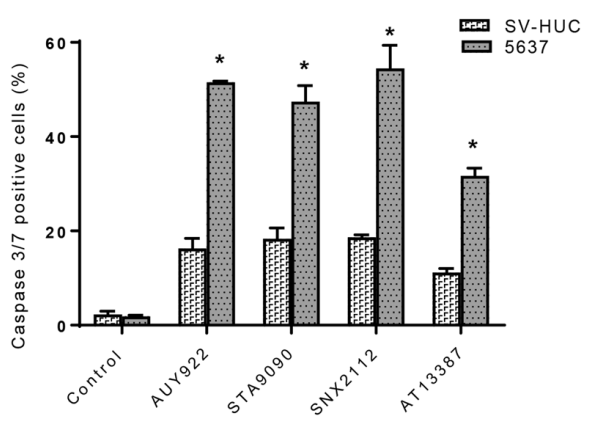
Proteomic analysis of proteome and histone post-translational modifications in heat shock protein 90 inhibition-mediated bladder cancer therapeutics. [Abstract]2017 Mar 15;7(1):201. PMID: 28298630
Onalespib purchased from MedChemExpress. Usage Cited in: Sci Rep. 2017 Mar 15;7(1):201. [Abstract]
5637 and SV-HUC cells (1 × 10⁴ per well) were evenly distributed in 96-well plates overnight. Cells were incubated with AUY922 (10 nM), ganetespib (10 nM), SNX2112 (100 nM), or AT13387 (Onalespib) (100 nM) for 48 h. For the caspase 3/7 assay, the HSP90 inhibitor-treated 5637 or SV-HUC cells are stained with Nexcelom ViaStain Caspase 3/7 reagent and Hoechst 33342. Caspase 3/7 positive cells are identified using the Celigo imaging cytometer, and the percentage of apoptotic caspase 3/7 positive cells is calculated with the Celigo software.
Onalespib purchased from MedChemExpress. Usage Cited in: Sci Rep. 2017 Mar 15;7(1):201. [Abstract]
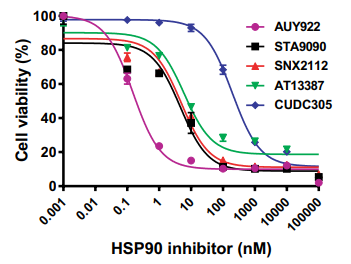
Heat shock protein 90 (HSP90) inhibitors suppress cell growth and proliferation in human bladder carcinoma cells. 5637 cells were evenly distributed in 96-well plates (5 × 10³ cells/well) and treated for 72 h with AUY922, ganetespib (STA9090), SNX2112, AT13387 (Onalespib), or CUDC395 at the indicated concentrations. The ability of HSP90 inhibitors to inhibit cell growth and proliferation was determined by the MTS assay.
-
J Appl Toxicol
2017 Nov;37(11):1325-1332. PMID: 28543094
Onalespib purchased from MedChemExpress. Usage Cited in: J Appl Toxicol. 2017 Nov;37(11):1325-1332. [Abstract]
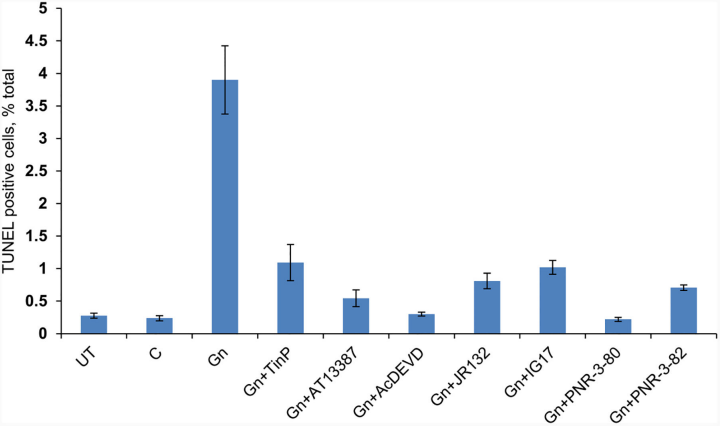
Alleviation of graphene toxicity by using chemical inhibitors (Onalespib (AT13387 et al; 20 nM pretreatment 2 h)) after 48 h exposure of NRK-52E cells with graphene (50 μg/ml). Quantification of TUNEL-positive cells in NRK-52E cells treated with graphene in the presence of chemical inhibitors for HO-1, HSP90, caspase 3, DNase I and EndoG (p < 0.01 for all bars vs. Gn).
-
Prostate
Diptoindonesin G antagonizes AR signaling and enhances the efficacy of antiandrogen therapy in prostate cancer. [Abstract]2022 Jun;82(8):917-932. PMID: 35322879 -
J Labelled Comp Radiopharm
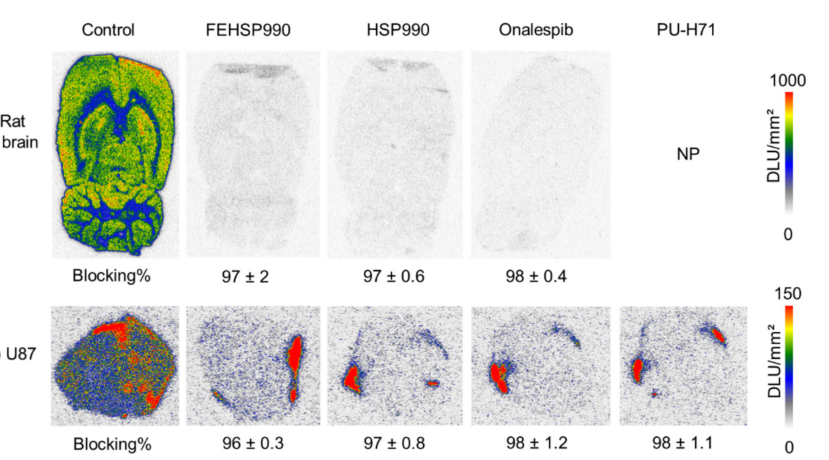
Radiosynthesis and Evaluation of [18F]FEHSP990 as Novel PET Tracer for Hsp90 PET Imaging. [Abstract]2025 Apr;68(4):e4144. PMID: 40219580
Onalespib purchased from MedChemExpress. Usage Cited in: J Labelled Comp Radiopharm. 2025 Apr;68(4):e4144. [Abstract]
In vitro autoradiography study. Slices were incubated with [18F]FEHSP990 (11 kBq/mL). Binding specificity was assessed by preincubation with authentic reference compound (FEHSP990), homologous (HSP990) and heterologous (Onalespib, PU‐H71) inhibitors (10 μM; 10 min) at RT. Rat brain slices (n = 3 per preincubation condition) and U87 tumour slices (n = 3 per preincubation condition).
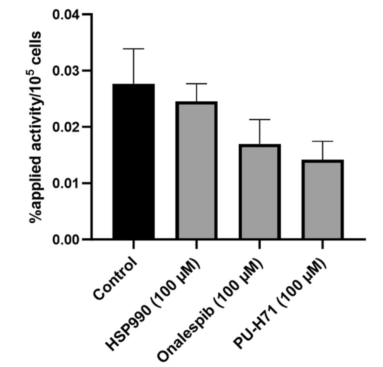
Onalespib purchased from MedChemExpress. Usage Cited in: J Labelled Comp Radiopharm. 2025 Apr;68(4):e4144. [Abstract]
In vitro cell binding study. U87 cells were incubated with [18F]FEHSP990 (84 kBq/mL). Binding specificity was assessed by preincubation with homologous (HSP990) and heterologous (Onalespib, PU‐H71) inhibitors (100 μM; 60 min) at 37°C (n = 3 per preincubation condition).
-
-
-
Oncotarget
2020 Nov 3;11(44):3921-3932. PMID: 33216841 -
Methods Mol Biol
2018:1711:351-398. PMID: 29344898


용액&용해도
In Vitro:
DMSO : 50 mg/mL (122.09 mM; ultrasonic and warming and heat to 60°C; Hygroscopic DMSO has a significant impact on the solubility of product, please use newly opened DMSO)
Please refer to the solubility information to select the appropriate solvent. Once prepared, please aliquot and store the solution to prevent product inactivation from repeated freeze-thaw cycles.
Storage method and period of stock solution: -80°C, 2 years; -20°C, 1 year. When stored at -80°C, please use it within 2 years. When stored at -20°C, please use it within 1 year.
Please refer to the solubility information to select the appropriate solvent. Once prepared, please aliquot and store the solution to prevent product inactivation from repeated freeze-thaw cycles.
Storage method and period of stock solution: -80°C, 2 years; -20°C, 1 year. When stored at -80°C, please use it within 2 years. When stored at -20°C, please use it within 1 year.
Concentration (start) × Volume (start) = Concentration (final) × Volume (final)
In Vivo:
Select the appropriate dissolution method based on your experimental animal and administration route.
- For the following dissolution methods, please ensure to first prepare a clear stock solution using an In Vitro approach and then sequentially add co-solvents:
- To ensure reliable experimental results, the clarified stock solution can be appropriately stored based on storage conditions. As for the working solution for In Vivo experiments, it is recommended to prepare freshly and use it on the same day.
- The percentages shown for the solvents indicate their volumetric ratio in the final prepared solution. If precipitation or phase separation occurs during preparation, heat and/or sonication can be used to aid dissolution.
Add each solvent one by one: 10% DMSO 40% PEG300 5% Tween-80 45% Saline
Solubility: ≥ 2.5 mg/mL (6.10 mM); Clear solution
This protocol yields a clear solution of ≥ 2.5 mg/mL (saturation unknown).
Taking 1 mL working solution as an example, add 100 μL DMSO stock solution (25.0 mg/mL) to 400 μL PEG300, and mix evenly; then add 50 μL Tween-80 and mix evenly; then add 450 μL Saline to adjust the volume to 1 mL.
Preparation of Saline: Dissolve 0.9 g sodium chloride in ddH₂O and dilute to 100 mL to obtain a clear Saline solution.
Add each solvent one by one: 10% DMSO 90% (20% SBE-β-CD in Saline)
Solubility: ≥ 2.5 mg/mL (6.10 mM); Clear solution
This protocol yields a clear solution of ≥ 2.5 mg/mL (saturation unknown).
Taking 1 mL working solution as an example, add 100 μL DMSO stock solution (25.0 mg/mL) to 900 μL 20% SBE-β-CD in Saline, and mix evenly.
Preparation of 20% SBE-β-CD in Saline (4°C, storage for one week): 2 g SBE-β-CD powder is dissolved in 10 mL Saline, completely dissolve until clear.
For the following dissolution methods, please prepare the working solution directly:
It is recommended to prepare fresh solutions and use them promptly within a short period of time.
The percentages shown for the solvents indicate their volumetric ratio in the final prepared solution. If precipitation or phase separation occurs during preparation, heat and/or sonication can be used to aid dissolution.
Add each solvent one by one: 50% PEG300 50% Saline
Solubility: 16.67 mg/mL (40.71 mM); Suspended solution; Need ultrasonic
In Vivo Dissolution Calculator
Please enter the basic information of animal experiments:
-
-
-
-
Recommended: Prepare an additional quantity of animals to account for potential losses during experiments.
Please enter your animal formula composition:
-
%DMSO +
Recommended: Keep the proportion of DMSO in working solution below 2% if your animal is weak.
-
%+
-
+%Tween-80 + +
-
%Saline +
The co-solvents required include: DMSO, . All of co-solvents are available by MedChemExpress (MCE). , Tween 80. All of co-solvents are available by MedChemExpress (MCE).
Working solution concentration: 0.22 mg/mL
Method for preparing stock solution: mg drug dissolved in μL DMSO. Stock solution concentration: mg/mL.
1. Take μL DMSO stock solution;
2. Add μL .
μL , mix evenly;
3. Then add μL Tween 80, mix evenly;
4. Then add μL
Please ensure that the stock solution in the first step is dissolved to a clear state, and add co-solvents in sequence. You can use ultrasonic heating (ultrasonic cleaner, recommended frequency 20-40 kHz), vortexing, etc. to assist dissolution.


순도&문서
-
Data Sheet (277 KB)
-
SDS (394 KB)
- English - EN (394 KB)
- Français - FR (394 KB)
- Deutsch - DE (394 KB)
- Norwegian - NO (394 KB)
- Español - ES (394 KB)
- Swedish - SV (394 KB)
- Italian - IT (394 KB)
- Korean - KR (394 KB)
- Portuguese - PT (394 KB)
-
Handling Instructions (2659 KB)
References
[1]. Woodhead AJ, et al. Discovery of (2,4-dihydroxy-5-isopropylphenyl)-[5-(4-methylpiperazin-1-ylmethyl)-1,3-dihydroisoindol-2-yl]methanone (AT13387), a novel inhibitor of the molecular chaperone Hsp90 by fragment based drug design. J Med Chem. 2010 Aug 26;53 [Content Brief]
[2]. Kang MH, et al. Initial testing (Stage 1) of AT13387, an HSP90 inhibitor, by the pediatric preclinical testing program. Pediatr Blood Cancer. 2012 Jul 15;59(1):185-8. [Content Brief]


Complete Stock Solution Preparation Table
Please refer to the solubility information to select the appropriate solvent. Once prepared, please aliquot and store the solution to prevent product inactivation from repeated freeze-thaw cycles.
Storage method and period of stock solution: -80°C, 2 years; -20°C, 1 year. When stored at -80°C, please use it within 2 years. When stored at -20°C, please use it within 1 year.
| Optional Solvent | Concentration Solvent Mass | 1 mg | 5 mg | 10 mg | 25 mg |
|---|---|---|---|---|---|
| DMSO | 1 mM | 2.4419 mL | 12.2094 mL | 24.4188 mL | 61.0471 mL |
| 5 mM | 0.4884 mL | 2.4419 mL | 4.8838 mL | 12.2094 mL | |
| 10 mM | 0.2442 mL | 1.2209 mL | 2.4419 mL | 6.1047 mL | |
| 15 mM | 0.1628 mL | 0.8140 mL | 1.6279 mL | 4.0698 mL | |
| 20 mM | 0.1221 mL | 0.6105 mL | 1.2209 mL | 3.0524 mL | |
| 25 mM | 0.0977 mL | 0.4884 mL | 0.9768 mL | 2.4419 mL | |
| 30 mM | 0.0814 mL | 0.4070 mL | 0.8140 mL | 2.0349 mL | |
| 40 mM | 0.0610 mL | 0.3052 mL | 0.6105 mL | 1.5262 mL | |
| 50 mM | 0.0488 mL | 0.2442 mL | 0.4884 mL | 1.2209 mL | |
| 60 mM | 0.0407 mL | 0.2035 mL | 0.4070 mL | 1.0175 mL | |
| 80 mM | 0.0305 mL | 0.1526 mL | 0.3052 mL | 0.7631 mL | |
| 100 mM | 0.0244 mL | 0.1221 mL | 0.2442 mL | 0.6105 mL |


Onalespib Related Classifications
HY-14463 Related Classifications
 Powered by Bioz