



Digitoxose

Based on 1 Customer Validation
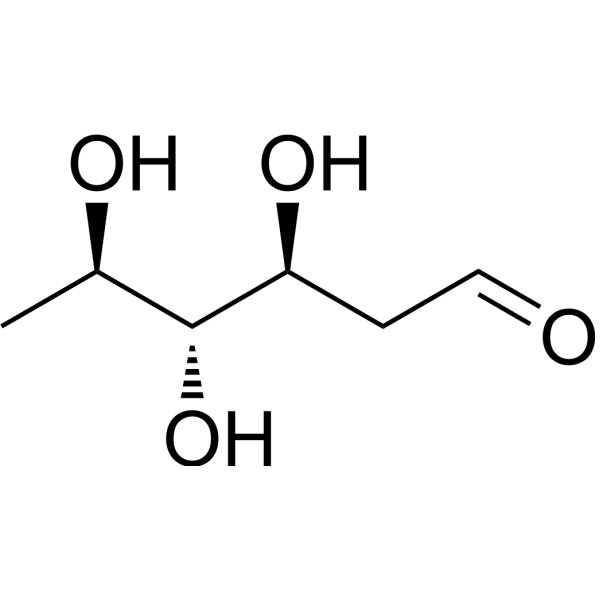
Digitoxose (D-(+)-Digitoxose) is a 2,6-dideoxy-D-ribo-hexose and the dideoxysugar moiety of Digitoxin (HY-B1357) and Digoxin (HY-B1049). Digitoxose acts by competitively inhibiting D-Glucose (HY-B0389)-stimulated Insulin (HY-P0035) release from pancreatic islets and shifting the glucose dose-response curve to the right. Digitoxose can be used in research on non-insulin-dependent diabetes mellitus.
연구목적의 판매만을 진행합니다. 환자를 대상으로 한 판매는 하지 않습니다.
- CAS No.: 527-52-6
- 화학식: C6H12O4
- 분자량:148.16
-
보관:Powder -20°C, 3 years , 4°C, 2 years ; In solvent -80°C, 6 months , -20°C, 1 month

To place orders, for customer services and technical support, please contact: MedChemExpress USA
Tel: 609-228-6898 E-mail: [email protected] [email protected]


-
 Biological Activity
-
Chemical Information
- Protocol
- 순도&문서
- References
-
 Help & FAQs




Biological Activity
제품 설명
In Vitro
Digitoxose (22.2 mM; 1 h) specifically inhibits glucose (16.7 mM)-stimulated insulin release in isolated islets from lean mice, without affecting insulin release stimulated by L-leucine (HY-N0486), L-arginine (HY-N0455), or Glibenclamide (HY-15206)[2].
Digitoxose (22.2 mM; 75 min) does not affect the oxidation of D-(U-14C)-glucose in isolated islets from lean or ob/ob mice under 16.7 mM glucose conditions[2].
MedChemExpress (MCE) has not independently confirmed the accuracy of these methods. They are for reference only.


Chemical Information
-
CAS No. 527-52-6
-
Appearance Solid
-
분자량 148.16
-
화학식 C6H12O4
-
Color Off-white to light yellow
-
SMILES
O=CC[C@H](O)[C@H](O)[C@H](O)C
-
Synonyms
D-(+)-Digitoxose
-
Structure Classification
-
Initial Source
-
선적
Room temperature in continental US; may vary elsewhere.
-
보관
Powder -20°C 3 years 4°C 2 years In solvent -80°C 6 months -20°C 1 month


순도&문서
-
Data Sheet (280 KB)
-
SDS (252 KB)
- English - EN (252 KB)
- Français - FR (252 KB)
- Deutsch - DE (252 KB)
- Norwegian - NO (252 KB)
- Español - ES (252 KB)
- Swedish - SV (252 KB)
- Italian - IT (252 KB)
- Korean - KR (252 KB)
- Portuguese - PT (252 KB)
-
Handling Instructions (2659 KB)
References

Calculators
Concentration (start) × Volume (start) = Concentration (final) × Volume (final)


Digitoxose Related Classifications
HY-N9685 Related Classifications
 Powered by Bioz