



Lysozyme
Based on 8 publication(s) in Google Scholar
Lysozyme (Muramidase) is a conserved antimicrobial protein. Lysozyme exerts its bactericidal effect by hydrolyzing bacterial cell wall peptidoglycan (PG). Lysozyme plays an important role in limiting bacterial growth on mucosal surfaces and other sites, not only controlling potential pathogens but also limiting overgrowth of microbiota to prevent dysbiosis. Extracellular lysozyme can also degrade polymeric PG into soluble fragments, activate NOD receptors in mucosal epithelial cells, and lead to the secretion of chemokines and activating factors by neutrophils and macrophages.
Nur für Forschungszwecke. Wir verkaufen nicht an Patienten.
- Reinheit : 95.0%
- CAS. Nr.: 9001-63-2
-
Speicherung:
Please store the product under the recommended conditions in the Certificate of Analysis.


To place orders, for customer services and technical support, please contact: MedChemExpress USA
Tel: 609-228-6898 E-mail: [email protected] [email protected]


-
 Biologische Aktivität
-
Chemical Information
-
Lösungsmittel & Löslichkeit
- Protokoll
- Reinheit & Dokumentation
- Verweise
-
 Help & FAQs


-
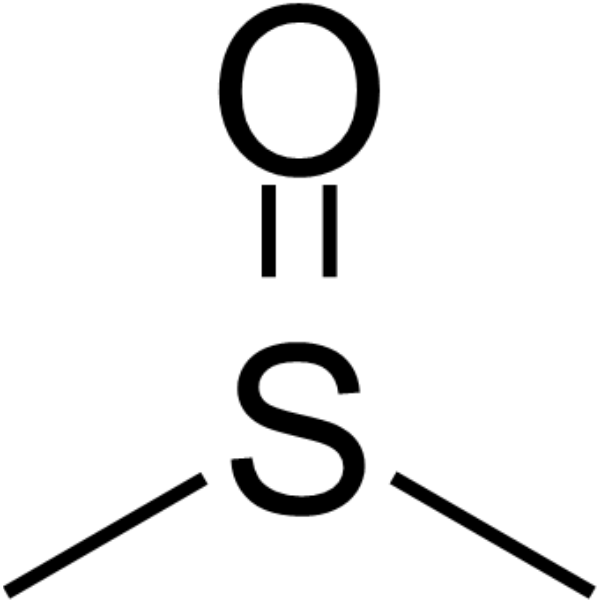
HY-Y0320
Dimethyl sulfoxide, meets analytical specification of Ch.P.Aprotic Solvent -

HY-129047
TrypsinSerine Protease -
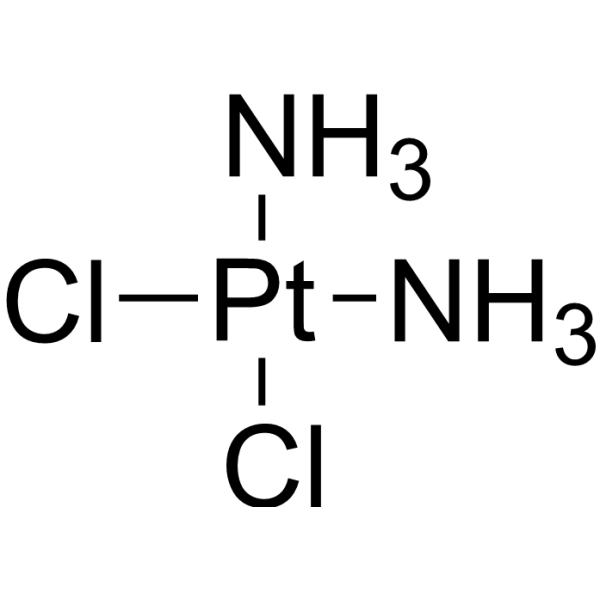
HY-17394
CisplatinDNA Alkylator -

HY-125857
Cytochrome CMulti-functional Enzyme -
HY-108882
DNase I, Bovine pancreasEnzyme -
HY-K0010
Protease Inhibitor Cocktail (EDTA-Free, 100× in DMSO) -
HY-P1068A
Recombinant human lysozyme (plant expression)Antibacterial Protein -
HY-N0038
AlantolactoneApoptosis Inducer -

HY-N0038R
Alantolactone (Standard)Apoptosis Inducer
Publications Citing Use of MedChemExpress (MCE) Lysozyme
More- Nature. 2023 Jan;613(7942):145-152. [Abstract]
- Immunity. 2025 Apr 8:S1074-7613(25)00128-1. [Abstract]
- Anal Chem. 2025 Mar 18;97(10):5488-5497. [Abstract]
- Microchem J. 2024 Dec.
- J Mol Struct. 5 November 2021, 131868.
- Spectrochim Acta A Mol Biomol Spectrosc. 2024 Nov 5:320:124630. [Abstract]
- PLoS One. 2021 Dec 9;16(12):e0260603. [Abstract]
- Vet Med Sci. 2021 Sep;7(5):1938-1947. [Abstract]
Alle TNF Receptor Isoform-spezifische Produkte anzeigen
More

Biologische Aktivität
Beschreibung
In Vitro
Instructions
Use 10 mM Tris-HCl (pH 8.0) to prepare a 1 mg/mL solution. It can also be dissolved in pure water and stored at 2-8°C for 1 week. Avoid repeated freezing and thawing.
MedChemExpress (MCE) has not independently confirmed the accuracy of these methods. They are for reference only.
In Vivo
Hen Egg Lysozyme (150 mg/kg; i.g.; once daily for 5 days) reduces the extent of inflammation and modulated local gene expression in a piglet model of dextran sodium sulfate (DSS)-induced colitis[4].
MedChemExpress (MCE) has not independently confirmed the accuracy of these methods. They are for reference only.
-
Animal Model:DSS-induced colitis piglet model
-
Dosage:150 mg/kg (Hen Egg Lysozyme)
-
Administration:Once a day for 5 days; gavage
-
Result:Reduced the expression of local pro-inflammatory cytokines TNF-R, IL-6, IFN-γ, IL-8, and IL-17, while increasing the expression of anti-inflammatory mediators IL-4 and TGF-β.
Clinical Trial
| NCT Number | Sponsor | Condition | Start Date |
Phase

|
|---|---|---|---|---|
| NCT01329991 | 2011-05 | PHASE1 |
EC Number
3.2.1.17
Specific Activity
>100000 IU/mg protein


Chemical Information
-
CAS. Nr. 9001-63-2
-
Appearance Solid
-
Color White to off-white
-
SMILES
[Lysozyme]
-
Synonyms
Muramidase
-
Versand
Room temperature in continental US; may vary elsewhere.
-
Speicherung
Please store the product under the recommended conditions in the Certificate of Analysis.


Publications (8)
-
Journal Impact Factor
-
Most Recent
-
Nature
2023 Jan;613(7942):145-152. PMID: 36517600 -
Immunity
Alcaligenes faecalis induces intestinal T helper-17 cells by enhancing Rorc transcription through E3 ligase Trim21-mediated Fbxw7 degradation. [Abstract]2025 Apr 8:S1074-7613(25)00128-1. PMID: 40215968 -
Anal Chem
2025 Mar 18;97(10):5488-5497. PMID: 40035313 -
-
-
Spectrochim Acta A Mol Biomol Spectrosc
Design of "Off-On-Off" fluorescence sensors for Heparin detection by precise modulation of molecular structure. [Abstract]2024 Nov 5:320:124630. PMID: 38865888 -
PLoS One
Optimization of layering technique and secondary structure analysis during the formulation of nanoparticles containing lysozyme by quality by design approach. [Abstract]2021 Dec 9;16(12):e0260603. PMID: 34882727 -
Vet Med Sci
Elevated temperatures accelerate the formation of toxic amyloid fibrils of hen egg-white lysozyme. [Abstract]2021 Sep;7(5):1938-1947. PMID: 33978313


Lösungsmittel & Löslichkeit
In Vitro:
H2O : 4.76 mg/mL (ultrasonic and adjust pH to 4 with 0.1 M HCl)


Reinheit & Dokumentation
-
Data Sheet (273 KB)
-
SDS (251 KB)
- English - EN (251 KB)
- Français - FR (251 KB)
- Deutsch - DE (251 KB)
- Norwegian - NO (251 KB)
- Español - ES (251 KB)
- Swedish - SV (251 KB)
- Italian - IT (251 KB)
- Korean - KR (251 KB)
- Portuguese - PT (251 KB)
-
Handling Instructions (2659 KB)
Verweise
[1]. Feingold DS, et al. Locus of the action of serum and the role of lysozyme in the serum bactericidal reaction. J Bacteriol. 1968 Dec;96(6):2118-26. [Content Brief]
[2]. Ragland S A, et al. From bacterial killing to immune modulation: Recent insights into the functions of lysozyme[J]. PLoS pathogens, 2017, 13(9): e1006512. [Content Brief]
[3]. Markart P, et al. Mouse lysozyme M is important in pulmonary host defense against Klebsiella pneumoniae infection[J]. American journal of respiratory and critical care medicine, 2004, 169(4): 454-458. [Content Brief]
[4]. Lee M, et al. Hen egg lysozyme attenuates inflammation and modulates local gene expression in a porcine model of dextran sodium sulfate (DSS)-induced colitis[J]. Journal of agricultural and food chemistry, 2009, 57(6): 2233-2240. [Content Brief]

Calculators
Konzentration (Stammlösung) × Volumen (Stammlösung) = Konzentration (Ziellösung) × Volumen (Ziellösung)


Lysozyme Related Classifications
HY-P1068 Related Classifications
 Powered by Bioz