



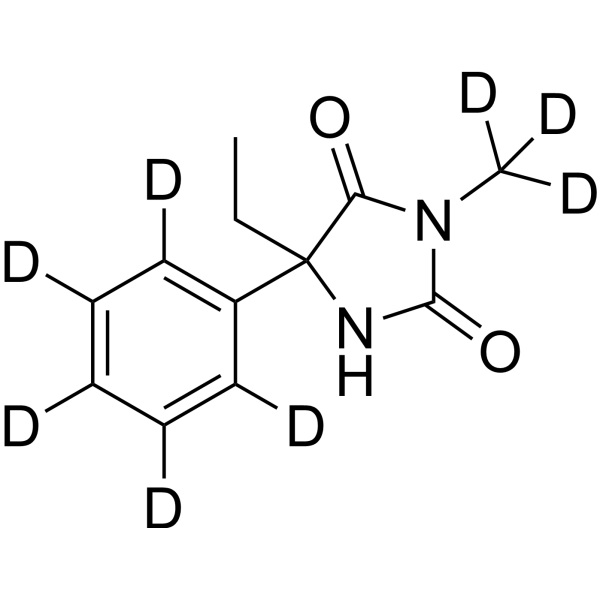
Mephenytoin-d8
Mephenytoin-d8 is the deuterium labeled Mephenytoin. Mephenytoin, an anticonvulsant, is the CYP2C19 and CYP2B6 substrate.
Nur für Forschungszwecke. Wir verkaufen nicht an Patienten.
- Formel: C12H6D8N2O2
- Molecular Weight:226.30
-
Speicherung:
Please store the product under the recommended conditions in the Certificate of Analysis.

To place orders, for customer services and technical support, please contact: MedChemExpress USA
Tel: 609-228-6898 E-mail: [email protected] [email protected]


-
 Biologische Aktivität
-
Chemical Information
- Reinheit & Dokumentation
- Verweise
-
 Help & FAQs




Biologische Aktivität
Beschreibung
In Vitro
Stable heavy isotopes of hydrogen, carbon, and other elements have been incorporated into drug molecules, largely as tracers for quantitation during the drug development process. Deuteration has gained attention because of its potential to affect the pharmacokinetic and metabolic profiles of drugs[1].
MedChemExpress (MCE) has not independently confirmed the accuracy of these methods. They are for reference only.
Anwendung
1. This compound can be used as a tracer
2. This compound can be used as an internal standard for quantitative analysis by NMR, GC-MS, or LC-MS.


Chemical Information
-
Unlabeled CAS 50-12-4
-
Molecular Weight 226.30
-
Formel C12H6D8N2O2
-
SMILES
O=C1N(C([2H])([2H])[2H])C(C(C2=C([2H])C([2H])=C([2H])C([2H])=C2[2H])(CC)N1)=O
-
Versand
Room temperature in continental US; may vary elsewhere.
-
Speicherung
Please store the product under the recommended conditions in the Certificate of Analysis.


Reinheit & Dokumentation
Verweise
[1]. Russak EM, et al. Impact of Deuterium Substitution on the Pharmacokinetics of Pharmaceuticals. Ann Pharmacother. 2019 Feb;53(2):211-216. [Content Brief]
[2]. Klaassen T, et al. Assessment of urinary mephenytoin metrics to phenotype for CYP2C19 and CYP2B6 activity. Eur J Clin Pharmacol. 2008;64(4):387-398. [Content Brief]
[3]. D R Minck, et al. Comparison of the behavioral teratogenic potential of phenytoin, mephenytoin, ethotoin, and hydantoin in rats. Teratology. 1991 Apr43(4):279-93. [Content Brief]
[4]. J H Maguire, et al. Hypolipidemic activity of antiepileptic 5-phenylhydantoins in mice. Eur J Pharmacol. 1985 Oct 29117(1):135-8. [Content Brief]

Calculators
Konzentration (Stammlösung) × Volumen (Stammlösung) = Konzentration (Ziellösung) × Volumen (Ziellösung)


Mephenytoin-d8 Related Classifications
HY-B1184S2 Related Classifications
 Powered by Bioz