



Methapyrilene

Based on 1 Customer Validation
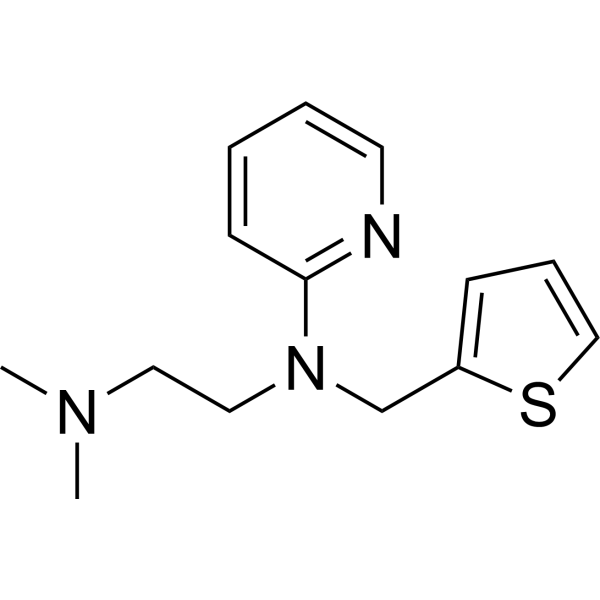
Methapyrilene is a histamine antagonist, a pyridine chemical with anticholinergic activity. Methapyrilene can cause target organ-specific epigenetic alterations, such as a decrease in DNA methylation levels. Methapyrilene induces hepatocellular carcinoma in rats.
연구목적의 판매만을 진행합니다. 환자를 대상으로 한 판매는 하지 않습니다.
- Purity : 99.66%
- CAS No.: 91-80-5
- 화학식: C14H19N3S
- 분자량:261.39
-
보관:
4°C, protect from light
* In solvent : -80°C, 6 months; -20°C, 1 month (protect from light)

To place orders, for customer services and technical support, please contact: MedChemExpress USA
Tel: 609-228-6898 E-mail: [email protected] [email protected]


-
 Biological Activity
-
Chemical Information
- Protocol
- 순도&문서
- References
-
 Help & FAQs


All Histamine Receptor Isoforms
More

Biological Activity
제품 설명
Cellular Effect
|
Cell Line

|
Type | Value | Description | References |
|---|---|---|---|---|
| Sf21 | IC50 |
>1000 μM
Compound: Methapyrilene
|
Inhibition of human BSEP expressed in plasma membrane vesicles of Sf21 cells assessed as inhibition of ATP-dependent [3H]taurocholate uptake
Inhibition of human BSEP expressed in plasma membrane vesicles of Sf21 cells assessed as inhibition of ATP-dependent [3H]taurocholate uptake
|
[PMID: 21965623] |
| Sf21 | IC50 |
>1000 μM
Compound: Methapyrilene
|
Inhibition of Sprague-Dawley rat Bsep expressed in plasma membrane vesicles of Sf21 cells assessed as inhibition of ATP-dependent [3H]taurocholate uptake
Inhibition of Sprague-Dawley rat Bsep expressed in plasma membrane vesicles of Sf21 cells assessed as inhibition of ATP-dependent [3H]taurocholate uptake
|
[PMID: 21965623] |
In Vitro
Methapyrilene (650 μM, 72 h) decreases the transcriptional level of transferrin and is accompanied by a decrease in transferrin protein levels in HepRG cells[1].
MedChemExpress (MCE) has not independently confirmed the accuracy of these methods. They are for reference only. Further protocols information, click here.
In Vivo
MedChemExpress (MCE) has not independently confirmed the accuracy of these methods. They are for reference only.
-
Animal Model:Male Wistar derived AlpK:APfSD (Alderley Park) rats[2]
-
Dosage:50 mg/kg, 150 mg/kg
-
Administration:Gavage with water (vehicle), daily, 3 days
-
Result:Showed mild to moderate periportal hepatocyte degeneration and necrosis as well as acute inflammatory cells were observed in the filtering periportal vein at a dose concentration of 150 mg/kg.
Decreased levels of both glucose and glycogen in the liver.
Showed higher levels of succinic acid and dimethylglycine of urine obtained from the low dose group of 50 mg/kg.


Chemical Information
-
CAS No. 91-80-5
-
Appearance Liquid
-
분자량 261.39
-
화학식 C14H19N3S
-
Color Colorless to light yellow
-
SMILES
CN(C)CCN(C1=NC=CC=C1)CC2=CC=CS2
-
선적
Room temperature in continental US; may vary elsewhere.
-
보관
4°C, protect from light
* In solvent : -80°C, 6 months; -20°C, 1 month (protect from light)

Protocol
-
Research Protocol for Epigenomic Data Analysis
Epigenomic data analysis identifies genome-wide regulatory features that influence gene expression, chromatin state, and phenotype without changing the underlying DNA sequence. In this strategy, the core regulatory layer includes chromatin accessibility, transcription-factor or histone-mark occupancy, DNA methylation, and chromatin-state patterns; these features are measured by sequencing-based assays and interpreted as regulatory elements, promoters, enhancers, repressive domains, methylated cytosines, or candidate phenotype-associated chromatin programs. The literature links epigenomic features to phenotype by showing that functional genomic elements can be mapped across human cell types and tissues, and that integrated epigenomic maps reveal cell-type-specific regulatory programs. ENCODE integrated transcription, chromatin accessibility, transcription-factor occupancy, and histone modification data to annotate functional elements in the human genome, while the Roadmap Epigenomics Co
-
Liver Cancer Modeling
Liver cancer can be classified into primary liver cancer and secondary liver cancer. Secondary liver cancer is the metastatic liver cancer. Primary liver cancer includes hepatocellular carcinoma (HCC), intrahepatic cholangiocarcinoma (ICC) and fibrolamellar HCC, of which HCC is the most common form, accounting for approximately 90% of primary liver cancers[1]. HCC mouse models include chemical agent-induced models, transplanted tumor models, and genetic engineered models.


순도&문서
-
Data Sheet (272 KB)
-
SDS (479 KB)
- English - EN (479 KB)
- Français - FR (479 KB)
- Deutsch - DE (479 KB)
- Norwegian - NO (479 KB)
- Español - ES (479 KB)
- Swedish - SV (479 KB)
- Italian - IT (479 KB)
- Korean - KR (479 KB)
- Portuguese - PT (479 KB)
-
Handling Instructions (2659 KB)
References
[1]. Volodymyr Tryndyak, et al. Effect of aflatoxin B1, benzo[a]pyrene, and methapyrilene on transcriptomic and epigenetic alterations in human liver HepaRG cells. Food Chem Toxicol. 2018 Nov;121:214-223. [Content Brief]
[2]. Andrew Craig, et al. Systems toxicology: integrated genomic, proteomic and metabonomic analysis of methapyrilene induced hepatotoxicity in the rat. J Proteome Res. 2006 Jul;5(7):1586-60 [Content Brief]

Calculators
Concentration (start) × Volume (start) = Concentration (final) × Volume (final)


Methapyrilene Related Classifications
HY-111130 Related Classifications
 Powered by Bioz