



Osavampator

Based on 1 Customer Validation
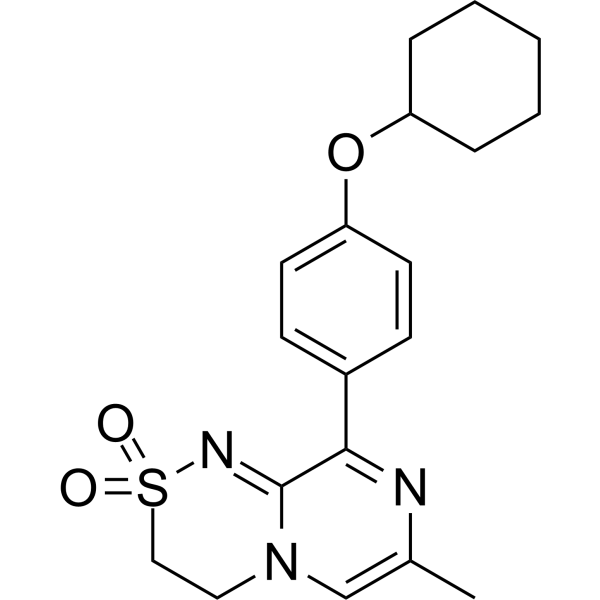
Osavampator (TAK-653) is a AMPA receptor positive allosteric modulator. Osavampator selectively binds to AMPA-R in a glutamate-dependent manner and induces Ca2+ influx in hGluA1i CHO cells (EC50 = 3.3 μM). Osavampator improves learning and memory in many models. Osavampator is can be used for the research of depressive disorders.
For research use only. We do not sell to patients.
- Purity : 99.74%
- CAS No.: 1358751-06-0
- Formula: C19H23N3O3S
- Molecular Weight:373.47
-
Storage:
4°C, sealed storage, away from moisture and light
* In solvent : -80°C, 6 months; -20°C, 1 month (sealed storage, away from moisture and light)

To place orders, for customer services and technical support, please contact: MedChemExpress USA
Tel: 609-228-6898 E-mail: [email protected] [email protected]


-
 Biological Activity
-
Chemical Information
-
Solvent & Solubility
- Protocols
- Purity & Documentation
- References
-
 Help & FAQs


All iGluR Isoforms
More

Biological Activity
Description
IC50 & Target
|
AMPA Receptor |
5-LO |
In Vivo
Osavampator (0.3 mg/kg, p.o., single dose) enhances sustained attention in the poor performing rats[2].
Osavampator (0.06 mg/kg, p.o., single dose) improves working memory in monkeys[2].
Osavampator (1 mg/kg, p.o., single dose) produces antidepressant-like effects in the rat RSBM (reduction of submissive behavior model)[1].
MedChemExpress (MCE) has not independently confirmed the accuracy of these methods. They are for reference only.
-
Animal Model:Normal rats[2]
-
Dosage:0.03 mg/kg, 0.1 mg/kg, 0.3 mg/kg
-
Administration:Oral gavage (p.o.)
-
Result:Improved the novelty discrimination index (NDI).
-
Animal Model:Poor performing rats[2]
-
Dosage:0.3 mg/kg
-
Administration:Oral gavage (p.o.)
-
Result:Increased correct responses and decreased omissions in the poor performing rats.
-
Animal Model:Fasted monkey[2]
-
Dosage:0.06 mg/kg
-
Administration:Oral gavage (p.o.)
-
Result:Significantly increased delayed match-to-sample (DMTS) accuracy at a 16-s delay interval. Maintained the beneficial effect 24 h after administration.
-
Animal Model:submissive behavior model [1]
-
Dosage:0.1 mg/kg, 1 mg/kg
-
Administration:Oral gavage (p.o.)
-
Result:Led to a significant reduction in dominance levels compared with vehicle treatment starting from the seventh day of treatment and maintained throughout the study period. Had a significant effect in reducing dominance levels at 0.1 and 1 mg/kg.
Clinical Trial
| NCT Number | Sponsor | Condition | Start Date |
Phase

|
|---|---|---|---|---|
| NCT01329991 | Plexxikon| | 2011-05 | PHASE1 |


Chemical Information
-
CAS No. 1358751-06-0
-
Appearance Solid
-
Molecular Weight 373.47
-
Formula C19H23N3O3S
-
Color White to yellow
-
SMILES
O=S1(N=C2C(C3=CC=C(C=C3)OC4CCCCC4)=NC(C)=CN2CC1)=O
-
Synonyms
TAK-653; NBI-1065845
-
Shipping
Room temperature in continental US; may vary elsewhere.
-
Storage
4°C, sealed storage, away from moisture and light
* In solvent : -80°C, 6 months; -20°C, 1 month (sealed storage, away from moisture and light)


Solvent & Solubility
In Vitro:
DMSO : ≥ 12.5 mg/mL (33.47 mM; Hygroscopic DMSO has a significant impact on the solubility of product, please use newly opened DMSO)
* "≥" means soluble, but saturation unknown.
Please refer to the solubility information to select the appropriate solvent. Once prepared, please aliquot and store the solution to prevent product inactivation from repeated freeze-thaw cycles.
Storage method and period of stock solution: -80°C, 6 months; -20°C, 1 month (sealed storage, away from moisture and light). When stored at -80°C, please use it within 6 months. When stored at -20°C, please use it within 1 month.
Please refer to the solubility information to select the appropriate solvent. Once prepared, please aliquot and store the solution to prevent product inactivation from repeated freeze-thaw cycles.
Storage method and period of stock solution: -80°C, 6 months; -20°C, 1 month (sealed storage, away from moisture and light). When stored at -80°C, please use it within 6 months. When stored at -20°C, please use it within 1 month.
Concentration (start) × Volume (start) = Concentration (final) × Volume (final)
In Vivo:
For the following dissolution methods, please prepare the working solution directly:
It is recommended to prepare fresh solutions and use them promptly within a short period of time.
The percentages shown for the solvents indicate their volumetric ratio in the final prepared solution. If precipitation or phase separation occurs during preparation, heat and/or sonication can be used to aid dissolution.
Add each solvent one by one: 50% PEG300 50% Saline
Solubility: 0.83 mg/mL (2.22 mM); Suspended solution; Need ultrasonic
Add each solvent one by one: 15% Cremophor EL 85% Saline
Solubility: 1 mg/mL (2.68 mM); Suspended solution; Need ultrasonic

Protocols
-
Protocol for Shuttle Box Test (TDPA)
The Shuttle Box Test for TDPA, or temporally dissociated passive avoidance, measures hippocampus-dependent associative learning by testing whether a rodent avoids entering a dark compartment that was previously paired with foot shock after a temporal delay between dark-compartment entry and shock delivery. The main behavioral readout is crossover or step-through latency from the light chamber into the dark chamber; increased latency across training or retention trials reflects learned avoidance memory rather than motor performance alone.
-
Protocol for Water Maze
The Morris Water Maze is a rodent spatial learning and memory assay in which a mouse or rat swims in opaque water to find an escape platform; in the hidden-platform version, the animal cannot see the platform and must use distal extra-maze cues to learn its fixed spatial location. The assay primarily measures hippocampus-dependent spatial learning during acquisition trials and spatial reference memory during probe trials after platform removal; readouts include escape latency, swim path length, swim speed, quadrant occupancy, platform-site crossings, and proximity to the former platform location.
-
Ca2+ Staining Technique
Ca2+ staining is an experimental technique that utilizes specific fluorescent probes (such as Fluo-4 AM, Fura-2, etc.) to qualitatively or quantitatively detect dynamic changes in intracellular Ca2+ concentrations; this is achieved by monitoring the changes in fluorescent signals generated when these probes bind to free intracellular calcium ions. The underlying principle relies primarily on the presence of chelating groups within the probe's molecular structure that possess high affinity for calcium ions.


Purity & Documentation
-
Data Sheet (280 KB)
-
SDS (252 KB)
- English - EN (252 KB)
- Français - FR (252 KB)
- Deutsch - DE (252 KB)
- Norwegian - NO (252 KB)
- Español - ES (252 KB)
- Swedish - SV (252 KB)
- Italian - IT (252 KB)
- Korean - KR (252 KB)
- Portuguese - PT (252 KB)
-
Handling Instructions (2659 KB)
References
[1]. Hara H, et al. TAK-653, an AMPA receptor potentiator with minimal agonistic activity, produces an antidepressant-like effect with a favorable safety profile in rats [J]. Pharmacology Biochemistry and Behavior, 2021, 211: 173289. [Content Brief]
[2]. Suzuki A, et al. Strictly regulated agonist-dependent activation of AMPA-R is the key characteristic of TAK-653 for robust synaptic responses and cognitive improvement [J]. Scientific Reports, 2021, 11(1): 14532. [Content Brief]
[3]. Hara H, et al. TAK-653, an AMPA receptor potentiator with minimal agonistic activity, produces an antidepressant-like effect with a favorable safety profile in rats. Pharmacol Biochem Behav. 2021 Dec;211:173289. [Content Brief]


Complete Stock Solution Preparation Table
Please refer to the solubility information to select the appropriate solvent. Once prepared, please aliquot and store the solution to prevent product inactivation from repeated freeze-thaw cycles.
Storage method and period of stock solution: -80°C, 6 months; -20°C, 1 month (sealed storage, away from moisture and light). When stored at -80°C, please use it within 6 months. When stored at -20°C, please use it within 1 month.
| Optional Solvent | Concentration Solvent Mass | 1 mg | 5 mg | 10 mg | 25 mg |
|---|---|---|---|---|---|
| DMSO | 1 mM | 2.6776 mL | 13.3880 mL | 26.7759 mL | 66.9398 mL |
| 5 mM | 0.5355 mL | 2.6776 mL | 5.3552 mL | 13.3880 mL | |
| 10 mM | 0.2678 mL | 1.3388 mL | 2.6776 mL | 6.6940 mL | |
| 15 mM | 0.1785 mL | 0.8925 mL | 1.7851 mL | 4.4627 mL | |
| 20 mM | 0.1339 mL | 0.6694 mL | 1.3388 mL | 3.3470 mL | |
| 25 mM | 0.1071 mL | 0.5355 mL | 1.0710 mL | 2.6776 mL | |
| 30 mM | 0.0893 mL | 0.4463 mL | 0.8925 mL | 2.2313 mL |


Osavampator Related Classifications
HY-115864 Related Classifications
 Powered by Bioz