



Rifaquizinone
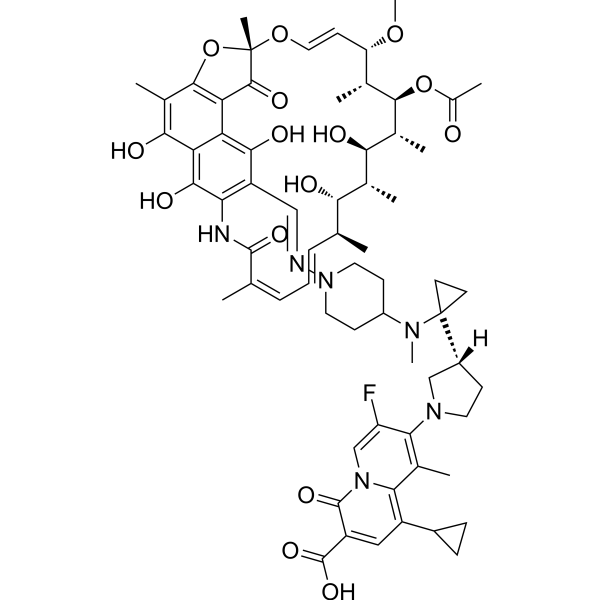
Rifaquizinone (CBR-2092; TNP-2092) is a rifamycin-quinolone hybrid antibiotic. Rifaquizinone has an IC50 of 0.034 μM against wild-type Staphylococcus aureus DNA-dependent RNA polymerase. Rifaquizinone potently inhibits Staphylococcus aureus infection, with an MIC range of 0.008-0.5 μg/mL against 300 clinical isolates of staphylococci and streptococci. Rifaquizinone can be used in research related to persistent Staphylococcus aureus infections.
For research use only. We do not sell to patients.
- CAS No.: 922717-97-3
- Formula: C65H81FN6O15
- Molecular Weight:1205.37
-
Storage:
Please store the product under the recommended conditions in the Certificate of Analysis.

To place orders, for customer services and technical support, please contact: MedChemExpress USA
Tel: 609-228-6898 E-mail: [email protected] [email protected]


-
 Biological Activity
-
Chemical Information
- Protocols
- Purity & Documentation
- References
-
 Help & FAQs




Biological Activity
Description
IC50 & Target
[1]|
Quinolone |
RNA Polymerase |
In Vitro
Rifaquizinone exhibits Rifampicin (HY-B0272)-like potency against wild-type Staphylococcus aureus σA RNA polymerase (IC50 = 0.034 μM)[1].
Rifaquizinone (incubated for 1 h) acts as a balanced inhibitor of wild-type Staphylococcus aureus DNA gyrase (CC50 = 1.5 μM) and DNA topoisomerase IV (CC50 = 1.7 μM), and retains activity against the fluoroquinolone-resistant ParC (S80F) DNA topoisomerase IV mutant (CC50 = 2.7 μM)[1].
Rifaquizinone exhibits potent antibacterial activity against wild-type and quinolone-resistant Staphylococcus aureus strains (MIC = 0.008-0.015 μg/mL), shows a moderate increase in MIC against Rifampicin-resistant strains (MIC = 0.06-2 μg/mL), and has the highest MIC against strains resistant to both Rifampicin and quinolones[1].
Single-step resistance to Rifaquizinone (0.08-0.8 μg/mL) in wild-type Staphylococcus aureus is mediated by rpoB mutations, whereas in Rifampicin-resistant strains, resistance is mediated by gyrA and parC/parE mutations, with no involvement of efflux mechanisms[1].
Rifaquizinone (0.5 μg/mL; up to 200 min) inhibits primary RNA synthesis in wild-type and quinolone-resistant Staphylococcus aureus strains CB190 and CB814, whereas it instead inhibits primary DNA synthesis in the Rifampicin-resistant strain CB370[1].
MedChemExpress (MCE) has not independently confirmed the accuracy of these methods. They are for reference only. Further protocols information, click here.
Clinical Trial
| NCT Number | Sponsor | Condition | Start Date |
Phase

|
|---|---|---|---|---|
| NCT01329991 | Plexxikon| | 2011-05 | PHASE1 |


Chemical Information
-
CAS No. 922717-97-3
-
Molecular Weight 1205.37
-
Formula C65H81FN6O15
-
SMILES
CN(C1CCN(CC1)/N=C/C2=C3C(O)=C4C(C5=C(O[C@@](C5=O)(O/C=C/[C@@H]([C@H]([C@H]([C@@H]([C@@H]([C@@H]([C@H]([C@H](/C=C/C=C(C(N3)=O)/C)C)O)C)O)C)OC(C)=O)C)OC)C)C(C)=C4O)=C2O)C6([C@@]7([H])CN(C8=C(C9=C(C%10CC%10)C=C(C(N9C=C8F)=O)C(O)=O)C)CC7)CC6
-
Synonyms
CBR-2092; TNP-2092
-
Shipping
Room temperature in continental US; may vary elsewhere.
-
Storage
Please store the product under the recommended conditions in the Certificate of Analysis.

Protocols
-
Research Protocol for Infectious Diseases
Infectious-disease experiments test how pathogens interact with host barriers, innate immune receptors, inflammatory signaling, pathogen replication, and tissue injury; pattern-recognition receptors such as TLRs, RIG-I-like receptors, NOD-like receptors, and inflammasomes detect microbial molecules and activate NF-κB, interferon, and cytokine responses. The central hypothesis is that infection severity reflects the balance between pathogen burden and host response: protective inflammation restricts pathogen growth, whereas excessive or mislocalized inflammation contributes to tissue damage and disease phenotype. Unresolved questions include which host pathways are protective versus pathogenic, why some infection models fail to translate to human disease, and which combined readouts best predict clinically relevant infection outcomes.
-
Cell Cytotoxicity Assay
Cytotoxicity assays are usually based on the assessment of cell membrane damage, which can also be indirectly detected by measuring cell viability. Detection methods include MTT assay, CKK-8 assay, LDH assay and ATP assay, etc.


Purity & Documentation
References

Calculators
Concentration (start) × Volume (start) = Concentration (final) × Volume (final)


Rifaquizinone Related Classifications
HY-135184 Related Classifications
 Powered by Bioz
Keywords
- Rifaquizinone
- 922717-97-3
- CBR-2092
- TNP-2092
- CBR2092
- CBR 2092
- TNP2092
- TNP 2092
- TNP-2092
- Antibiotic
- Bacterial
- DNA/RNA Synthesis
- Staphylococcus aureus
- DNA-dependent RNA polymerase
- protein synthesis
- DNA gyrase
- ParC (S80F)
- DNA topoisomerase IV
- DNA synthesis
- RNA synthesis
- cell wall synthesis
- RpoB (H481Y)
- Inhibitor
- inhibitor
- inhibit