



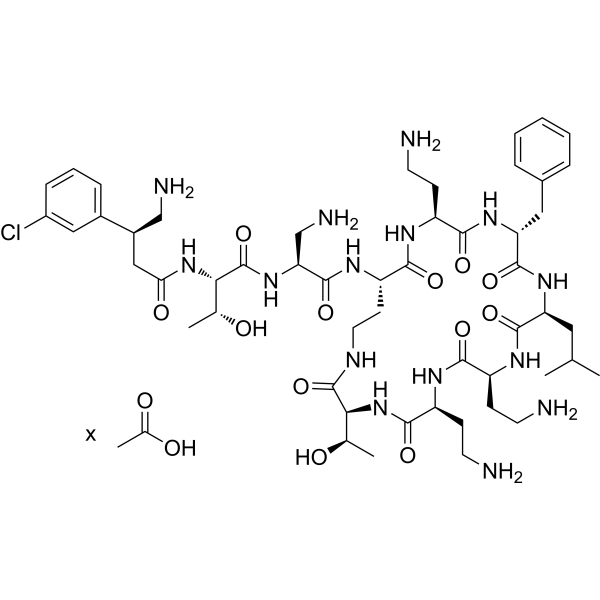
SPR206 acetate
Based on 1 publication(s) in Google Scholar
SPR206 acetate is a polymyxin analog with antibiotic activity against Gram-negative pathogens, including multidrug-resistant (MDR) variants. SPR206 acetate has an anti-bacterial infection effect by interacting with the bacterium’s outer membrane. The MIC values of SPR206 acetate against Pseudomonas aeruginosa Pa14 and Acinetobacter baumannii NCTC13301 are both 0.125 mg/L.
For research use only. We do not sell to patients.
- Purity : 98.88%
- CAS No.: 2408422-41-1
- Formula: C52H82ClN15O12.xC2H4O2
-
Storage:
-20°C, sealed storage, away from moisture
* In solvent : -80°C, 6 months; -20°C, 1 month (sealed storage, away from moisture)

To place orders, for customer services and technical support, please contact: MedChemExpress USA
Tel: 609-228-6898 E-mail: [email protected] [email protected]


-
 Biological Activity
-
Chemical Information
-
Solvent & Solubility
- Protocols
- Purity & Documentation
- References
-
 Help & FAQs


Publications Citing Use of MedChemExpress (MCE) SPR206 acetate
MoreAll Antibiotic Isoforms
More

Biological Activity
Description
IC50 & Target
MIC: 0.125 mg/L (Pseudomonas aeruginosa Pa14) and 0.125 mg/L (Acinetobacter baumannii NCTC13301)[1][2]
In Vitro
SPR206 exhibits strong anti-microbial properties against Gram-negative bacteria. The MIC values of SPR206 against E. coli IHMA558090, E. coli ATCC 25922, K. pneumonia ATCC 13882, P. aeruginosa ATCC 27853, A. baumannii NCTC13424 and A. baumannii ATCC 19003 are 8 mg/L, 0.125 mg/L, 0.125 mg/L, 0.25 mg/L, 0.06 mg/L and 0.125 mg/L, respectively, together with lower cytotoxicity [1].
MedChemExpress (MCE) has not independently confirmed the accuracy of these methods. They are for reference only.
In Vivo
MedChemExpress (MCE) has not independently confirmed the accuracy of these methods. They are for reference only.
-
Animal Model:Neutropenic mice infected Pa14 or NCTC13301[2]
-
Dosage:3 mg/kg, 10 mg/kg, 20 mg/kg, 30 mg/kg (intravenous injection); 0.125 mg/kg, 0.5 mg/kg, 1 mg/kg, 4 mg/kg (subcutaneous injection)
-
Administration:Intravenous injection or subcutaneous injection; every 8 hours or every 4 hours; for 16 hours or 24 hours
-
Result:In lung tissue, reduced the burden of Pa14 and NCTC13301 by 1.5 and 3.6 log10 CFU/mL. In the thigh model, reduced the burden of Ab13301 by 3.4 and 4.3 log10 CFU/g.


Chemical Information
-
CAS No. 2408422-41-1
-
Appearance Solid
-
Formula C52H82ClN15O12.xC2H4O2
-
Color White to off-white
-
SMILES
O=C(N[C@@H](CC(C)C)C(N[C@@H](CCN)C(N[C@@H](CCN)C(N1)=O)=O)=O)[C@H](NC([C@H](CCN)NC([C@H](CCNC([C@@H]1[C@H](O)C)=O)NC([C@H](CN)NC([C@@H](NC(C[C@@H](C2=CC=CC(Cl)=C2)CN)=O)[C@H](O)C)=O)=O)=O)=O)CC3=CC=CC=C3.CC(O)=O.[x]
-
Shipping
Room temperature in continental US; may vary elsewhere.
-
Storage
-20°C, sealed storage, away from moisture
* In solvent : -80°C, 6 months; -20°C, 1 month (sealed storage, away from moisture)


Publications (1)
-
Journal Impact Factor
-
Most Recent


Solvent & Solubility
In Vitro:
DMSO : ≥ 100 mg/mL
* "≥" means soluble, but saturation unknown.
In Vivo:
Select the appropriate dissolution method based on your experimental animal and administration route.
- For the following dissolution methods, please ensure to first prepare a clear stock solution using an In Vitro approach and then sequentially add co-solvents:
- To ensure reliable experimental results, the clarified stock solution can be appropriately stored based on storage conditions. As for the working solution for In Vivo experiments, it is recommended to prepare freshly and use it on the same day.
- The percentages shown for the solvents indicate their volumetric ratio in the final prepared solution. If precipitation or phase separation occurs during preparation, heat and/or sonication can be used to aid dissolution.
Add each solvent one by one: 10% DMSO 40% PEG300 5% Tween-80 45% Saline
Solubility: ≥ 2.5 mg/mL; Clear solution
This protocol yields a clear solution of ≥ 2.5 mg/mL (saturation unknown).
Taking 1 mL working solution as an example, add 100 μL DMSO stock solution (25.0 mg/mL) to 400 μL PEG300, and mix evenly; then add 50 μL Tween-80 and mix evenly; then add 450 μL Saline to adjust the volume to 1 mL.
Preparation of Saline: Dissolve 0.9 g sodium chloride in ddH₂O and dilute to 100 mL to obtain a clear Saline solution.
Add each solvent one by one: 10% DMSO 90% (20% SBE-β-CD in Saline)
Solubility: ≥ 2.5 mg/mL; Clear solution
This protocol yields a clear solution of ≥ 2.5 mg/mL (saturation unknown).
Taking 1 mL working solution as an example, add 100 μL DMSO stock solution (25.0 mg/mL) to 900 μL 20% SBE-β-CD in Saline, and mix evenly.
Preparation of 20% SBE-β-CD in Saline (4°C, storage for one week): 2 g SBE-β-CD powder is dissolved in 10 mL Saline, completely dissolve until clear.
In Vivo Dissolution Calculator
Please enter the basic information of animal experiments:
-
-
-
-
Recommended: Prepare an additional quantity of animals to account for potential losses during experiments.
Please enter your animal formula composition:
-
%DMSO +
Recommended: Keep the proportion of DMSO in working solution below 2% if your animal is weak.
-
%+
-
+%Tween-80 + +
-
%Saline +
The co-solvents required include: DMSO, . All of co-solvents are available by MedChemExpress (MCE). , Tween 80. All of co-solvents are available by MedChemExpress (MCE).
Working solution concentration: 0.22 mg/mL
Method for preparing stock solution: mg drug dissolved in μL DMSO. Stock solution concentration: mg/mL. * In solvent : -80°C, 6 months; -20°C, 1 month (sealed storage, away from moisture)
1. Take μL DMSO stock solution;
2. Add μL .
μL , mix evenly;
3. Then add μL Tween 80, mix evenly;
4. Then add μL
Please ensure that the stock solution in the first step is dissolved to a clear state, and add co-solvents in sequence. You can use ultrasonic heating (ultrasonic cleaner, recommended frequency 20-40 kHz), vortexing, etc. to assist dissolution.


Purity & Documentation
-
Data Sheet (292 KB)
-
SDS (252 KB)
- English - EN (252 KB)
- Français - FR (252 KB)
- Deutsch - DE (252 KB)
- Norwegian - NO (252 KB)
- Español - ES (252 KB)
- Swedish - SV (252 KB)
- Italian - IT (252 KB)
- Korean - KR (252 KB)
- Portuguese - PT (252 KB)
-
Handling Instructions (2659 KB)
References
[1]. Brown P, et al. Design of Next Generation Polymyxins with Lower Toxicity: The Discovery of SPR206. ACS Infect Dis. 2019 Oct 11;5(10):1645-1656. [Content Brief]
[3]. Noushin Akhoundsadegh, et al. Outer Membrane Interaction Kinetics of New Polymyxin B Analogs in Gram-Negative Bacilli. Antimicrob Agents Chemother. 2019 Sep 23;63(10):e00935-19. [Content Brief]

Calculators
Concentration (start) × Volume (start) = Concentration (final) × Volume (final)


SPR206 acetate Related Classifications
HY-128780B Related Classifications
 Powered by Bioz