
392 Results for "

Chelators

" in MedChemExpress (MCE) Product Catalog:
Products (392)

392 Results for "Chelators" in MCE Product Catalog:

Cat. No.: HY-125362
CAS No.: 133705-26-7
Target:  

Bacterial Fungal

Research Areas:  

Infection

Nannochelin C is a citrate-hydroxamate siderophore and iron chelator found in Nannocystis exedens strain Na e485. The MIC of Nannochelin C against Brevibacterium ammoniagenes is 0.39 μg/mL, and it exhibits weak growth inhibitory activity against some Gram-positive bacteria. The antimicrobial effect of Nannochelin C may be associated with its metal chelating activity. Nannochelin C can be used in studies related to siderophores, microbial iron metabolism and antimicrobial activity .
loading...
    loading...
Cat. No.: HY-164574
CAS No.: 2565792-45-0
BCN-DOTA is a cyclooctyne-linked DOTA chelator. BCN-DOTA integrates BCN and DOTA, enabling conjugation with azide-functionalized groups via the click chemistry properties of BCN, while binding to metal ions through the coordination capacity of DOTA. BCN-DOTA can serve as a radionuclide-drug conjugate (RDC) to target specific biomolecules, cells or tissues after radiolabeling with zirconium-89. BCN-DOTA is applicable to research related to PET imaging and targeted therapy .
loading...
    loading...
Cat. No.: HY-169268
Target:  

Amyloid-β

Research Areas:  

Neurological Disease

Aβ-IN-10 (Compound Alz -5) is a bifunctional copper chelator and an inhibitor for beta-amyloid (Aβ), that interacts with Aβ aggregates and reduces the neurotoxicity. Aβ-IN-10 exhibits antioxidant efficacy, reveals moderate cytotoxicity with the presence of CuCl2 in SH-SY5Y and HepG2 with IC50 of 65.5, 31.2 μM. Aβ-IN-10 reduces the increase of cell stiffness caused by Aβ .
loading...
    loading...
Cat. No.: HY-W012788R
CAS No.: 118-71-8
Maltol (Standard) is the analytical standard of Maltol. This product is intended for research and analytical applications. Maltol, a type of aromatic compound, is an antioxidant agent. Maltol enhances neural function by mitigating oxidative stress and cell apoptosis. Maltol is an inhibitor of oxidative damage in nerve cells and is effective in preventing diabetic peripheral neuropathy (DPN). Maltol is used extensively as a safe flavoring agent and food preservative. Maltol is a metal ion chelator that can be used in the field of catalysis, cosmetics, and medicine .
loading...
    loading...
Cat. No.: HY-W012788S
CAS No.: 132331-92-1
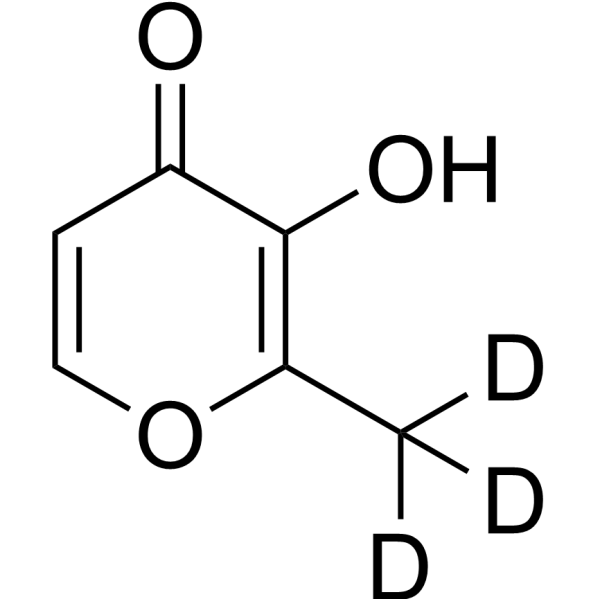
Maltol-d3 is a deuterium labeled Maltol (HY-W012788). Maltol, a type of aromatic compound, is an antioxidant agent. Maltol enhances neural function by mitigating oxidative stress and cell apoptosis. Maltol is an inhibitor of oxidative damage in nerve cells and is effective in preventing diabetic peripheral neuropathy (DPN). Maltol is used extensively as a safe flavoring agent and food preservative. Maltol is a metal ion chelator that can be used in the field of catalysis, cosmetics, and medicine .
loading...
    loading...
Cat. No.: HY-W068771
CAS No.: 943-89-5
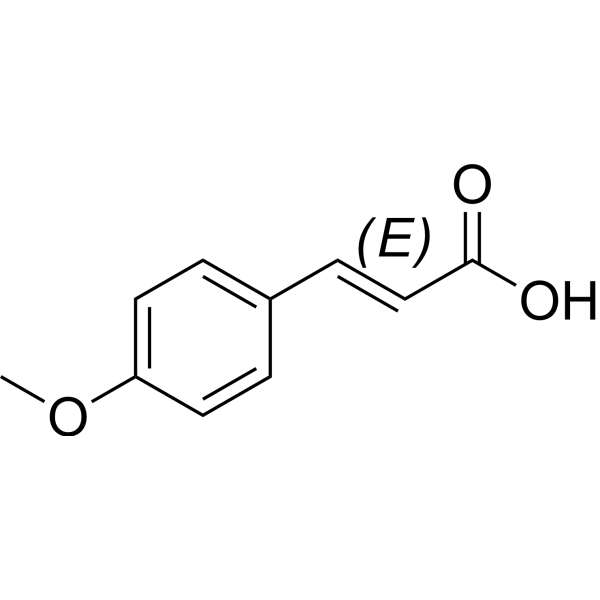
(E)-3-(4-Methoxyphenyl)acrylic acid is an antioxidant and metal chelator that modulates E-NTPDase and Na +/K + ATPase activities in iron-induced testicular injury by scavenging DPPH (HY-112053) free radicals, reducing ferric iron, chelating Fe 2+, inhibiting lipid peroxidation, and enhancing GSH, SOD, and CAT activities. (E)-3-(4-Methoxyphenyl)acrylic acid can be used for research on iron-induced testicular injury .
loading...
    loading...
Cat. No.: HY-W339484
CAS No.: 30652-12-1
Research Areas:  

Others

1-Ethyl-2-methyl-3-hydroxypyrid-4-one is an α-ketohydroxypyridinium iron chelator with high specificity for iron and no specific activity against other metal ions such as copper, zinc, calcium and magnesium. In rabbits with iron overload, 1-Ethyl-2-methyl-3-hydroxypyrid-4-one increased iron excretion after oral or parenteral administration.
loading...
    loading...
Cat. No.: HY-183538
Necroptosis inducer 2 is a necroptosis inducer and copper chelator. Necroptosis inducer 2 chelates intracellular free copper ions, disrupts redox homeostasis, elevates ROS levels, disrupts mitochondrial membrane potential, and induces cancer cell necroptosis. Necroptosis inducer 2 upregulates the necroptosis markers p-MLKL and p-RIP3 expression. Necroptosis inducer 2 exhibits anti-tumor activity in mice. Necroptosis inducer 2 can be used for the research of cancer, such as triple-negative breast cancer .
loading...
    loading...
Cat. No.: HY-186088
CAS No.: 3078821-76-5
Target:  

Drug Intermediate

Research Areas:  

Others

DOTA-tris (t-Bu) ester-PEG3-C2-amine (Compound 9) is a conjugate of DOTA-based chelator and linker, bearing tris (t-Bu) ester and PEG3-C2-amine functional groups. DOTA-tris (t-Bu) ester-PEG3-C2-amine can be conjugated to payloads via bioorthogonal click chemistry for targeted delivery .
loading...
    loading...
Cat. No.: HY-B2153
CAS No.: 4961-41-5
Target:  

Cuproptosis Bacterial

Research Areas:  

Infection

Tetraethylenepentamine pentahydrochloride is an orally active copper chelator and copper mobilizer. Tetraethylenepentamine pentahydrochloride exhibits growth inhibitory and hypolipidemic properties. Tetraethylenepentamine pentahydrochloride significantly increases urinary copper excretion and reduces renal copper accumulation in copper overload models, but does not significantly alter hepatic copper levels. Tetraethylenepentamine pentahydrochloride exerts growth inhibitory effects on Candida albicans and Fluconazole (HY-B0101)-resistant strains, and can be widely used in studies related to Wilson's disease and Candida infections .
loading...
    loading...
Cat. No.: HY-D1637
CAS No.: 172646-43-4
Target:  

Fluorescent Dye

Research Areas:  

Others

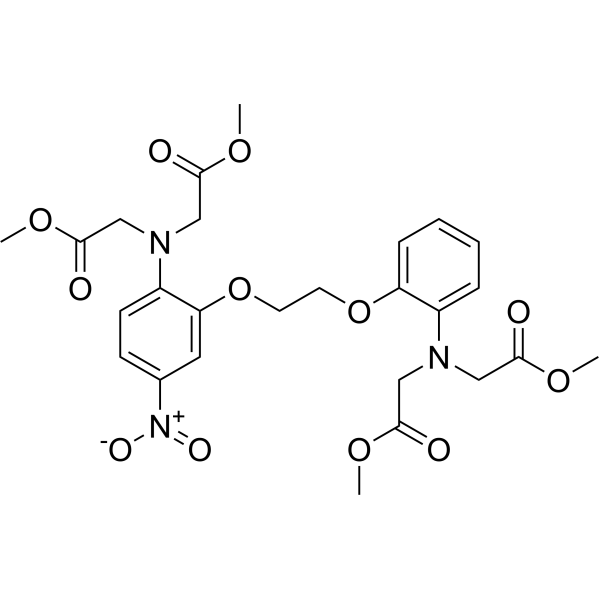
5-Nitro BAPTA tetramethyl ester is a calcium chelator. 5-Nitro BAPTA tetramethyl ester involves in the two-photon probe synthesis, and is used for real-time imaging of intracellular calcium ions, calcium waves monitoring at a depth of 100-300 μm in liver tissues for 1100-4000 s. 5-Nitro BAPTA tetramethyl ester, together with fluorescent compound 2-Me-substituted TM, can be used to form a red fluorescent probe (CaTM-2 AM) .
loading...
    loading...
Cat. No.: HY-N18050
CAS No.: 545434-89-7
Petrobactin is a bis-catechol α-hydroxy acid siderophore, Fe (III) chelator, and oxidative stress protector. Petrobactin is produced by marine bacteria and Bacillus anthracis Sterne strain under iron-starvation conditions. Petrobactin promotes the biodegradation of petroleum hydrocarbons by microorganisms, as well as the proliferation, virulence exertion, vegetative growth, sporulation efficiency, and spore binding of Bacillus anthracis; it also mediates community iron acquisition in the global ocean. Petrobactin can be used in anthrax-related research .
loading...
    loading...
Cat. No.: HY-P10913
CAS No.: 1186217-15-1
Target:  

Bacterial

Research Areas:  

Infection

HYNIC-UBI29-41 is composed of a bifunctional chelator HYNIC and an antimicrobial peptide UBI 29-41 (HY-P10364) (HY-P10364). HYNIC-UBI29-41 retains the antibacterial properties of UBI 29-41, and exhibits good affinity to Gram-positive and Gram-negative bacteria. HYNIC-UBI29-41 can be used as an imaging agent for bacterial infection detection in mouse models, when labeled with the radioactive element technetium (99mTc) .
loading...
    loading...
Cat. No.: HY-P10913A
Target:  

Bacterial

Research Areas:  

Infection

HYNIC-UBI29-41 TFA is composed of a bifunctional chelator HYNIC and an antimicrobial peptide UBI 29-41 (HY-P10364). HYNIC-UBI29-41 TFA retains the antibacterial properties of UBI 29-41, and exhibits good affinity to Gram-positive and Gram-negative bacteria. HYNIC-UBI29-41 TFA can be used as an imaging agent for bacterial infection detection in mouse models, when labeled with the radioactive element technetium (99mTc) .
loading...
    loading...
Cat. No.: HY-P10978
CAS No.: 3137461-57-2
Target:  

PD-1/PD-L1

Research Areas:  

Cancer

NK224 is a peptide-based radiotracer targeting human PD-L1, with dual-radionuclide (68Ga and 18F) labeling compatibility enabled by the NOTA chelator. NK224 exhibits high binding affinity to PD-L1, with an IC50 value of 2.45 nM. NK224 visualizes tumor heterogeneity and dynamically monitors PD-L1 target occupancy during immunotherapy. NK224 can be used for the study of non-small cell lung cancer (NSCLC) .
loading...
    loading...
Cat. No.: HY-W012683
CAS No.: 142-73-4
Iminodiacetic acid is a metal ion chelator targeting Cr 6+, Cd 2+, Ni 2+, and Pb 2+. Iminodiacetic acid selectively and irreversibly binds metal ions through the coordination of carboxyl and imino groups, reduces the toxicity of metal ions and promotes their adsorption and separation. Iminodiacetic acid has the functions of heavy metal ion removal and coordination complex stabilization. Iminodiacetic acid is often used in environmental pollution control (such as heavy metal adsorption in water) and coordination chemistry (such as metal ion detection and separation) research .
loading...
    loading...
Cat. No.: HY-W012683R
CAS No.: 142-73-4
Iminodiacetic acid is a metal ion chelator targeting Cr6+, Cd2+, Ni2+, and Pb2+. Iminodiacetic acid selectively and irreversibly binds metal ions through the coordination of carboxyl and imino groups, reduces the toxicity of metal ions and promotes their adsorption and separation. Iminodiacetic acid has the functions of heavy metal ion removal and coordination complex stabilization. Iminodiacetic acid is often used in environmental pollution control (such as heavy metal adsorption in water) and coordination chemistry (such as metal ion detection and separation) research .
loading...
    loading...
Cat. No.: HY-W989128
CAS No.: 686723-15-9
Ethyl 8-hydroxy-α-(2-propynylamino) is a bifunctional iron chelator that inhibits lipid peroxidation (IC50 = 15 μM). Ethyl 8-hydroxy-α-(2-propynylamino) chelates Fe (II) and Fe (III) metal ions, and inhibits iron/ascorbic acid-induced mitochondrial membrane lipid peroxidation. Ethyl 8-hydroxy-α-(2-propynylamino) can be used in the research of oxidative stress and neurodegenerative diseases .
loading...
    loading...
Cat. No.: HY-D3128
CAS No.: 2348351-60-8
Target:  

Fluorescent Dye

Research Areas:  

Others

Mito-RhFe is a Fluorescent probe for mitochondrial labile Fe³⁺ monitoring via imaging and flow cytometry. This probe is a rhodamine-based construct with a spirolactam fluorescence signaling group and an N2-hydroxyethyldiethylenetriamine chelator; its delocalized positive charge enables mitochondria-targeting ability in live cells, and it exhibits fine cell membrane permeability. In its native state, it exists in the non-fluorescent spirolactam form, but upon binding to Fe³⁺, it undergoes a ring-opening conversion to the fluorescent rhodamine form, triggering a turn-on fluorescent response; this process is reversible, as the addition of the metal chelator TPEN removes Fe³⁺ and converts the probe back to its non-fluorescent spirolactam form, and re-addition of Fe³⁺ restores fluorescence. The probe shows high selectivity for Fe³⁺ over most other metal cations present in living systems, with a ~90-fold fluorescence enhancement upon binding to 20 equiv of Fe³⁺. Mito-RhFe has excitation/emission wavelengths of Ex/Em = 540/578 nm, with an ~8 nm bathochromic shift in emission upon Fe³⁺ binding, and it can also be excited at 543 nm for confocal imaging with emission detected at 570-620 nm[1].
loading...
    loading...
Cat. No.: HY-115973
Target:  

Cholinesterase (ChE)

Research Areas:  

Neurological Disease

AChE-IN-11 (compound 5C) is a triple inhibitor targeting AChE/MAO-B/BACE1 (IC50=7.9 μM, 9.9 μM, 8.3 μM, respectively) and a selective metal ion chelators. AChE-IN-11 exhibits mixed AChE inhibitory effects, binding to both CAS and PAS of AChE. AChE-IN-11 also exhibits good antioxidant activity (ORAC=2.5 eq) and potential neuroprotective effects in Alzheimer's disease .
loading...
    loading...

