100 Results for "

L-glutamic

" in MedChemExpress (MCE) Product Catalog:
Products (100)

100 Results for "L-glutamic" in MCE Product Catalog:

Cat. No.: HY-W015240S1
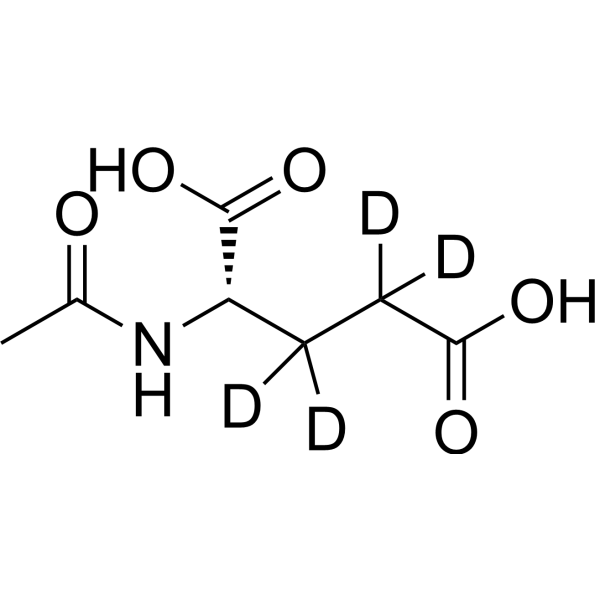
N-Acetyl-L-glutamic acid-d4 is the deuterium labeled N-Acetyl-L-glutamic acid (HY-W015240). N-Acetyl-L-glutamic acid is a type of glutamic acid that can serve as a component of cell culture media. When combined with media containing inorganic salts, carbohydrates, vitamins, and amino acids, N-Acetyl-L-glutamic acid plays roles in promoting cell growth, enhancing antibody production, etc. N-Acetyl-L-glutamic acid is also an endogenous metabolite that can be found in the brain. Additionally, as an IgE blocker, N-Acetyl-L-glutamic acid can be used in the research of allergic diseases .
loading...
    loading...
Cat. No.: HY-135094R
CAS No.: 38079-66-2
Synonyms: N-Palmitoyl-L-glutamic acid (Standard)
Palmitoyl glutamic acid (Standard) is the analytical standard of Palmitoyl glutamic acid. This product is intended for research and analytical applications. Palmitoyl glutamic acid (N-Palmitoyl-L-glutamic acid) is an acyl amino acid with neuroprotective effects[1]. Palmitoyl glutamic acid is used as cosmetic material[2].
loading...
    loading...
Cat. No.: HY-W015424R
CAS No.: 35989-16-3
N-Methyl-DL-glutamic acid is a L-Glutamic acid (HY-14608) analog with cytotoxic effects .
loading...
    loading...
Cat. No.: HY-100815D
CAS No.: 76463-67-7
Purity:  99.90%
Synonyms: (±)-AMPA monohydrate
Target:  

iGluR

Research Areas:  

Neurological Disease

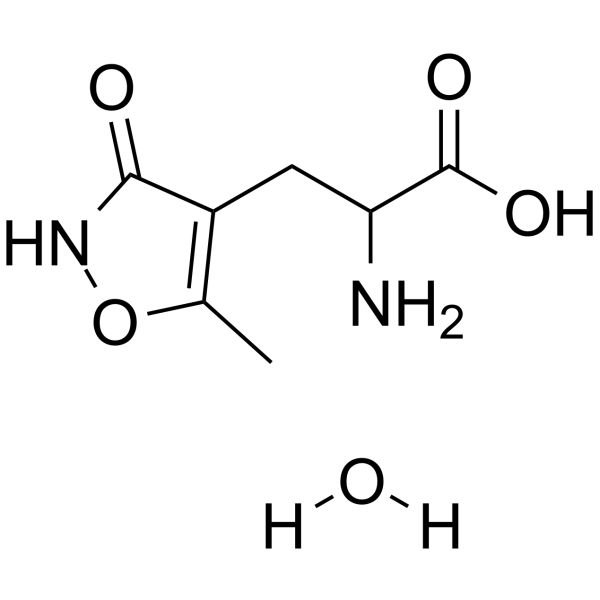
(RS)-AMPA monohydrate ((±)-AMPA monohydrate) is a glutamate analogue and a potent and selective excitatory neurotransmitter L-glutamic acid agonist. (RS)-AMPA monohydrate does not interfere with binding sites for kainic acid or NMDA receptors .
loading...
    loading...
Cat. No.: HY-100815E
CAS No.: 2922283-04-1
Synonyms: (±)-AMPA hydrochloride
Target:  

iGluR

Research Areas:  

Neurological Disease

(RS)-AMPA hydrochloride ((±)-AMPA hydrochloride) is a glutamate analogue and a potent and selective excitatory neurotransmitter L-glutamic acid agonist. (RS)-AMPA hydrochloride hydrobromide does not interfere with binding sites for kainic acid or NMDA receptors .
loading...
    loading...
Cat. No.: HY-16158R
CAS No.: 3485-14-1
Synonyms: Wy-4508 (Standard); Aminocyclohexylpenicillin (Standard); Ciclacillin (Standard)
Research Areas:  

Infection

DL-Glutamic acid (Standard) is the analytical standard of DL-Glutamic acid. This product is intended for research and analytical applications. DL-Glutamic acid is the conjugate acid of Glutamic acid, which acts as a fundamental metabolite. Comparing with the second phase of polymorphs α and β L-Glutamic acid, DL-Glutamic acid presents better stability .
loading...
    loading...
Cat. No.: HY-100815BR
CAS No.: 77521-29-0
Synonyms: (±)-AMPA (Standard)
Research Areas:  

Neurological Disease

(RS)-AMPA (Standard) is the analytical standard of (RS)-AMPA. This product is intended for research and analytical applications. (RS)-AMPA ((±)-AMPA) is a glutamate analogue and a potent and selective excitatory neurotransmitter L-glutamic acid agonist. (RS)-AMPA does not interfere with binding sites for kainic acid or NMDA receptors .
loading...
    loading...
Cat. No.: HY-15121A
CAS No.: 34271-54-0
Synonyms: DL-glutamic acid γ-ethyl amide; Nγ-Ethyl-DL-glutamine
Target:  

Bacterial

Research Areas:  

Infection

DL-Theanine (DL-Glutamic acid γ-ethyl amide) is an antimetabolite of L-glutamic acid, and exhibits antibacterial activity against Staphylococcus aureus and Escherichia coli. DL-Theanine shows no significant inhibitory activity against bacterial glutamate decarboxylase. DL-Theanine can be used in studies related to bacterial infections .
loading...
    loading...
Cat. No.: HY-W766574
CAS No.: 2714331-41-4
L-Glutamine-5- 13C Hydrochloride is the 13C-labeled L-Glutamine (HY-N0390). L-Glutamine (L-Glutamic acid 5-amide) is a non-essential amino acid present abundantly throughout the body and involved in many metabolic processes. L-Glutamine provides a source of carbons for oxidation in some cells .
loading...
    loading...
Cat. No.: HY-118758
CAS No.: 98394-38-8
Synonyms: γ-Kainic acid-glutamic acid
Target:  

Sodium Channel

Research Areas:  

Neurological Disease

γ-Kainylglutamic acid (γ-Kainic acid-glutamic acid), a dipeptide derived from kainic and L-Glutamic acids, is a selective antagonist of amino acid induced neuroexcitation with anticonvulsant properties. γ-Kainylglutamic acid inhibits the stimulation of Na + fluxes induced in brain slices by the neuroexcitant N-methyl-D-aspartic acid. γ-Kainylglutamic acid is also effective in protecting mice from picrotoxin-induced convulsions with an EC50 value of 0.17 μmol .
loading...
    loading...
Cat. No.: HY-176967
CAS No.: 23828-78-6
Synonyms: GluCA
N-Cholyl-L-glutamic acid (GluCA) is a Cholic acid (HY-N0324) conjugated with L-glutamic acid (HY-14608). N-Cholyl-L-glutamic acid increases expression of PXR and downstream PXR-target gene Cyp3a11. N-Cholyl-L-glutamic acid can be used in the research of Crohn's disease .
loading...
    loading...
Cat. No.: HY-W011592
CAS No.: 340-90-9
Target:  

NO Synthase

Research Areas:  

Inflammation/Immunology

N-Phthaloyl-L-glutamic acid is an orally active anti-inflammatory agent. N-Phthaloyl-L-glutamic acid inhibits Lipopolysaccharides (HY-D1056) (LPS)-induced nitric oxide production in murine spleen cells. N-Phthaloyl-L-glutamic acid does not exhibit significant cytotoxicity in vitro against tumor cells and BALB/c mice spleen cell culture. N-Phthaloyl-L-glutamic acid can be used for the research of inflammation .
loading...
    loading...
Cat. No.: HY-167142
CAS No.: 3397-16-8
Synonyms: N-Stearoyl-L-glutamic acid
Research Areas:  

Others

Stearoyl glutamic acid (N-Stearoyl-L-glutamic acid) is a saturated aliphatic amide compound and also an additive for lipid cubic phase materials. Stearoyl glutamic acid is used in studies as a surfactant and emulsifier .
loading...
    loading...
Cat. No.: HY-114844
CAS No.: 3617-45-6
Synonyms: H-Phe-Glu-OH
Research Areas:  

Infection

L-Phenylalanyl-L-glutamic acid (H-Phe-Glu-OH) is a dipeptide present in the exudates of alfalfa seedlings, which exhibits high affinity for PEPT2. L-Phenylalanyl-L-glutamic acid can serve as the peptide scaffold of a tyrosyl-tRNA synthetase inhibitor against Staphylococcus aureus .
loading...
    loading...
Cat. No.: HY-180687
CAS No.: 1681-96-5
Synonyms: N-Formyl-L-glutamic acid
N-Formyl-L-glutamate (N-Formyl-L-glutamic acid) can be obtained from the conversion of L-histidine. N-Formyl-L-glutamate can be degraded into L-glutamate .
loading...
    loading...
Cat. No.: HY-114844A
Synonyms: H-Phe-Glu-OH TFA
Research Areas:  

Infection

L-Phenylalanyl-L-glutamic acid TFA (H-Phe-Glu-OH TFA) is a dipeptide present in the exudates of alfalfa seedlings, which exhibits high affinity for PEPT2. L-Phenylalanyl-L-glutamic acid TFA can serve as the peptide scaffold of a tyrosyl-tRNA synthetase inhibitor against Staphylococcus aureus .
loading...
    loading...
Cat. No.: HY-180749
CAS No.: 106454-68-6
L-4-Hydroxyglutamate semialdehyde is a derivative of glutamate semialdehyde, with a hydroxyl group introduced at the 4-position of L-glutamic 5-semialdehyde. L-4-Hydroxyglutamate semialdehyde functions as a metabolite in yeast, mice, and humans, and is functionally associated with L-glutamic 5-semialdehyde, playing a role in arginine and proline metabolism .
loading...
    loading...
Cat. No.: HY-N17468
CAS No.: 2001062-74-2
Neocrocin B is a carotenoid crocin. Neocrocin B inhibits L-Glutamic acid (HY-14608)-induced neuronal cell damage in a dose-dependent manner. Neocrocin B can be used in studies related to neuronal injury .
loading...
    loading...
Cat. No.: HY-N21704
CAS No.: 1001232-23-0
Sampsonione O is a neuroprotective agent. Sampsonione O is present in Hypericum species. Sampsonione O exerts neuroprotective effects against L-glutamic acid (HY-14608)-induced injury. Sampsonione O can be used for research on neuronal injury [3]4].
loading...
    loading...
Cat. No.: HY-184849
CAS No.: 7219-59-2
Research Areas:  

Others

Glu-Arg is a dipeptide linked by L-glutamic acid and L-arginine. Glu-Arg contributes to the construction of the hydrophobic network and maintenance of stability of mouse cAMP-dependent protein kinase; it acts as a core hub connecting the activation segment and the GHI subdomain in eukaryotic protein kinases, and promotes signal transmission between elements and within enzymes. As a salt bridge, Glu-Arg regulates the formation and unfolding rates of α-helices, and its optimized spatial conformation is conducive to the stability and folding rate of α-helices. Glu-Arg induces concentration-dependent intracellular calcium changes in cultured human fungiform taste bud cells .
loading...
    loading...

