213 Results for "

STEP

" in MedChemExpress (MCE) Product Catalog:
Products (213)

213 Results for "STEP" in MCE Product Catalog:

Cat. No.: HY-171826
CAS No.: 2541626-55-3
Target:  

CDK PROTACs

Research Areas:  

Cancer

PROTAC CDK2/4/6 Degrader-1 is an orally active CDK2/CDK4/CDK6 PROTAC degrader. PROTAC CDK2/4/6 Degrader-1 is a prodrug derived from PROTAC CDK2/4/6 Degrader-2 via one-step reaction with chloromethyl pivalate. PROTAC CDK2/4/6 Degrader-1 can be used for malignant melanoma research .
loading...
    loading...
Cat. No.: HY-19895
CAS No.: 1356918-39-2
Target:  

Bacterial

Research Areas:  

Infection

DS-8587 is a new fluoroquinolone with significant antibacterial activity. The MIC value of DS-8587 against clinically isolated amoxicillin-resistant Bacillus strains is superior to ciprofloxacin and levofloxacin. The antibacterial activity of DS-8587 is less affected by adeA/adeB/adeC or abeM efflux pumps, and has more advantages than ciprofloxacin. DS-8587 has a lower single-step mutation frequency than ciprofloxacin. DS-8587 may be an effective drug for inhibiting amoxicillin-resistant Bacillus infections .
loading...
    loading...
Cat. No.: HY-101812R
CAS No.: 56488-59-6
Terbufibrol (Standard) is the analytical standard of Terbufibrol (HY-101812). This product is intended for research and analytical applications. Terbufibrol is an orally active lipid-lowering agent. Terbufibrol inhibits hepatic Cholesterol 7 alpha-hydroxylase. Terbufibrol blocks a step between Acetate and HMG-CoA in the hepatic cholesterol synthesis process. Terbufibrol reduces serum total cholesterol, HDL, LDL, lipoprotein levels, and the cholesterol/phospholipid ratio, with dose- and sex-dependent changes in lipoprotein components. Terbufibrol exerts sustained cholesterol-lowering activity in baboons and rats. Terbufibrol can be used in research related to hypercholesterolemia .
loading...
    loading...
Cat. No.: HY-139480
CAS No.: 68865-60-1
Purity:  ≥98.0%
Research Areas:  

Others

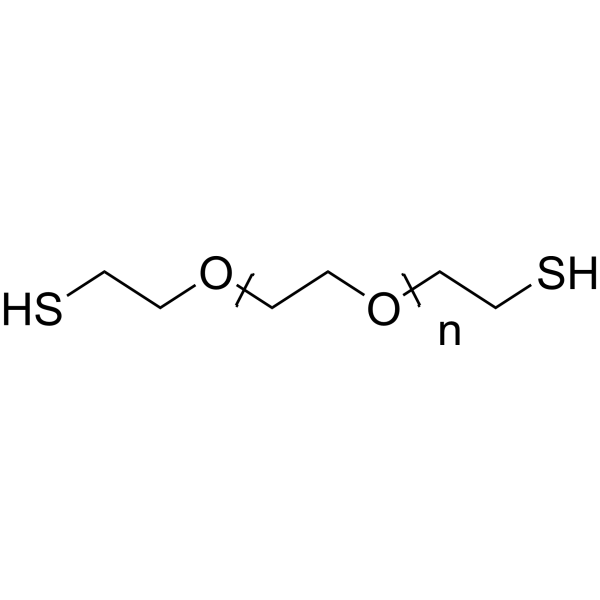
Poly (ethylene glycol) dithiol (Mn 3400) is a bifunctional thiol-terminated PEG crosslinking and polymerization reagent. The terminal thiol groups of Poly (ethylene glycol) dithiol (Mn 3400) can undergo thiol-ene photochemical click reactions with norbornene groups, thereby crosslinking to form hydrogel networks; it can also serve as a dithiol monomer in the step-growth polymerization of hexahydrotriazine (HT) to form poly (thioaminal) polymers containing dynamic thioacetal bonds. Poly (ethylene glycol) dithiol (Mn 3400) is applicable for hydrogel construction, biomanufacturing, and dynamic covalent polymer research .
loading...
    loading...
Cat. No.: HY-N0842R
CAS No.: 174022-42-5
Synonyms: PA-457 (Standard); MPC-4326 (Standard); YK FH312 (Standard)
Bevirimat (Standard) is the analytical standard of Bevirimat. This product is intended for research and analytical applications. Bevirimat (PA-457, MPC-4326, YK FH312) is an inhibitor of HIV-1 viral particle maturation.Bevirimat specifically inhibits the final rate-limiting step in Gag processing, preventing the release of the mature capsid protein (CA) from its precursor (CA-SP1), resulting in the production of immature non-infectious viral particles. Bevirimat can be used in HIV-1 infection studies[1][2][3][4].
loading...
    loading...
Cat. No.: HY-N13064
CAS No.: 123702-96-5
2,2′,4,4′-Tetrahydroxychalcone (Compound 18) is a selective and potent BACE1 inhibitor with an IC50 of 0.62 μM. 2,2′,4,4′-Tetrahydroxychalcone is a derivative of Isoliquiritigenin (HY-N0102) found in Glycyrrhiza uralensis. 2,2′,4,4′-Tetrahydroxychalcone can block the β-cutting step of amyloid precursor protein (APP), thereby reducing the production of β-amyloid (Aβ) peptide. 2,2′,4,4′-Tetrahydroxychalcone can be used for research of Alzheimer’s disease .
loading...
    loading...
Cat. No.: HY-W749394
CAS No.: 2707945-47-7
4-Methyl-5-thiazoleethanol- 13C3 is the 13C-labeled 4-Methyl-5-thiazoleethanol (HY-W015695). 4-Methyl-5-thiazoleethanol is a natural sulfur-containing flavor compound with the aroma of beef and nuts. In addition, the composite material prepared by modifying graphene oxide with 4-Methyl-5-thiazoleethanol through a one-step esterification reaction can selectively adsorb copper ions (Cu2+) in aqueous solutions .
loading...
    loading...
Cat. No.: HY-W779018
CAS No.: 201741-00-6
Synonyms: D-(+)-Xylose-13C2; (+)-Xylose-13C2; Wood sugar-13C2
Xylose- 13C2 (D-(+)-Xylose- 13C2) is the 13C-labeled Xylose. Xylose (D-(+)-Xylose) is a natural pentose sugar that is catalyzed by xylose isomerase to form xylulose, which is a key step in the anaerobic ethanol fermentation of Xylose. Xylose can be used by microorganisms to produce fuels, chemicals, and bulk industrial enzymes. Xylose provides the substances and energy for cells, as a carbon source for the biosynthesis of high-value chemicals and biofuel. Xylose can be used to fully explore lignocellulose resources and provide a new direction for microbia fermentation .
loading...
    loading...
Cat. No.: HY-W779019
CAS No.: 1262683-58-8
Synonyms: D-(+)-Xylose-13C5; (+)-Xylose-13C5; Wood sugar-13C5
Xylose- 13C5 (D-(+)-Xylose- 13C5) is 13C labeled Xylose. Xylose (D-(+)-Xylose) is a natural pentose sugar that is catalyzed by xylose isomerase to form xylulose, which is a key step in the anaerobic ethanol fermentation of Xylose. Xylose can be used by microorganisms to produce fuels, chemicals, and bulk industrial enzymes. Xylose provides the substances and energy for cells, as a carbon source for the biosynthesis of high-value chemicals and biofuel. Xylose can be used to fully explore lignocellulose resources and provide a new direction for microbia fermentation .
loading...
    loading...
Cat. No.: HY-B1119R
CAS No.: 3380-34-5
Triclosan (Standard) is the analytical standard of Triclosan. This product is intended for research and analytical applications. Triclosan is a broad-spectrum antibacterial agent that inhibits bacterial fatty acid synthesis at the enoyl-acyl carrier protein reductase (FabI) step. Triclosan inhibits E. coli enoyl-acyl carrier protein reductase (FabI) and FabI containing a glycine-to-valine substitution at position 93 (FabIG93V) with IC50s of 2 µM and 10 µM, respectively. Triclosan causes apoptotic effect in cultured rat neural stem cells (NSC). Triclosan exacerbates colitis and colitis-associated colorectal tumorigenesis in animal models .
loading...
    loading...
Cat. No.: HY-D3182
CAS No.: 2252329-12-5
AldeRed 588-A is a fluorescent labeling reagent and a substrate for aldehyde dehydrogenase (ALDH). AldeRed 588-A is metabolized by functionally active ALDH enzymes, thereby specifically labeling viable ALDH bright cell populations with red-shifted fluorescence. AldeRed 588-A supports one-step isolation and sorting of ALDH-expressing cells (including normal stem cells and cancer stem cells), and can be used in combination with green fluorophores for multicolor experimental applications. AldeRed 588-A is widely applicable to research related to various cancers such as bladder cancer, breast cancer, and head and neck cancer .
loading...
    loading...
Cat. No.: HY-E70410
CAS No.: 9032-69-3
Synonyms: NAD+ Synthetase; Nicotinamide adenine dinucleotide synthetase
NAD synthetase is responsible for the final step in the synthesis of nicotinamide adenine dinucleotide (NAD). The Km values for NAD, ATP, and ammonia of NAD synthetase from Escherichia coli are 200 μM, 11 μM, and 0.65 μM, respectively, while the Km values for NAD, ATP, and ammonia of NAD synthetase from yeast are 170 μM, 190 μM, and 64 μM, respectively. NAD synthetase can be used for enzymatic assays to determine ATP, ammonia, urea, or creatinine, and is also suitable for enzymatic cycling methods. Additionally, NAD synthetase holds potential for research into metabolic diseases, cancer, aging, and neurodegenerative diseases .
loading...
    loading...
Cat. No.: HY-E71156
Research Areas:  

Others

1,4-Dihydroxy-2-naphthoate polyprenyltransferase (EC 2.5.1.74) catalyses a step in the synthesis of menaquinone, in which the prenyl chain synthesized by polyprenyl diphosphate synthase is transferred to 1,4-Dihydroxy-2-naphthoate (DHNA) . 1,4-Dihydroxy-2-naphthoate polyprenyltransferase (EC 2.5.1.74) is an inner membrane protein, with the C-terminus located in the periplasm. 1,4-Dihydroxy-2-naphthoate polyprenyltransferase (EC 2.5.1.74) is highly specific for DHNA but not for a specific length of the prenyl chain.
loading...
    loading...
Cat. No.: HY-N0537S3
CAS No.: 131771-69-2
Synonyms: D-(+)-Xylose-2-13C; (+)-Xylose-2-13C; Wood sugar-2-13C
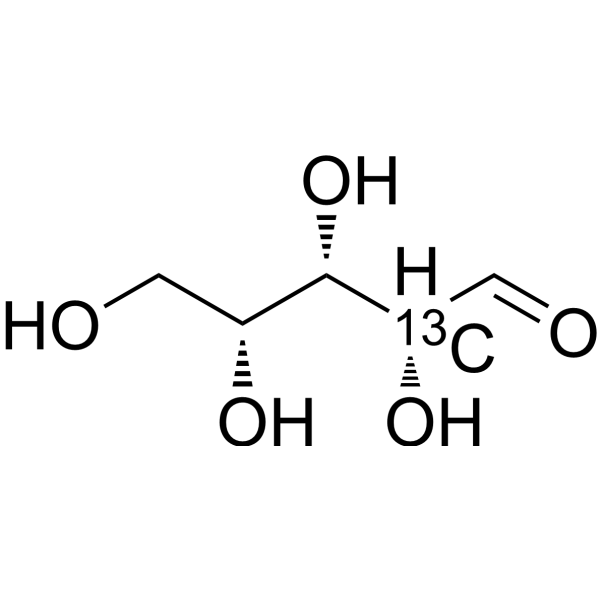
Xylose-2- 13C (D-(+)-Xylose-2- 13C) is the 13C labeled Xylose (HY-N0537). Xylose (D-(+)-Xylose) is a natural pentose sugar that is catalyzed by xylose isomerase to form xylulose, which is a key step in the anaerobic ethanol fermentation of Xylose. Xylose can be used by microorganisms to produce fuels, chemicals, and bulk industrial enzymes. Xylose provides the substances and energy for cells, as a carbon source for the biosynthesis of high-value chemicals and biofuel. Xylose can be used to fully explore lignocellulose resources and provide a new direction for microbia fermentation .
loading...
    loading...
Cat. No.: HY-W653962
CAS No.: 2726926-25-4
Triclosan- 13C6 is 13C labeled Triclosan. Triclosan is a broad-spectrum antibacterial agent that inhibits bacterial fatty acid synthesis at the enoyl-acyl carrier protein reductase (FabI) step. Triclosan inhibits E. coli enoyl-acyl carrier protein reductase (FabI) and FabI containing a glycine-to-valine substitution at position 93 (FabIG93V) with IC50s of 2 μM and 10 μM, respectively. Triclosan causes apoptotic effect in cultured rat neural stem cells (NSC). Triclosan exacerbates colitis and colitis-associated colorectal tumorigenesis in animal models .
loading...
    loading...
Cat. No.: HY-W768934
Synonyms: L-Gulonolactone-13C6
L-Gulono-1,4-lactone- 13C6 (L-Gulonolactone- 13C6) is the 13C-labeled L-Gulono-1,4-lactone (HY-W016628). L-Gulono-1,4-lactone is a substrate of L-gulono-1,4-lactone oxidoreductase, which catalyzes the last step of the biosynthesis of L-ascorbic (Vatamin) C. In other words, L-Gulono-1,4-lactone is a direct precursor of vitamin C in animals, in plants and in some protists.
loading...
    loading...
Cat. No.: HY-110078R
CAS No.: 412960-54-4
Research Areas:  

Cancer

Eeyarestatin I (Standard) is the analytical standard of Eeyarestatin I (HY-110078). This product is intended for research and analytical applications. Eeyarestatin I, a potent endoplasmic reticulum-associated protein degradation (ERAD) inhibitor, is a potent protein translocation inhibitor. Eeyarestatin I inhibits Sec61 translocon. Eeyarestatin I targets the p97-associated deubiquitinating process (PAD) and inhibits atx3-dependent deubiquitination. Eeyarestatin I interferes at a step prior to proteasomal degradation. Eeyarestatin I induces cell death via the proapoptotic protein NOXA and has anticancer effects .
loading...
    loading...
Cat. No.: HY-121998
CAS No.: 220088-42-6
Target:  

Aurora Kinase

Research Areas:  

Others

Binucleine 2 is an isoform-specific and ATP-competitive inhibitor of Drosophila Aurora B kinase (Ki=0.36 μM), a kinase involved in cell division. It is specific for Drosophila Aurora B kinase, inhibiting it in a dose-dependent manner, with minimal inhibition of human or X. laevis Aurora B kinases at concentrations up to 100 μM. Binucleine 2 induces mitotic and cytokinesis defects in Drosophila Kc167 cells. It prevents Drosophila S2 cells from assembling a contractile ring during cell division when used at a concentration of 40 μM but does not affect ring ingression, suggesting that Aurora B kinase activity is not required for that step.
loading...
    loading...
Cat. No.: HY-179654
CAS No.: 1013620-98-8
Target:  

HDAC Apoptosis

Research Areas:  

Cancer

ST13, an ortho-hydroxyanilide, is a selective, slow- and tight-binding HDAC1 and HDAC2 inhibitor with IC50s of 23 nM and 49 nM, respectively. ST13 shows a weak inhibition of HDAC3 (IC50 = 4.30 μM) and HDAC6 (IC50 > 10 μM). The induced fit mechanism of ST13 proceeds through a two-step process: first, the enzyme and inhibitor rapidly form a collision complex (EI), which then slowly transforms into the stable complex E*I. ST13 induces apoptosis in cancer cells. ST13 can be used for the study of melanoma and triple-negative breast .
loading...
    loading...
Cat. No.: HY-183573
PTPRO-IN-1 is a selective, orally active PTPRO inhibitor with an IC50 of 0.16 μM. PTPRO-IN-1 exhibits IC50 values of 2.4 μM, 2.33 μM and 2.13 μM against PTPN22, PTP1B and PTPRT, respectively, and shows almost no inhibitory activity against STEP/SSH2. PTPRO-IN-1 inhibits the TLR4/NF-κB signaling pathway in macrophages, ameliorates colonic pathological conditions and suppresses the secretion of pro-inflammatory cytokines by T cells. PTPRO-IN-1 can be used for the research of inflammatory bowel disease .
loading...
    loading...

