19 Results for "

A549 human lung cancer cell

" in MedChemExpress (MCE) Product Catalog:
Products (19)

19 Results for "A549 human lung cancer cell" in MCE Product Catalog:

1
1 Cited Publications
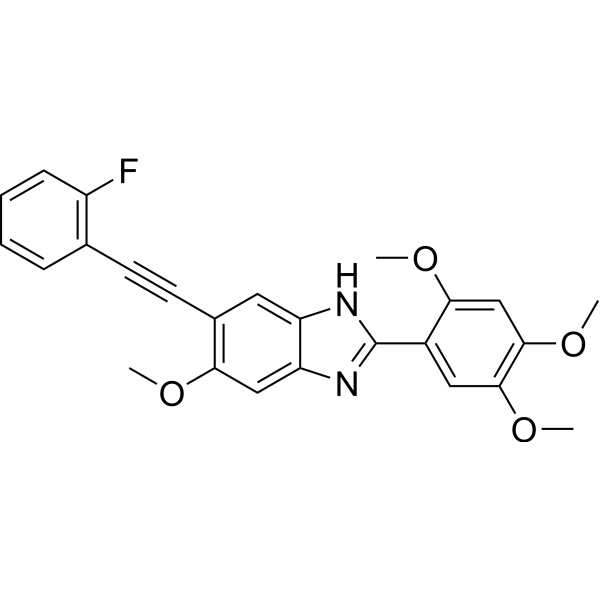
Cat. No.: HY-131344
CAS No.: 2489196-70-3
Purity:  98.14%
Target:  

mTOR Autophagy

Research Areas:  

Cancer

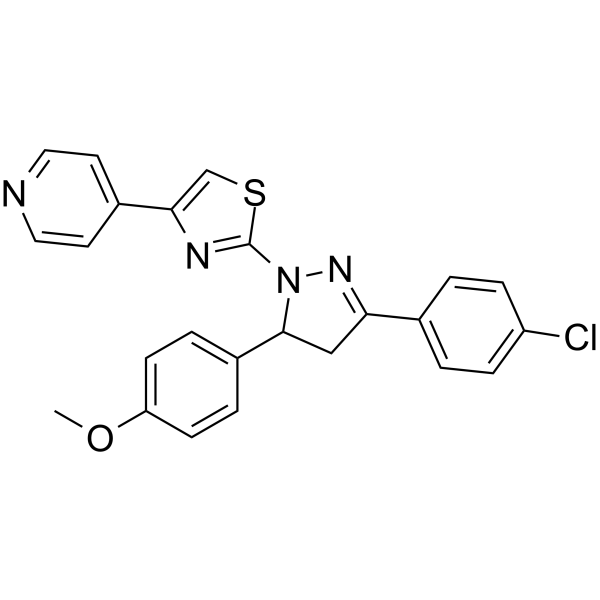
mTOR inhibitor-8 is an mTOR inhibitor and autophagy inducer. mTOR inhibitor-8 inhibits the activity of mTOR via FKBP12 and induces autophagy of A549 human lung cancer cells .
loading...
    loading...
Cat. No.: HY-121255
CAS No.: 482-22-4
Purity:  ≥99.0%
Synonyms: (R)-Cryptopleurine; NSC 19912
Target:  

TMV

Research Areas:  

Cancer

(–)-Cryptopleurine is an alkaloid that has been found in Lauraceae and has diverse biological activities. It inhibits the growth of human A375 melanoma, A431 epidermoid carcinoma, A549 lung, MES-SA uterine sarcoma, and MCF-7 breast cancer cells (IC50=3 nM for all).2 (–)-Cryptopleurine inhibits hypoxia-induced gene expression in a hypoxia response element (HRE) reporter assay (IC50=8.7 nM).3 (–)-Cryptopleurine (500 μg/mL) prevents lesion formation in tobacco (N. tabacum) plants infected with tobacco mosaic virus (TMV). It also inhibits protein synthesis by yeast and mammalian ribosomes.
loading...
    loading...
Cat. No.: HY-N16602
CAS No.: 1179524-22-1
(±)-Blephenanthrofuran B is a pair of enantiomers can be found in Bletilla striata. (±)-Blephenanthrofuran B shows no cytotoxic activity against human lung cancer A549 cells .
loading...
    loading...
Cat. No.: HY-174336
Target:  

Survivin Apoptosis

Research Areas:  

Cancer

Survivin-IN-1 (Compound II₃) is a potent Survivin (a member of the Inhibitor of Apoptosis Protein family) inhibitor with an IC50 value of 8.1 μM against human lung cancer A549 cells and 9.0 μM against breast cancer MCF-7 cells. Survivin-IN-1 reduces Survivin protein levels and induces tumor cell apoptosis. Survivin-IN-1 is promising for research of malignant tumors such as lung cancer and breast cancer .
loading...
    loading...
Cat. No.: HY-162098
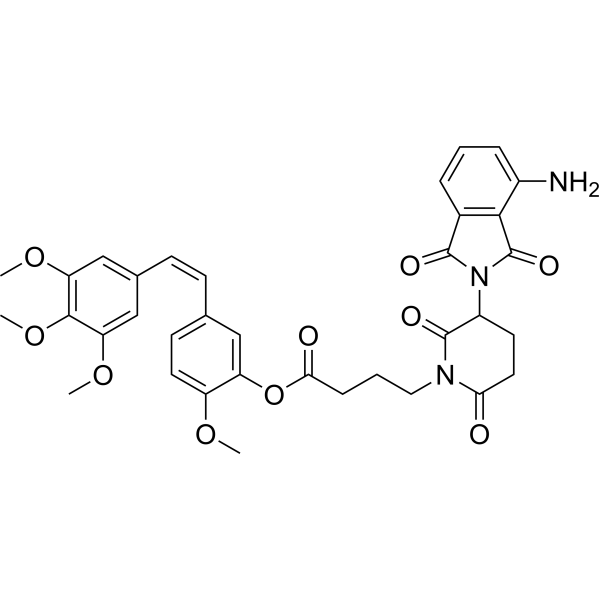
PROTAC tubulin-Degrader-1 is a α/β/β3-tubulin PROTAC degrader. PROTAC tubulin-Degrader-1 exhibits potent anti-proliferative activity against multiple human tumor cell lines. PROTAC tubulin-Degrader-1 induces G2/M phase arrest and apoptosis and inhibits colony formation in A549 and A549/Taxol cells. PROTAC tubulin-Degrader-1demonstrates potent anti-tumor efficacy in A549 and A549/Taxol (Taxol-resistant) xenograft model. PROTAC tubulin-Degrader-1 can be used for the study of non-small cell lung cancer (NSCLC). (Pink: Tubulin ligand (HY-N2146), Blue: CRBN Ligand (HY-10984), Black: Linker (HY-N6056)) .
loading...
    loading...
Cat. No.: HY-173367
Target:  

EGFR PI3K mTOR

Research Areas:  

Cancer

Anticancer agent 271 (compound 5C) has antiproliferative activity against lung (A549), colon (Caco-2) cancer cell lines, and human lung fibroblast (WI38) with an IC50 value of 9.18 μM on A549 cells. Anticancer agent 271 downregulates PI3K and mTOR gene expression that can be used for cancer research .
loading...
    loading...
Cat. No.: HY-162885
CAS No.: 1194235-46-5
Research Areas:  

Cancer

YSY01A is a proteasome inhibitor that can suppress cancer cell survival by inducing apoptosis (Apoptosis). Its IC50 values are 51.0 nM for HEK293T, 9.2 nM for A549, 5.2 nM for MCF-7, 8.9 nM for MGC-803, and 35.4 nM for PC-3M cells. Additionally, YSY01A eliminates constitutive STAT3 signaling by downregulating gp130 and JAK2 in human A549 lung cancer cells. YSY01A holds promise for research in the field of cancer therapy .
loading...
    loading...
Cat. No.: HY-N3210
CAS No.: 60048-88-6
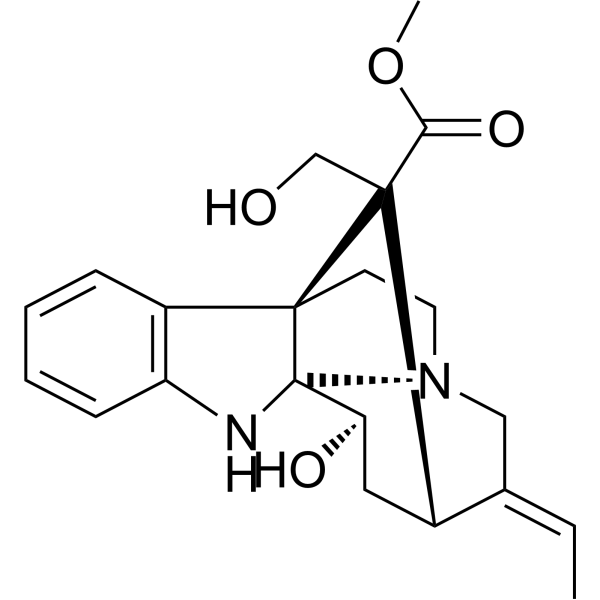
Nb-Demethylechitamine is an alkaloid isolated from the methanol extract of Alstonia rostrata twigs. Nb-Demethylechitamine has in vitro cytotoxic activity against several human cancer cell lines, including human myeloid leukemia HL-60, liver cancer SMMC-7721, lung cancer A-549, breast cancer MCF-7, and colon cancer SW480 cells .
loading...
    loading...
Cat. No.: HY-172881
Target:  

Pyruvate Kinase

Research Areas:  

Cancer

PKM2-IN-10 (Compound 16) is a PKM2 inhibitor. PKM2-IN-10 inhibits the proliferation of A549 and HCC1833 cell lines with IC50 of 3.36 μM and 9.20 μM, respectively. PKM2-IN-10 exhibits antitumor activity in human non-small cell lung cancer (NSCLC) and mouse lung adenocarcinoma models. PKM2-IN-10 can be used in lung cancer research .
loading...
    loading...
Cat. No.: HY-N15578
CAS No.: 540528-05-0
Actinidioionoside (Compound 2) is a megastigmane glucoside compound found in Borago officinalis L. Actinidioionoside has DPPH free radical scavenging activity (IC50: 41.3 μM). Actinidioionoside has no significant cytotoxicity against A549 human lung cancer cells (IC50 > 100 μM). Actinidioionoside can be used in antioxidant studies .
loading...
    loading...
Cat. No.: HY-175598
Target:  

Others

Research Areas:  

Cancer

Anticancer agent 278 (Compound 5e) is an anticancer agent. Anticancer agent 278 has potent toxicity and inhibitory activities against cancer cells with IC50s of 4.02  μM, 6.02  μM and 6.11 μM for A549, HeLa and HCT116, respectively. Anticancer agent 278 can be used for cancers like human lung, cervical and colorectal cancer research .
loading...
    loading...
Cat. No.: HY-159512
Target:  

EGFR Apoptosis

Research Areas:  

Cancer

EGFR kinase inhibitor 7 (compound 18i) is an EGFR inhibitor (IC50=42.3 nM) with anticancer activity. EGFR kinase inhibitor 7 has significant in vitro cytotoxicity and apoptosis induction ability. EGFR kinase inhibitor 7 has antiproliferative activity against human colon cancer cell line HCT116 and human non-small cell lung cancer cell line A549, with IC50 values ​​of 4.82 µM and 1.43 µM, respectively .
loading...
    loading...
Cat. No.: HY-151295
CAS No.: 2827065-29-0
Target:  

DNA/RNA Synthesis

Research Areas:  

Cancer

Antitumor agent-75 is a novel potent antitumor agent. Antitumor agent-75 has cytotoxic effects on cancer and normal human cell lines. Antitumor agent-75 shows a highly selective cytotoxic effect against human lung adenocarcinoma (cell line A549) when combined with Antitumor agent-74 (HY-151292), the IC50 value of 2.8 μM. Antitumor agent-75 can be used for the research of cancer .
loading...
    loading...
Cat. No.: HY-B0530A
CAS No.: 1798-50-1
Synonyms: γ-pipradol hydrochloride
Research Areas:  

Cancer

Azacyclonol (γ-pipradol) hydrochloride is a compound with promising anticancer activity, showing effectiveness in inhibiting NOX-derived ROS in A549 human lung cancer cells. Azacyclonol hydrochloride exhibits enhanced proliferation inhibition against androgen-refractory cancer cell lines, specifically DU145 and PC-3. Azacyclonol hydrochloride demonstrates antitumor activity in DU145-xenografted chorioallantoic membrane tumor models. Azacyclonol hydrochloride also acts as a ligand for the M3 muscarinic acetylcholine receptor, which is overexpressed in ARPC. Azacyclonol hydrochloride effectively blocks carbachol-induced proliferation and NOX activity in DU145 cells. Azacyclonol hydrochloride can also be utilized for the treatment of chronic schizophrenia.
loading...
    loading...
Cat. No.: HY-156080
CAS No.: 3052306-60-9
Target:  

PI3K Akt

Research Areas:  

Cancer

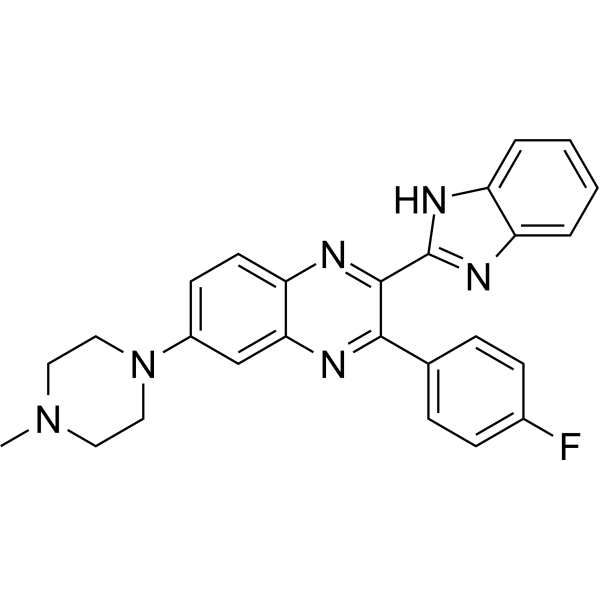
PI3K-IN-48 is a PI3K inhibitor with IC50 value of 1.55 ± 0.18 μM for A549 cells. PI3K-IN-48 can induce G0/G1 phase arrest, cell apoptosis, and down-regulate expression of p-PI3K and p-Akt. PI3K-IN-48 can be used for human lung cancers diseases research .
loading...
    loading...
Cat. No.: HY-N16759
CAS No.: 2122-36-3
Apparicine is a monoterpene indole alkaloid that can be naturally extracted from the stems of Tabernaemontana divaricata. Apparicine shows no cytotoxicity against MCF-7 human breast cancer cells and A-549 human lung cancer cells .
loading...
    loading...
Cat. No.: HY-174271
CAS No.: 2077221-00-0
Target:  

Apoptosis

Research Areas:  

Cancer

Antioxidant agent-21 (Compound 9) is a phenolic heterocyclic compound with antioxidant and anticancer activities. Antioxidant agent-21 shows significant cytotoxicity toward human gastric adenocarcinoma (AGS) and lung cancer (A549) cells. Antioxidant agent-21 induces caspase-dependent apoptosis in cancer cells .
loading...
    loading...
Cat. No.: HY-N13139
Dexylosyltubeimoside Ⅲ (compound 3) is a cyclic disoside that can be isolated from Actinostemma lobatum MAXIM. Dexylosyltubeimoside Ⅲ has in vitro anticancer activity and inhibits the growth of human esophageal cancer cell line ECA109 (IC50=22.37 μM), lung cancer cell line A549 (IC50=27.27 μM) and gastric cancer cell line MGC-803 (IC50=36.85 μM) .
loading...
    loading...
Cat. No.: HY-N16695
CAS No.: 62043-50-9
(2S,3S)-Pterosin S 14-O-glucoside is a sesquiterpene glycoside compound that can be isolated from the fern Pteris multifida. (2S,3S)-Pterosin S 14-O-glucoside showed no significant cytotoxicity against A549 (human lung adenocarcinoma), LOVO (colon adenocarcinoma), PANC-1 (human pancreatic cancer), and NCI-H446 (human small cell lung cancer) cell lines (IC50 > 100 μM) .
loading...
    loading...
  • 1

