
1. Search Result
Search Result
Results for "

disulfide groups

" in MedChemExpress (MCE) Product Catalog:

21

Inhibitors & Agonists

2

Screening Libraries

3

Biochemical Assay Reagents

2

Peptides

3

Click Chemistry

Targets Recommended:
Cat. No. Product Name Target Research Areas Chemical Structure
  • HY-NP008

    Lipocalin Family Inflammation/Immunology
    β-Lactoglobulin, a major whey protein, is a small globular protein from the lipocalin family. β-Lactoglobulin is an important source of the essential and branched-chain amino acids (leucine, isoleucine, and valine). β-Lactoglobulin shows antioxidant properties, because it contains two disulfide bonds and one free thiol group. β-Lactoglobulin is a ligand transport agent. β-Lactoglobulin is one of the major allergens in milk and can be utilized in the research for developing safe hypoallergenic dairy products .
    β-Lactoglobulin
  • HY-100216
    SPDP
    5 Publications Verification

    SPDP Crosslinker; Py-ds-Prp-OSu

    ADC Linker Cancer
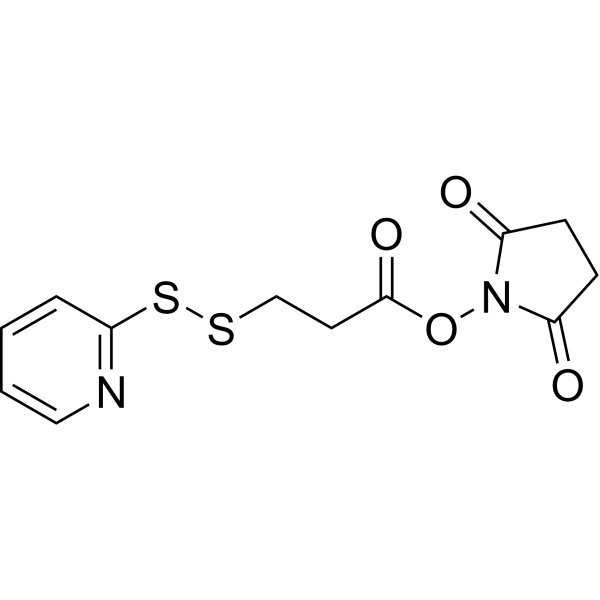
    SPDP (SPDP Crosslinker) is a short-chain crosslinker for amine-to-sulfhydryl conjugation via NHS-ester and pyridyldithiol reactive groups that form cleavable (reducible) disulfide bonds with cysteine sulfhydryls. It is a glutathione cleavable ADC linker used for the antibody-drug conjugates (ADCs) .
    SPDP
  • HY-Y1666

    Biochemical Assay Reagents Others
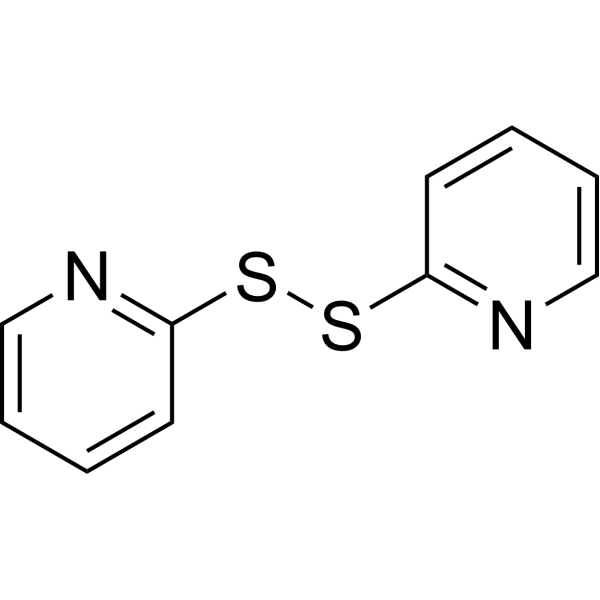
    2,2′-Dipyridyl disulfide is a useful reagent for the determination of sulfhydryl groups. 2,2′-Dipyridyl disulfide is a common reagent in peptide chemistry, often used in oxidation–reduction condensations to form peptide bonds or in coupling reactions to form disulfide-linked heterodimers .
    2,2′-Dipyridyl disulfide
  • HY-15917A
    L-Dithiothreitol
    2 Publications Verification

    Biochemical Assay Reagents Others
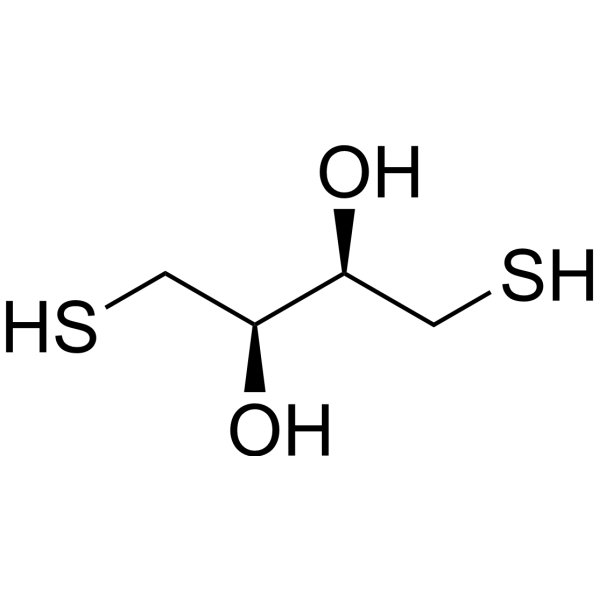
    L-Dithiothreitol (DTT) is a reducing agent commonly used in various biochemical applications to break disulfide bonds in proteins, thereby denaturing proteins or preventing the formation of unwanted aggregates. DTT has a unique chemical property that cleaves the sulfur-sulfur bond in the disulfide bond to form a sulfhydryl group. This makes it a useful tool for protein purification, enzyme assays, and protein structure studies.
    L-Dithiothreitol
  • HY-100433
    PACMA 31
    5 Publications Verification

    PDI Cancer
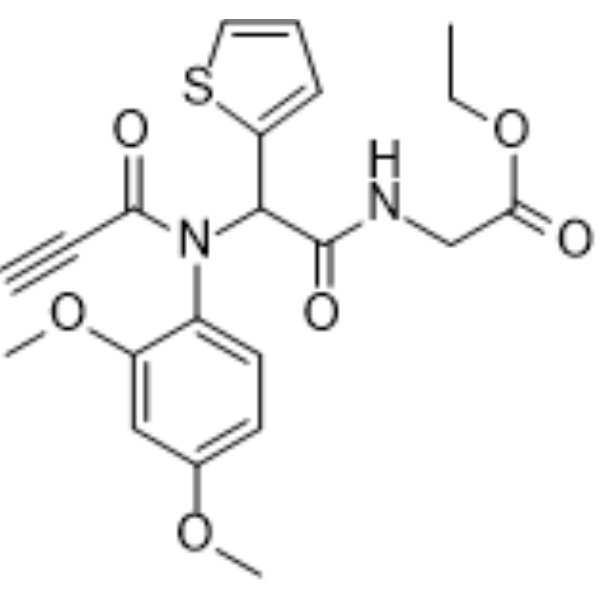
    PACMA 31 is an irreversible, orally active protein disulfide isomerase (PDI) inhibitor with an IC50 of 10 μM. PACMA 31 forms a covalent bond with the active site cysteines of PDI. PACMA 31 shows tumor targeting ability and significantly suppresses ovarian tumor growth without causing toxicity to normal tissues . PACMA 31 is a click chemistry reagent, it contains an Alkyne group and can undergo copper-catalyzed azide-alkyne cycloaddition (CuAAc) with molecules containing Azide groups.
    PACMA 31
  • HY-117570

    PDI Neurological Disease
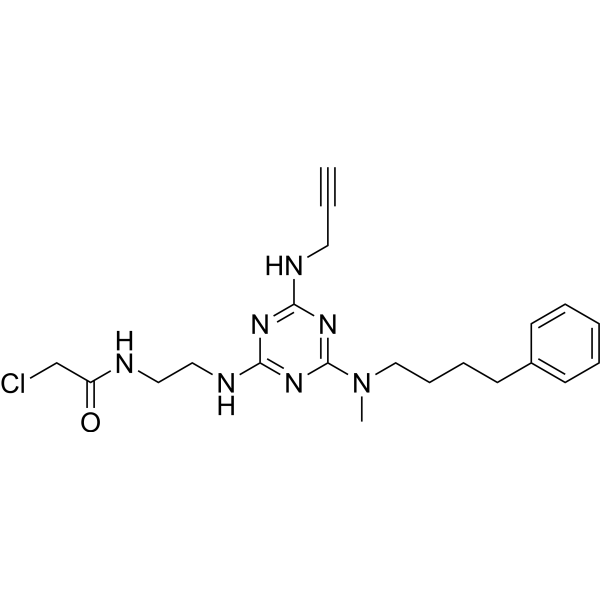
    KSC-34, a covalent modifier of protein disulfide isomerase A1 (PDIA1), is also a selective and potent a-site inhibitor of PDIA1 with an IC50 of 3.5 μM. KSC-34 displays a 30-fold selectivity for a domain over a′ domain and displays high selectivity for PDIA1 in complex proteomes with minimal engagement of other members of the PDI family . KSC-34 is a click chemistry reagent, it contains an Alkyne group and can undergo copper-catalyzed azide-alkyne cycloaddition (CuAAc) with molecules containing Azide groups.
    KSC-34
  • HY-130080

    Maytansinoid DM3

    ADC Payload Microtubule/Tubulin Cancer
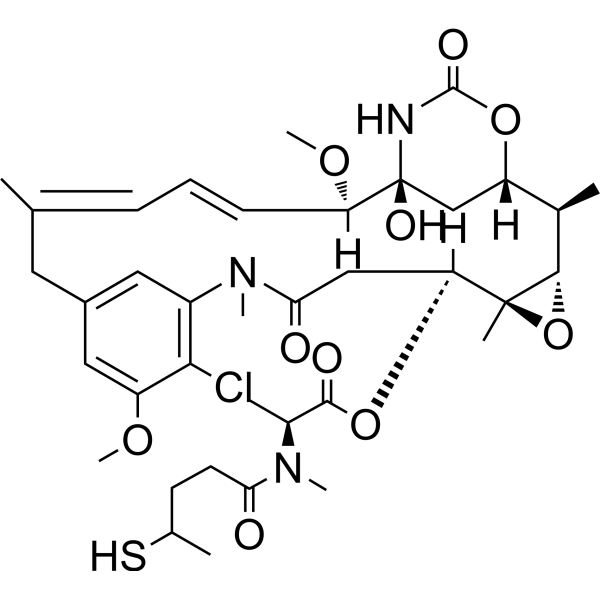
    DM3 (Maytansinoid DM3), a Maytansine (HY-13674) analog bearing disulfide or thiol groups, and is a tubulin inhibitor. DM3 a cytotoxic moiety of antibody-drug conjugates (ADCs) .
    DM3
  • HY-W106411

    Dithio-bis-maleimidoethane

    Biochemical Assay Reagents Others
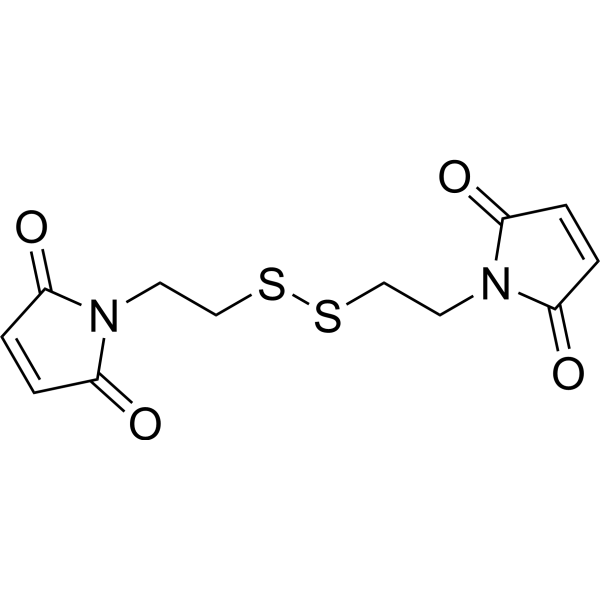
    DTME (dithio-bis-maleimidoethane) is a homobifunctional, maleimide crosslinker specifically designed for conjugation between sulfhydryl groups (-SH). DTME, whose molecular structure consists of two maleimide groups connected by an ethylene disulfide bridge, can specifically react with thiol - containing molecules (such as cysteine residues) to form stable covalent bonds. DTME allows crosslinks that can be cleaved with reducing agents such as DTT (HY-15917). DTME is commonly utilized to explore and characterize protein structure, particularly oligomerization, or protein interactions .
    DTME
  • HY-B0178B

    6M Guanidinium chloride Solution; 6M Aminoformamidine hydrochloride Solution

    Biochemical Assay Reagents Others
    6M Guanidine hydrochloride Solution (6M Guanidinium chloride Solution) is a strong protein denaturant. 6M Guanidine hydrochloride Solution causes proteins to assume a random coil conformation .
    6M Guanidine hydrochloride Solution
  • HY-W014316

    Bacterial Fungal Infection
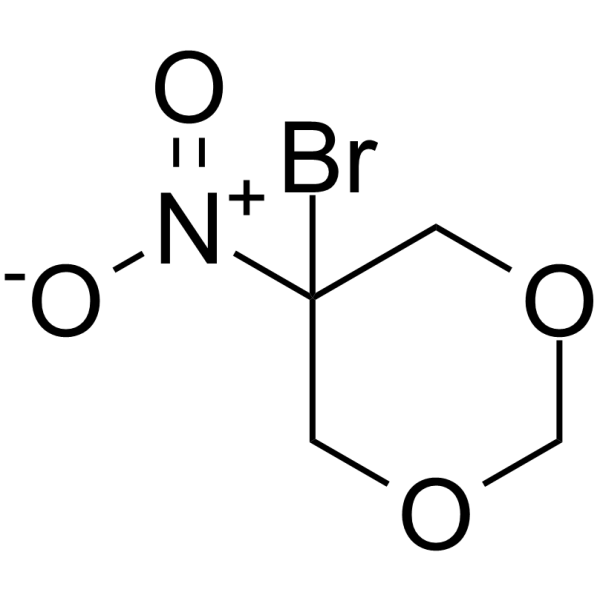
    5-Bromo-5-nitro-1,3-dioxane is a broad-spectrum antimicrobial agent active against Gram-positive bacteria, Gram-negative bacteria and fungi. 5-Bromo-5-nitro-1,3-dioxane oxidizes free thiol groups to their corresponding disulfides. 5-Bromo-5-nitro-1,3-dioxane induces intracellular substance leakage in Escherichia coli and Staphylococcus aureus. 5-Bromo-5-nitro-1,3-dioxane modulates the oxygen consumption of Escherichia coli and Staphylococcus aureus .
    5-Bromo-5-nitro-1,3-dioxane
  • HY-P4087

    HIV Infection Cancer
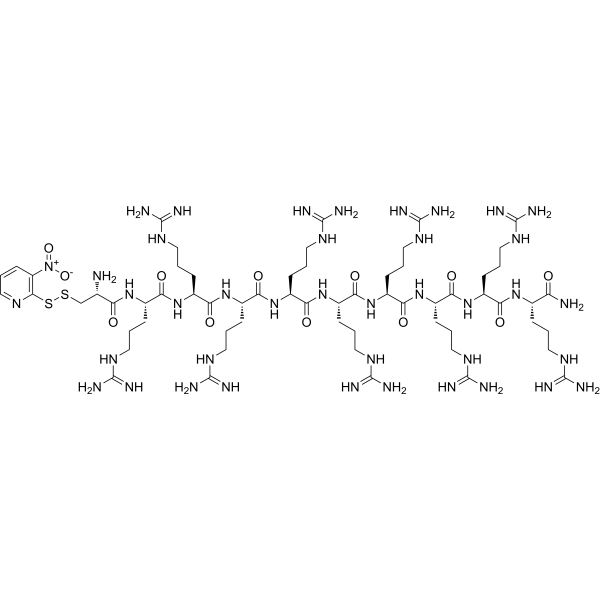
    Cys(Npys)-(Arg)9 is a synthetic cationic cell-penetrating peptide with a reversible thiol-reactive nitropyridyl (Npys) group. Cys(Npys)-(Arg)9 efficiently mediates the internalization and delivery of various "cargo" such as proteins and antibodies by forming reversible disulfide bonds with surface-exposed cysteine residues. Cys(Npys)-(Arg)9 endows TALEN proteins with cell-penetrating activity, enabling gene knockout in mammalian cells and protein transduction in wheat microspores. Cys(Npys)-(Arg)9 can be conjugated with antibodies to form cationized IgG for enhancing endosomal escape of oligonucleotides, or form siRNA delivery complexes. When the molar ratio of Cys(Npys)-(Arg)9 to loaded molecules is higher than 1:1, it exerts certain cytotoxic effects on cells. Cys(Npys)-(Arg)9 can be used in studies related to oral squamous cell carcinoma and HIV infection .
    Cys(Npys)-(Arg)9
  • HY-129654

    Sodium (2-Sulfonatoethyl)methanethiosulfonate

    Biochemical Assay Reagents Others
    MTSES sodium (Sodium (2-Sulfonatoethyl)methanethiosulfonate) is a negatively charged, membrane-impermeable methanethiosulfonate (MTS). MTS is a compound that reacts with sulfhydryl groups to form mixed disulfide bonds and is often used to study cysteine ??residues on proteins.
    MTSES sodium
  • HY-P4087B

    HIV Others
    Cys(Npys)-(Arg)9 acetate is a synthetic cationic cell-penetrating peptide with a reversible thiol-reactive nitropyridyl (Npys) group. Cys(Npys)-(Arg)9 acetate efficiently mediates the internalization and delivery of various "cargo" such as proteins and antibodies by forming reversible disulfide bonds with surface-exposed cysteine residues. Cys(Npys)-(Arg)9 acetate endows TALEN proteins with cell-penetrating activity, enabling gene knockout in mammalian cells and protein transduction in wheat microspores. Cys(Npys)-(Arg)9 acetate can be conjugated with antibodies to form cationized IgG for enhancing endosomal escape of oligonucleotides, or form siRNA delivery complexes. When the molar ratio of Cys(Npys)-(Arg)9 acetate to loaded molecules is higher than 1:1, it exerts certain cytotoxic effects on cells. Cys(Npys)-(Arg)9 acetate can be used in studies related to oral squamous cell carcinoma and HIV infection .
    Cys(Npys)-(Arg)9 acetate
  • HY-W800651

    Biochemical Assay Reagents Others
    Biotin-SS-Amine hydrochloride is a cleavable biotinylation reagent. The amine group can react with carboxylic acids, activated NHS esters and other carbonyl groups. The disulfide bond in this linker can be cleaved using reducing agents such as DTT, BME and TCEP.
    Biotin-SS-Amine hydrochloride
  • HY-W190951

    Biochemical Assay Reagents Others
    3-((2-(2,2,2-Trifluoroacetamido)ethyl)disulfanyl)propanoic acid is a cleavable linker containing a carboxylic acid. The terminal carboxylic acid can be reacted with primary amine groups in the presence of activators (e.g. EDC, or HATU) to form a stable amide bond. The disulfide bond can be cleaved via reduction reactions.
    3-((2-(2,2,2-Trifluoroacetamido)ethyl)disulfanyl)propanoic acid
  • HY-W014316R

    Reference Standards Bacterial Fungal Infection
    5-Bromo-5-nitro-1,3-dioxane (Standard) is the analytical standard of 5-Bromo-5-nitro-1,3-dioxane (HY-W014316). This product is intended for research and analytical applications. 5-Bromo-5-nitro-1,3-dioxane is a broad-spectrum antimicrobial agent active against Gram-positive bacteria, Gram-negative bacteria and fungi. 5-Bromo-5-nitro-1,3-dioxane oxidizes free thiol groups to their corresponding disulfides. 5-Bromo-5-nitro-1,3-dioxane induces intracellular substance leakage in Escherichia coli and Staphylococcus aureus. 5-Bromo-5-nitro-1,3-dioxane modulates the oxygen consumption of Escherichia coli and Staphylococcus aureus .
    5-Bromo-5-nitro-1,3-dioxane (Standard)
  • HY-W591325

    Biochemical Assay Reagents Others
    4-((5-Nitropyridin-2-yl)disulfanyl)pentanoic acid is a synthetic building block with terminal nitro and carboxylic acid groups with a disulfide bond in the center.
    4-((5-Nitropyridin-2-yl)disulfanyl)pentanoic acid
  • HY-W591360

    Biochemical Assay Reagents Others
    Iodoacetamido-PEG6-azide is an aqueous soluble PEG linker containing an azide and a terminal Iodoacetamido group. The azide group can react with alkyne, BCN, DBCO via Click Chemistry to yield a stable triazole linkage. The Iodoacetamido moiety is commonly used to bind covalently with the thiol group of cysteine so the protein cannot form disulfide bonds.
    Iodoacetamido-PEG6-azide
  • HY-W015811

    PDI Metabolic Disease Inflammation/Immunology Cancer
    3-N-Propylphenol is a small phenolic derivative containing a hydroxyl aryl group that competitively inhibits the binding of the peptide to pancreatic-specific protein disulfide isomerase (PDIp). 3-Propylphenol can be used for research on pancreatic-related diseases .
    3-N-Propylphenol
  • HY-100216R

    SPDP Crosslinker (Standard); Py-ds-Prp-OSu (Standard)

    ADC Linker Reference Standards Cancer
    SPDP (Standard) is the analytical standard of SPDP (HY-100216). This product is intended for research and analytical applications. SPDP (SPDP Crosslinker) is a short-chain crosslinker for amine-to-sulfhydryl conjugation via NHS-ester and pyridyldithiol reactive groups that form cleavable (reducible) disulfide bonds with cysteine sulfhydryls. It is a glutathione cleavable ADC linker used for the antibody-drug conjugates (ADCs) .
    SPDP (Standard)
  • HY-100433R

    PDI Reference Standards Cancer
    PACMA 31 (Standard) is the analytical standard of PACMA 31 (HY-100433). This product is intended for research and analytical applications. PACMA 31 is an irreversible, orally active protein disulfide isomerase (PDI) inhibitor with an IC50 of 10 μM. PACMA 31 forms a covalent bond with the active site cysteines of PDI. PACMA 31 shows tumor targeting ability and significantly suppresses ovarian tumor growth without causing toxicity to normal tissues . PACMA 31 is a click chemistry reagent, it contains an Alkyne group and can undergo copper-catalyzed azide-alkyne cycloaddition (CuAAc) with molecules containing Azide groups.
    PACMA 31 (Standard)

Inquiry Online

Your information is safe with us. * Required Fields.

Salutation


Country or Region *

Applicant Name *


Organization Name *

Department *


Email Address *


Product Name *

Cat. No.


Requested quantity *

Phone Number *


Remarks

Inquiry Online

Inquiry Information

Product Name:
Cat. No.:
Quantity:
MCE Japan Authorized Agent:

