
18 Results for "

super-resolution imaging

" in MedChemExpress (MCE) Product Catalog:
Products (18)

18 Results for "super-resolution imaging" in MCE Product Catalog:

1
1 Cited Publications
Cat. No.: HY-133535
CAS No.: 2093120-32-0
Synonyms: PA-JF646-NHS
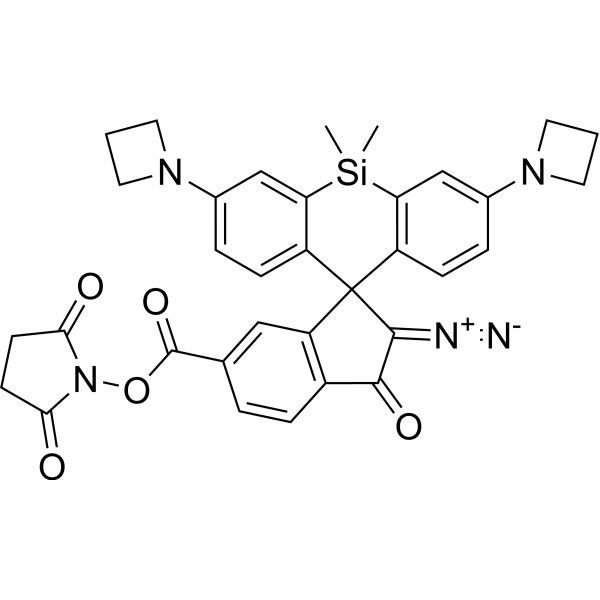
PA Janelia Fluor 646, SE (PA-JF646-NHS) is a photo-activatable fluorescent dye. PA Janelia Fluor 646, SE is a far-red light-excited, 405 nm-activated NHS ester-based dye. Janelia Fluor fluorescent dyes can be chemically conjugated to the specific HaloTag substrate (a chloroalkane ligand) to form a fluorescent ligand, rather than binding directly to the HaloTag protein itself. PA Janelia Fluor 646, SE can achieve extremely low background and single-molecule-level ultra-high-resolution imaging through photo-controlled switching, making it a powerful tool for live cell super-resolution microscopy technology (Ex/Em = 646/664 nm).
loading...
    loading...
Cat. No.: HY-D2348A
ACE TFA is a low-background, photostable fluorophore with nanomolar binding affinity for the Okra RNA aptamer. ACE TFA enables clear visualization of mRNA in live bacteria and mammalian cells, including tracking the trafficking of mRNA to stress granules and dual-color super-resolution imaging of RNA in live cells. (Ex=488 nm, Em=555 nm) .
loading...
    loading...
Cat. No.: HY-D2348
CAS No.: 3058751-62-2
ACE is a low-background, photostable fluorophore with nanomolar binding affinity for the Okra RNA aptamer. ACE enables clear visualization of mRNA in live bacteria and mammalian cells, including tracking the trafficking of mRNA to stress granules and dual-color super-resolution imaging of RNA in live cells. (Ex=488 nm, Em=555 nm) .
loading...
    loading...
Cat. No.: HY-W784030
CAS No.: 1380349-88-1
Research Areas:  

Others

N-TCO-L-lysine is a non-canonical amino acid. N-TCO-L-lysine contains a trans-cyclooctene (TCO) bioorthogonal reactive linker. N-TCO-L-lysine undergoes a bioorthogonal click reaction with SiR-Tz to enable fluorescent labeling of endogenously expressed proteins with site-specific incorporation. When used in combination with SiR-Tz, N-TCO-L-lysine allows super-resolution and live-cell imaging of endogenous proteins .
loading...
    loading...
Cat. No.: HY-W400925
CAS No.: 1481447-40-8
Target:  

Fluorescent Dye

Research Areas:  

Cancer

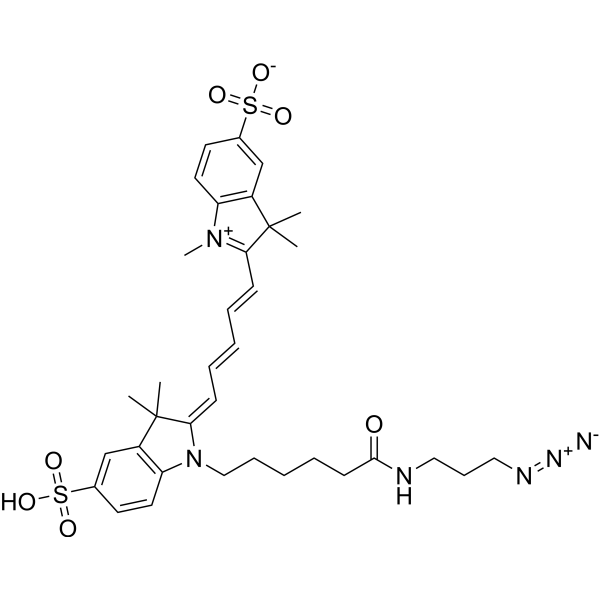
Sulfo-Cy5-N3 is an azide-functionalized sulfonated cyanine 5 Fluorescent dye and also serves as click chemistry coupling reagent. Sulfo-Cy5-N3 undergoes copper (I)-catalyzed azide-alkyne cycloaddition with alkyne-functionalized antibody constructs and peptide probes for site-selective fluorescent labeling. Sulfo-Cy5-N3 also acts as an emission dye for STORM super-resolution imaging. Sulfo-Cy5-N3 is applicable to the study of HER2-positive breast cancer .
loading...
    loading...
Cat. No.: HY-D2417
CAS No.: 2365417-91-8
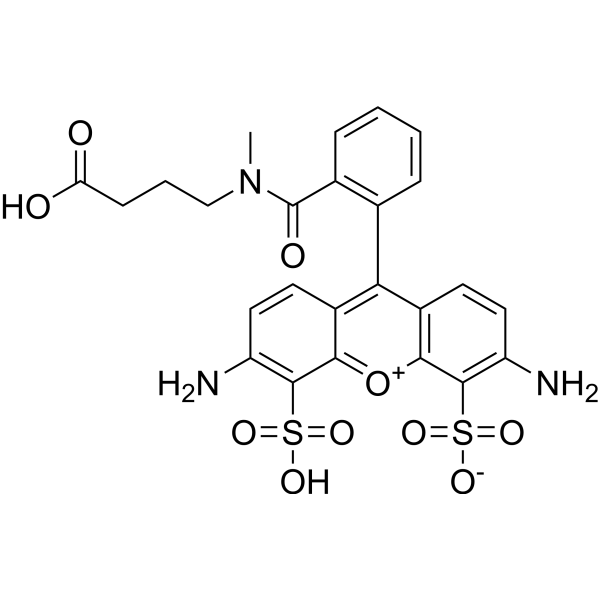
SiRA 2 is a fluorescent inducer with a Kd value of 430 nM for binding to the SiRA RNA aptamer. When used in combination with the SiRA aptamer, SiRA 2 enables live-cell RNA imaging of aptamer-labeled mRNA as well as stimulated emission depletion super-resolution microscopy imaging. SiRA 2 has high photostability and forms a bright far-red light-up aptamer system upon binding to SiRA .
loading...
    loading...
Cat. No.: HY-D1305
CAS No.: 1443553-08-9
Target:  

Fluorescent Dye

Research Areas:  

Others

ATTO 488 carboxylic acid is a bright green fluorescent dye with high photostability, which is commonly used in protein fluorescent labeling, single-molecule fluorescence imaging and super-resolution microscopy studies. The carboxylic acid form of ATTO 488 can be covalently coupled to primary amines of proteins via activation, or prepared into a maleimide derivative for coupling with thiol groups; it emits green fluorescence after labeling. Ex/Em = 488/524 nm .
loading...
    loading...
Cat. No.: HY-D2002
CAS No.: 1219127-42-0
ATTO 488 maleimide is a thiol-reactive fluorescent labeling reagent that forms a covalent bond via its maleimide group with the thiol group of the C-terminal cysteine residue of α-synGC. ATTO 488 maleimide enables α-syn fiber imaging via super-resolution stimulated emission depletion (STED) fluorescence microscopy. ATTO 488 maleimide is applicable to research related to Parkinson's disease (Ex/Em = 488/592nm) .
loading...
    loading...
Cat. No.: HY-D2923
CAS No.: 1811539-43-1
PA-JF549-Halo ligand is a covalently linked conjugate comprising the photoactivatable fluorescent dye PA-JF549 and a ligand for the HaloTag protein. PA-JF549-Halo ligand exhibts inherent structural properties and predispose it to localize within mitochondria. PA-JF549-Halo ligand combines the exceptional brightness, photostability, and cell permeability of the JF549 dye with photoactivation capabilities and the high specificity characteristic of HaloTag protein labeling technology. PA-JF549-Halo ligand enables high-quality single-molecule imaging and super-resolution imaging of specific proteins within live cells .
loading...
    loading...
Cat. No.: HY-D2183
CAS No.: 1811539-31-7
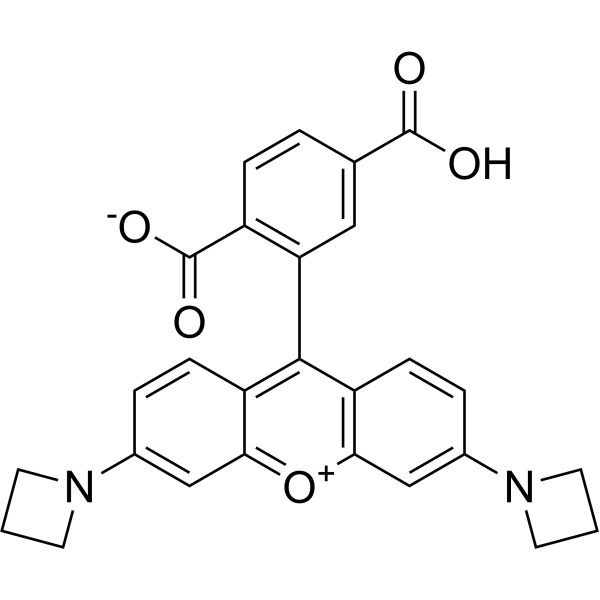
6-Carboxy-JF5252 is a fluorophore. 6-Carboxy-JF5252 can be used as probes, dyes, tags. 6-Carboxy-JF5252 can be used for the research of super-resolution imaging .
loading...
    loading...
Cat. No.: HY-D2953
Synonyms: CLIP-CPY
BC-CPY is a CLIP-tagged probe based on the pyridine-benzoanthrone (CPY) fluorophore (Ex/Em: 580 nm/610 nm). BC-CPY has excellent cell membrane permeability, enabling deep imaging, low phototoxicity and high signal-to-noise ratio. BC-CPY can be used for super-resolution microscopy imaging of living cells .
loading...
    loading...
Cat. No.: HY-D2954
CAS No.: 1108751-16-1
Synonyms: CLIP-PEG-NH2
BC-PEG-NH2 (CLIP-PEG-NH2) is a chemical building block specifically designed for the CLIP-tag system, featuring enhanced water solubility and reactivity. BC-PEG-NH2 can be used for the synthesis of super-resolution imaging probes .
loading...
    loading...
Cat. No.: HY-D3366
Target:  

Fluorescent Dye

Research Areas:  

Others

Th-TMR-S-Halo is a fluorescent probe for HaloTag labeling and live-cell imaging, including super-resolution imaging and real-time visualization of endoplasmic reticulum (ER) vortex formation under ER stress conditions. Th-TMR-S-Halo shows weak fluorescence in the free state, and upon covalent binding to HaloTag, fluorescence activation is achieved by restricting the rotation of the thiophene ring. Th-TMR-S-Halo can be used in studies related to intracellular protein localization, cytoskeleton structure, and ER vortex formation. Live-cell NSPARC super-resolution detection is performed using Ex/Em = 561/570-616 nm .
loading...
    loading...
Cat. No.: HY-D3570
Target:  

Fluorescent Dye

Research Areas:  

Others

AF405 DBCO is a blue fluorescent dye derivative containing a dibenzocyclooctyne (DBCO) group. AF405 DBCO reacts rapidly with azide-labeled biomolecules at room temperature without the need for a metal catalyst, enabling copper-free click chemistry (SPAAC) for applications in live-cell imaging, flow cytometry, super-resolution microscopy, and other research fields .
loading...
    loading...
Cat. No.: HY-D3438
Target:  

Fluorescent Dye

Research Areas:  

Others

Photoswitchable PM8 is a fluorescent probe used for super-resolution imaging of the plasma membrane. Photoswitchable PM8 functions through a light-induced Z/E isomerization mechanism: in the hydrophobic cell membrane environment, the Z isomer forms a planar intramolecular charge transfer state stabilized by an intramolecular hydrogen bond, which restricts conformational freedom, reduces nonradiative decay, and produces bright fluorescence; in contrast, the E isomer lacks this hydrogen bond, has increased conformational freedom, and exhibits a fluorescence-quenched state. The fluorescence of Photoswitchable PM8 can be switched "on/off" by visible light: activation with 405 nm light forms the fluorescent Z isomer, and switching with 561 nm light converts it to the nonfluorescent E isomer. In the membrane environment, Photoswitchable PM8 enables single-molecule localization for super-resolution imaging. Due to solvent-induced quenching and aggregation, Photoswitchable PM8 has negligible fluorescence in aqueous solution, but upon binding to the hydrophobic membrane environment it produces bright fluorescence, enabling high signal-to-noise ratio imaging without washing .
loading...
    loading...
Cat. No.: HY-D3240
CAS No.: 2375541-43-6
Photoactive NTR probe (Compound 1) is a covalent crosslinker and Fluorescent indicator targeting Nitroreductase. The Photoactive NTR probe undergoes a sequential activation process: it is first activated via nitroreductase-mediated nitro-to-amino conversion, and then forms a fluorescent product upon photoactivation. The Photoactive NTR probe can form covalent adducts with the side chains of cysteine, tyrosine, lysine and histidine in adjacent proteins to reduce fluorophore diffusion. The Photoactive NTR probe enables super-resolution (STORM) imaging of active mitochondrial nitroreductase microdomains in living cells .
loading...
    loading...
Cat. No.: HY-D3437
Target:  

Fluorescent Dye

Research Areas:  

Others

LRhod-PM is a photo-activated plasma membrane fluorescent probe based on a self-initiating photo-oxidation cascade mechanism. LRhod-PM, a non-fluorescent reduced rhodamine, is oxidized to the fluorescent form Rhod-PM upon visible light irradiation. LRhod-PM has maximum excitation and emission wavelengths of 560 nm and 585 nm, respectively. LRhod-PM enables wash-free labeling of the plasma membrane of living cells, including fine structures such as filopodia and tunneling nanotubes. LRhod-PM can be used in studies related to single-molecule localization super-resolution imaging of living cells .
loading...
    loading...
Cat. No.: HY-D3148
CAS No.: 1804107-88-7
Target:  

Fluorescent Dye

Research Areas:  

Others

TPE-Ph-In is a mitochondria-targeted voltage-sensitive probe that can be used for mitochondrial membrane potential detection, mitochondrial imaging of animal and plant cells and tissues, mouse sperm activity indication, and detection of mitochondrial membrane potential changes associated with early apoptosis. TPE-Ph-In is non-fluorescent in solution, but emits strong fluorescence when aggregated via restriction of intramolecular rotation/movement, and its fluorescence intensity is directly correlated with local probe concentration or mitochondrial membrane potential level. TPE-Ph-In can penetrate cell membranes, target mitochondria through charge-dependent accumulation, has low cytotoxicity and high photostability, and enables super-resolution imaging of plant mitochondrial fission, fusion and cristae structures. The excitation wavelengths of TPE-Ph-In include 450 nm, 488 nm, and 489 nm, while its emission wavelengths include 551-661 nm, 660 nm, and 694 nm. TPE-Ph-In can be used for studies on mitochondrial dysfunction associated with early apoptosis .
loading...
    loading...
  • 1

