



Taurolidine

Based on 1 Customer Validation
Taurolidine is a potent antimicrobial and anticancer agent. Taurolidine inhibits cell proliferation. Taurolidine induces apoptosis and autophagy. Taurolidine rescues mice from sepsis-associated lethality.
For research use only. We do not sell to patients.
- Purity : 98.13%
- CAS No.: 19388-87-5
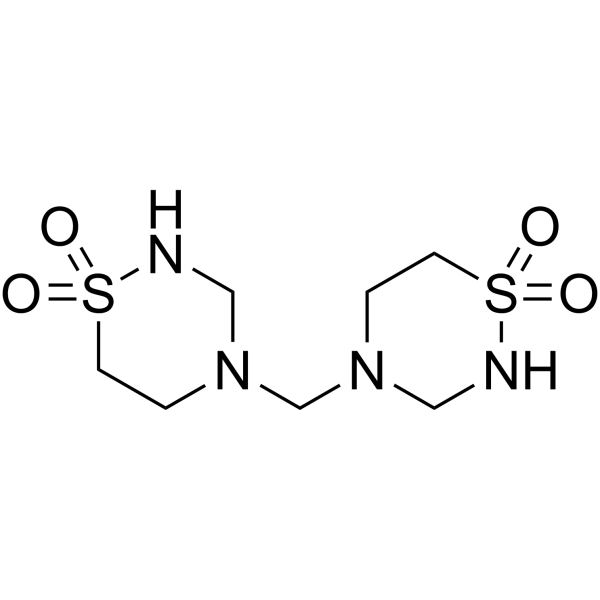
- Formula: C7H16N4O4S2
- Molecular Weight:284.36
-
Storage:Powder -20°C, 3 years , 4°C, 2 years ; In solvent -80°C, 2 years , -20°C, 1 year

To place orders, for customer services and technical support, please contact: MedChemExpress USA
Tel: 609-228-6898 E-mail: [email protected] [email protected]


-
 Biological Activity
-
Chemical Information
-
Solvent & Solubility
- Protocols
- Purity & Documentation
- References
-
 Help & FAQs


-

HY-W011522R
Taurolidine (Standard)Antimicrobial Agent -
HY-B1078
Cefazolin sodiumCephalosporin Antibiotic -
HY-15287A
Nelfinavir MesylateHIV-1 Protease Inhibitor -
HY-B1484
Moxalactam sodium saltAntibacterial Agent -
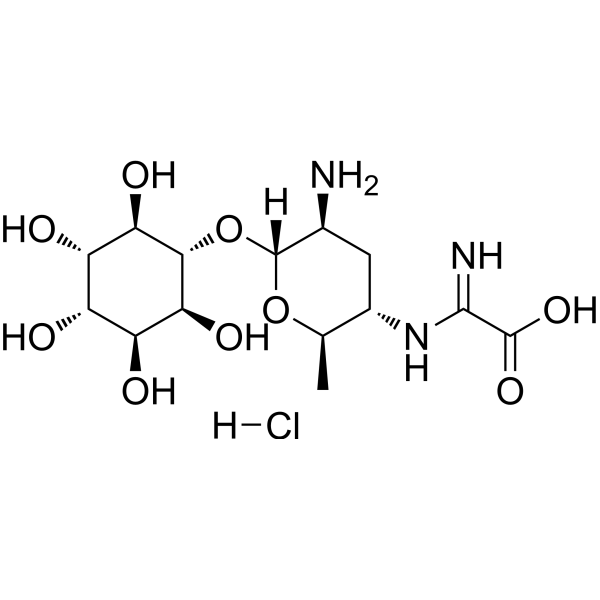
HY-B1864A
Kasugamycin hydrochlorideAntibiotic -
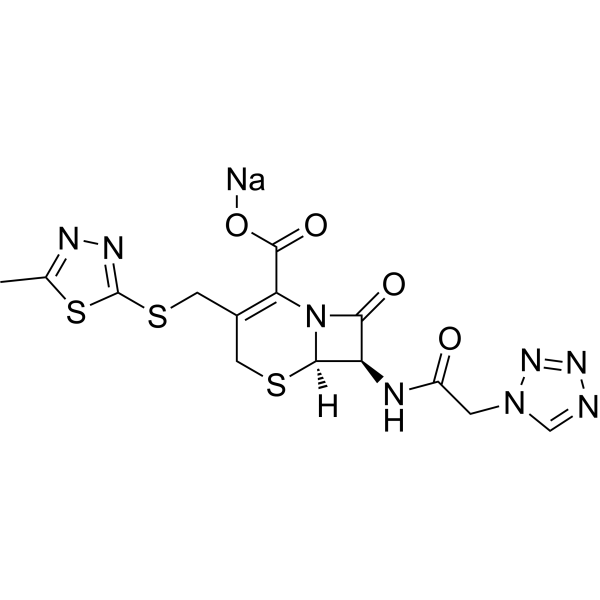
HY-B1078R
Cefazolin sodium (Standard)Cephalosporin Antibiotic -

HY-15287AR
Nelfinavir Mesylate (Standard)HIV-1 Protease Inhibitor -

HY-B1864AR
Kasugamycin hydrochloride (Standard)Reference Standard
All Antibiotic Isoforms
More

Biological Activity
Description
In Vitro
Taurolidine (0-500 μM; 24 h) inhibits cell proliferation with IC50s of 150, 55, 23, 119 μM for Saos-2, D17, Hmpos, Cos cells, respectively[1].
Taurolidine (125, 250 µM; 12, 24 h) induces apoptosis[1].
MedChemExpress (MCE) has not independently confirmed the accuracy of these methods. They are for reference only.
-
Cell Line:Saos-2, D17, Hmpos, Cos cells
-
Concentration:0-500 μM
-
Incubation Time:24 h
-
Result:Inhibited cell proliferation with IC50s of 150, 55, 23, 119 μM for Saos-2, D17, Hmpos, Cos cells, respectively.
-
Cell Line:D17 cells
-
Concentration:125, 250 µM
-
Incubation Time:12, 24 h
-
Result:Induced cell apoptosis.
In Vivo
MedChemExpress (MCE) has not independently confirmed the accuracy of these methods. They are for reference only.
-
Animal Model:C57BL/6 and LC3b−/− mice (CLP-induced polymicrobial sepsis)[2]
-
Dosage:125 mg/kg
-
Administration:IP; 6 h before CLP or at 6 or 12 h after CLP
-
Result:Significantly improved mouse survival administered at 6 h before CLP and 6 h after CLP, 6 h before CLP significantly diminished bacterial counts in the circulation and visceral organs including the liver, spleen, and lungs at 12 and 24 h post-CLP.
- Research Protocol for Infectious Diseases
- Annexin V plus membrane-impermeant dye apoptosis staining
- BrdU Incorporation Assay
- Somatic Cell Culture
- CFSE Dye Dilution Proliferation Assay
- Dye-dilution cell tracking and proliferation staining
- CCK-8/WST-8 Cell Proliferation Assay
- Protocol for Cell Cycle
- Cell Counting-Based Growth Curve Assay
- Colony Formation (Clonogenic) Assay
- Cell Viability Determination by MTT Colorimetric Assay
- EdU Incorporation Assay (Click Chemistry-Based DNA Synthesis Measurement)
- Ki-67 Immunostaining Proliferation Assay
- Detection of Apoptosis
- TUNEL staining for apoptotic DNA fragmentation
- PCNA Immunodetection Proliferation Assay
- LPS-Induced Endotoxemia/Systemic Inflammation
- Protocol for Cell Counting and Cell Density Analysis
- Autophagy
- Apoptosis Solutions
- Lysosome and acidic-vesicle live-cell staining
- MTT Cell Proliferation Assay
- Macroautophagy Solutions
Clinical Trial
| NCT Number | Sponsor | Condition | Start Date |
Phase

|
|---|---|---|---|---|
| NCT01329991 | 2011-05 | PHASE1 |


Chemical Information
-
CAS No. 19388-87-5
-
Appearance Solid
-
Molecular Weight 284.36
-
Formula C7H16N4O4S2
-
Color White to off-white
-
SMILES
O=S1(NCN(CN(CC2)CNS2(=O)=O)CC1)=O
-
Shipping
Room temperature in continental US; may vary elsewhere.
-
Storage
Powder -20°C 3 years 4°C 2 years In solvent -80°C 2 years -20°C 1 year


Solvent & Solubility
In Vitro:
DMSO : 62.5 mg/mL (219.79 mM; Need ultrasonic; Hygroscopic DMSO has a significant impact on the solubility of product, please use newly opened DMSO)
Please refer to the solubility information to select the appropriate solvent. Once prepared, please aliquot and store the solution to prevent product inactivation from repeated freeze-thaw cycles.
Storage method and period of stock solution: -80°C, 2 years; -20°C, 1 year. When stored at -80°C, please use it within 2 years. When stored at -20°C, please use it within 1 year.
Please refer to the solubility information to select the appropriate solvent. Once prepared, please aliquot and store the solution to prevent product inactivation from repeated freeze-thaw cycles.
Storage method and period of stock solution: -80°C, 2 years; -20°C, 1 year. When stored at -80°C, please use it within 2 years. When stored at -20°C, please use it within 1 year.
Concentration (start) × Volume (start) = Concentration (final) × Volume (final)
In Vivo:
Select the appropriate dissolution method based on your experimental animal and administration route.
- For the following dissolution methods, please ensure to first prepare a clear stock solution using an In Vitro approach and then sequentially add co-solvents:
- To ensure reliable experimental results, the clarified stock solution can be appropriately stored based on storage conditions. As for the working solution for In Vivo experiments, it is recommended to prepare freshly and use it on the same day.
- The percentages shown for the solvents indicate their volumetric ratio in the final prepared solution. If precipitation or phase separation occurs during preparation, heat and/or sonication can be used to aid dissolution.
Add each solvent one by one: 10% DMSO 40% PEG300 5% Tween-80 45% Saline
Solubility: ≥ 2.08 mg/mL (7.31 mM); Clear solution
This protocol yields a clear solution of ≥ 2.08 mg/mL (saturation unknown).
Taking 1 mL working solution as an example, add 100 μL DMSO stock solution (20.8 mg/mL) to 400 μL PEG300, and mix evenly; then add 50 μL Tween-80 and mix evenly; then add 450 μL Saline to adjust the volume to 1 mL.
Preparation of Saline: Dissolve 0.9 g sodium chloride in ddH₂O and dilute to 100 mL to obtain a clear Saline solution.
Add each solvent one by one: 10% DMSO 90% (20% SBE-β-CD in Saline)
Solubility: ≥ 2.08 mg/mL (7.31 mM); Clear solution
This protocol yields a clear solution of ≥ 2.08 mg/mL (saturation unknown).
Taking 1 mL working solution as an example, add 100 μL DMSO stock solution (20.8 mg/mL) to 900 μL 20% SBE-β-CD in Saline, and mix evenly.
Preparation of 20% SBE-β-CD in Saline (4°C, storage for one week): 2 g SBE-β-CD powder is dissolved in 10 mL Saline, completely dissolve until clear.
In Vivo Dissolution Calculator
Please enter the basic information of animal experiments:
-
-
-
-
Recommended: Prepare an additional quantity of animals to account for potential losses during experiments.
Please enter your animal formula composition:
-
%DMSO +
Recommended: Keep the proportion of DMSO in working solution below 2% if your animal is weak.
-
%+
-
+%Tween-80 + +
-
%Saline +
The co-solvents required include: DMSO, . All of co-solvents are available by MedChemExpress (MCE). , Tween 80. All of co-solvents are available by MedChemExpress (MCE).
Working solution concentration: 0.22 mg/mL
Method for preparing stock solution: mg drug dissolved in μL DMSO. Stock solution concentration: mg/mL.
1. Take μL DMSO stock solution;
2. Add μL .
μL , mix evenly;
3. Then add μL Tween 80, mix evenly;
4. Then add μL
Please ensure that the stock solution in the first step is dissolved to a clear state, and add co-solvents in sequence. You can use ultrasonic heating (ultrasonic cleaner, recommended frequency 20-40 kHz), vortexing, etc. to assist dissolution.


Purity & Documentation
-
Data Sheet (274 KB)
-
SDS (393 KB)
- English - EN (393 KB)
- Français - FR (393 KB)
- Deutsch - DE (393 KB)
- Norwegian - NO (393 KB)
- Español - ES (393 KB)
- Swedish - SV (393 KB)
- Italian - IT (393 KB)
- Korean - KR (393 KB)
- Portuguese - PT (393 KB)
-
Handling Instructions (2659 KB)
References
[1]. Marley K, et al. The effects of taurolidine alone and in combination with doxorubicin or carboplatin in canine osteosarcoma in vitro. BMC Vet Res. 2013 Jan 18;9:15. doi: 10.1186/1746-6148-9-15. [Content Brief]
[2]. Huang J, et al. Autophagy induced by taurolidine protects against polymicrobial sepsis by promoting both host resistance and disease tolerance. Proc Natl Acad Sci U S A. 2022 May 10;119(19):e2121244119. [Content Brief]


Complete Stock Solution Preparation Table
Please refer to the solubility information to select the appropriate solvent. Once prepared, please aliquot and store the solution to prevent product inactivation from repeated freeze-thaw cycles.
Storage method and period of stock solution: -80°C, 2 years; -20°C, 1 year. When stored at -80°C, please use it within 2 years. When stored at -20°C, please use it within 1 year.
| Optional Solvent | Concentration Solvent Mass | 1 mg | 5 mg | 10 mg | 25 mg |
|---|---|---|---|---|---|
| DMSO | 1 mM | 3.5166 mL | 17.5832 mL | 35.1663 mL | 87.9158 mL |
| 5 mM | 0.7033 mL | 3.5166 mL | 7.0333 mL | 17.5832 mL | |
| 10 mM | 0.3517 mL | 1.7583 mL | 3.5166 mL | 8.7916 mL | |
| 15 mM | 0.2344 mL | 1.1722 mL | 2.3444 mL | 5.8611 mL | |
| 20 mM | 0.1758 mL | 0.8792 mL | 1.7583 mL | 4.3958 mL | |
| 25 mM | 0.1407 mL | 0.7033 mL | 1.4067 mL | 3.5166 mL | |
| 30 mM | 0.1172 mL | 0.5861 mL | 1.1722 mL | 2.9305 mL | |
| 40 mM | 0.0879 mL | 0.4396 mL | 0.8792 mL | 2.1979 mL | |
| 50 mM | 0.0703 mL | 0.3517 mL | 0.7033 mL | 1.7583 mL | |
| 60 mM | 0.0586 mL | 0.2931 mL | 0.5861 mL | 1.4653 mL | |
| 80 mM | 0.0440 mL | 0.2198 mL | 0.4396 mL | 1.0989 mL | |
| 100 mM | 0.0352 mL | 0.1758 mL | 0.3517 mL | 0.8792 mL |


Taurolidine Related Classifications
HY-W011522 Related Classifications
 Powered by Bioz