



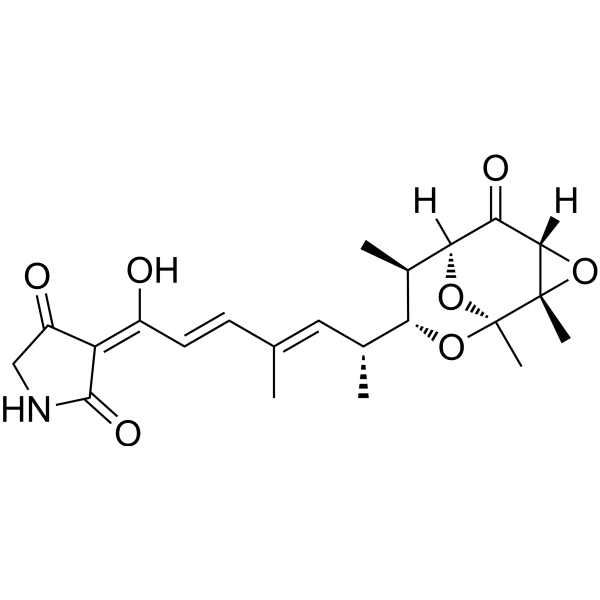
Tirandamycin A
Tirandamycin A, an antibiotic, is a bacterial RNA polymerase inhibitor. Tirandamycin A has antiamoebic and antibacterial properties.
Nos produits utilisent uniquement pour la recherche. Nous ne vendons pas aux patients.
- CAS No.: 34429-70-4
- Formule: C22H27NO7
- Masse moléculaire:417.45
-
Stockage:
Please store the product under the recommended conditions in the Certificate of Analysis.

To place orders, for customer services and technical support, please contact: MedChemExpress USA
Tel: 609-228-6898 E-mail: [email protected] [email protected]


-
 Activité biologique
-
Chemical Information
- Protocole
- Pureté et documentation
- Références
-
 Help & FAQs


Voir tous les produits spécifiques à Isoform DNA/RNA Synthesis
MoreVoir tous les produits spécifiques à Isoform Parasite
MoreVoir tous les produits spécifiques à Isoform Antibiotic
More

Activité biologique
Description
IC50 & Target
|
RNA Polymerase |
Amebae |
In Vitro
A 60 μM treatment with Tirandamycin A results in a slightly stronger inhibition, demonstrating a 84.2% reduction in growth of Entamoeba histolytica HM-1:IMSS and 64.8% reduction in growth by Entamoeba histolytica Col. Tirandamycin A inhibits chain initiation and elongation of bacterial RNA polymerase without acting on mammalian polymerases[1].
MedChemExpress (MCE) has not independently confirmed the accuracy of these methods. They are for reference only.


Chemical Information
-
CAS No. 34429-70-4
-
Masse moléculaire 417.45
-
Formule C22H27NO7
-
SMILES
O=C(/C1=C(O)\C=C\C(C)=C\[C@H]([C@@H]2[C@@H](C)[C@@]3([H])C([C@]4([H])O[C@]4(C)[C@@](O3)(C)O2)=O)C)NCC1=O
-
Structure Classification
-
Initial Source
Streptomyces flaveolus strain Tu 1240
-
Livraison
Room temperature in continental US; may vary elsewhere.
-
Stockage
Please store the product under the recommended conditions in the Certificate of Analysis.


Pureté et documentation
Références
[1]. Avelina Espinosa, et al. Antiamoebic properties of the actinomycete metabolites echinomycin A and tirandamycin A. Parasitol Res. 2012 Dec;111(6):2473-7. [Content Brief]
[2]. H Hagenmaier, et al. Metabiolic products of microorganisms. Tirandamycin B(author's transl). Arch Microbiol. 1976 Aug;109(1-2):65-74. [Content Brief]

Calculators
Concentration (start) × Volume (start) = Concentration (final) × Volume (final)


Tirandamycin A Related Classifications
HY-126406 Related Classifications
 Powered by Bioz