



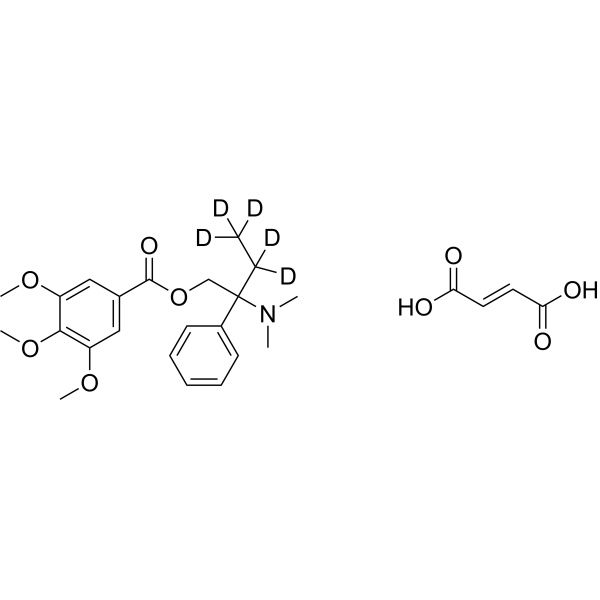
Trimebutine-d5 fumarate
Trimebutine-d5 fumarate is deuterium labeled Trimebutine fumarate. Trimebutine fumarate is a multi-target inhibitor and opioid receptor agonist with antimuscarinic activity. Trimebutine fumarate inhibits L-type Ca2+ channels and large-conductance calcium-activated potassium channels (BKCa channels), thereby inhibiting extracellular calcium influx and potassium ion efflux. Trimebutine fumarate also targets Toll-like receptors, inhibits Toll-like receptor 2/4/7/8/9 signals, and inhibits LPS-induced IRAK1 activation, as well as ERK1/2, JNK and NF-κB activation, thereby exerting anti-inflammatory effects. Trimebutine fumarate also induces tumor cell apoptosis by inhibiting the AKT/ERK pathway. Trimebutine fumarate also inhibits excessive contraction of smooth muscle and can be used in the study of gastrointestinal disorders such as irritable bowel syndrome (IBS).
For research use only. We do not sell to patients.
- CAS No.: 2747915-18-8
- Formula: C26H28D5NO9
- Molecular Weight:508.57
-
Storage:
Please store the product under the recommended conditions in the Certificate of Analysis.

To place orders, for customer services and technical support, please contact: MedChemExpress USA
Tel: 609-228-6898 E-mail: [email protected] [email protected]


-
 Biological Activity
-
Chemical Information
- Purity & Documentation
- References
-
 Help & FAQs




Biological Activity
Description
IC50 & Target
|
μ Opioid Receptor/MOR |
L-type calcium channel |
IRAK-1 |
ERK1 |
ERK2 |
In Vitro
Stable heavy isotopes of hydrogen, carbon, and other elements have been incorporated into drug molecules, largely as tracers for quantitation during the drug development process. Deuteration has gained attention because of its potential to affect the pharmacokinetic and metabolic profiles of drugs[1].
MedChemExpress (MCE) has not independently confirmed the accuracy of these methods. They are for reference only.
Application
1. This compound can be used as a tracer
2. This compound can be used as an internal standard for quantitative analysis by NMR, GC-MS, or LC-MS.


Chemical Information
-
CAS No. 2747915-18-8
-
Unlabeled CAS 39133-31-8
-
Molecular Weight 508.57
-
Formula C26H28D5NO9
-
SMILES
OC(/C=C/C(O)=O)=O.O=C(C1=CC(OC)=C(C(OC)=C1)OC)OCC(C([2H])([2H])C([2H])([2H])[2H])(C2=CC=CC=C2)N(C)C
-
Shipping
Room temperature in continental US; may vary elsewhere.
-
Storage
Please store the product under the recommended conditions in the Certificate of Analysis.


Purity & Documentation
References
[1]. Russak EM, et al. Impact of Deuterium Substitution on the Pharmacokinetics of Pharmaceuticals. Ann Pharmacother. 2019;53(2):211-216. [Content Brief]
[2]. Fan YP, et al. Trimebutine Promotes Glioma Cell Apoptosis as a Potential Anti-tumor Agent. Front Pharmacol. 2018 Jun 21;9:664. [Content Brief]
[3]. Tan W, et al. Effects of trimebutine maleate on colonic motility through Ca²+-activated K+ channels and L-type Ca²+ channels. Arch Pharm Res. 2011 Jun;34(6):979-85. [Content Brief]
[4]. Long Y, et al. Effectiveness of trimebutine maleate on modulating intestinal hypercontractility in a mouse model of postinfectious irritable bowel syndrome. Eur J Pharmacol. 2010 Jun 25;636(1-3):159-65. [Content Brief]
[5]. Xu J, et al. Trimebutine, a small molecule mimetic agonist of adhesion molecule L1, contributes to functional recovery after spinal cord injury in mice. Dis Model Mech. 2017 Sep 1;10(9):1117-1128. [Content Brief]
[6]. Ogawa N, et al. Trimebutine suppresses Toll-like receptor 2/4/7/8/9 signaling pathways in macrophages. Arch Biochem Biophys. 2021 Oct 30;711:109029. [Content Brief]
[7]. Cenac N, et al. A novel orally administered trimebutine compound (GIC-1001) is anti-nociceptive and features peripheral opioid agonistic activity and Hydrogen Sulphide-releasing capacity in mice. Eur J Pain. 2016 May;20(5):723-30. [Content Brief]

Calculators
Concentration (start) × Volume (start) = Concentration (final) × Volume (final)


Trimebutine-d5 fumarate Related Classifications
HY-B0380S1 Related Classifications
 Powered by Bioz