



Lecankitug

Based on 1 Customer Validation
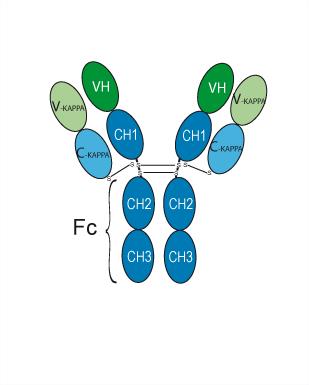
Lecankitug (LZM-012) is a humanized IgG1κ monoclonal antibody targeting IL-17A/F. Lecankitug exerts immunosuppressive and anti-inflammatory activities. Lecankitug can be used in the research of autoimmune and inflammatory diseases, such as psoriasis, ankylosing spondylitis, and rheumatoid arthritis.
For research use only. We do not sell to patients.
- Purity : 98%
- CAS No.: 2923284-76-6
- Molecular Weight:146.514 kDa
-
Storage:
Please store the product under the recommended conditions in the Certificate of Analysis.


To place orders, for customer services and technical support, please contact: MedChemExpress USA
Tel: 609-228-6898 E-mail: [email protected] [email protected]


-
 Biological Activity
-
Chemical Information
- Protocols
- Purity & Documentation
- References
-
 Help & FAQs




Biological Activity
Description
Isotype
Human IgG1 kappa
Recommend Isotype Controls
Species Reactivity
Human
IC50 & Target
[1]|
IL-17A |
IL-17F |
In Vitro
IL-17A/F are proinflammatory cytokines involved in the pathological processes of autoimmune diseases such as psoriasis and ankylosing spondylitis[1].
MedChemExpress (MCE) has not independently confirmed the accuracy of these methods. They are for reference only.
Clinical Trial
| NCT Number | Sponsor | Condition | Start Date |
Phase

|
|---|---|---|---|---|
| NCT01329991 | Plexxikon| | 2011-05 | PHASE1 |
Gene ID
Accession
Conjugated
Unconjugated
Reconsititution
The product can be reconstituted/diluted with sterile PBS or saline.
Format
-
IgG1-kappa
Application
ELISA, FACS, Functional assay
Verified Bioactivity
-
 Loaded Lecankitug on ProA biosensor, can bind HY-P70527 IL-17A Protein, Human (HEK293, His) with an affinity constant of 3.464E-10 M as determined in BLI assay.
 -
 Loaded Lecankitug on ProA biosensor, can bind HY-P72586 IL-17F Protein, Human (HEK293) with an affinity constant of 1.853E-09 M as determined in BLI assay.


Chemical Information
-
CAS No. 2923284-76-6
-
Appearance Liquid
-
Molecular Weight 146.514 kDa
-
Color Colorless to light yellow
-
SMILES
N/A
-
Synonyms
LZM-012; XKH004
-
Shipping
Shipping with dry ice.
-
Formulation
Please refer to the lot-specific COA for specific buffer information.
-
Storage
Please store the product under the recommended conditions in the Certificate of Analysis.


Purity & Documentation
-
Data Sheet (256 KB)
-
SDS (252 KB)
- English - EN (252 KB)
- Français - FR (252 KB)
- Deutsch - DE (252 KB)
- Norwegian - NO (252 KB)
- Español - ES (252 KB)
- Swedish - SV (252 KB)
- Italian - IT (252 KB)
- Korean - KR (252 KB)
- Portuguese - PT (252 KB)
-
Inhibitory Antibodies User Guide (603 KB)
References

Calculators
Concentration (start) × Volume (start) = Concentration (final) × Volume (final)


Lecankitug Related Classifications
HY-P991146 Related Classifications
 Powered by Bioz