



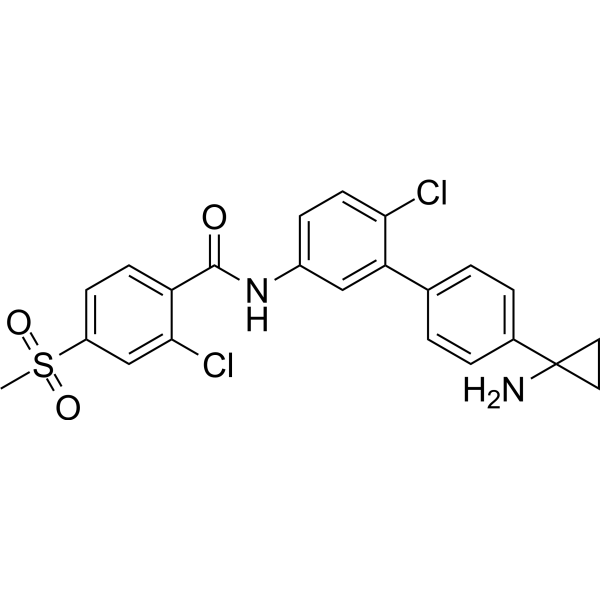
USP28-IN-2
USP28-IN-2 is a USP28 inhibitor (IC50=0.3 μM) with high selectivity over USP2, USP7, USP8, USP9x, UCHL3 and UCHL5. USP28-IN-2 shows cytotoxicity against cancer cells, down-regulates the cellular level of c-Myc through ubiquitin-proteasome system. USP28-IN-2 also decreases the ankyrase-1/2 level in vitro. USP28-IN-2 enhance the sensitivity of colorectal cancer cells to Regorafenib (HY-10331).
For research use only. We do not sell to patients.
- CAS No.: 2931509-11-2
- Formula: C23H20Cl2N2O3S
- Molecular Weight:475.39
-
Storage:
Please store the product under the recommended conditions in the Certificate of Analysis.

To place orders, for customer services and technical support, please contact: MedChemExpress USA
Tel: 609-228-6898 E-mail: [email protected] [email protected]


-
 Biological Activity
-
Chemical Information
- Protocols
- Purity & Documentation
- References
-
 Help & FAQs




Biological Activity
Description
IC50 & Target
[1]|
USP28 0.3 μM (IC50) |
Cellular Effect
|
Cell Line

|
Type | Value | Description | References |
|---|---|---|---|---|
| HCT-116 | IC50 |
26.01 μM
Compound: 9l
|
Antiproliferative activity against human HCT-116 cells assessed as cell growth inhibition incubated for 3 days by SRB assay
Antiproliferative activity against human HCT-116 cells assessed as cell growth inhibition incubated for 3 days by SRB assay
|
[PMID: 37075624] |
| LS174T | IC50 |
21.9 μM
Compound: 9l
|
Antiproliferative activity against human LS174T cells assessed as cell growth inhibition incubated for 3 days by SRB assay
Antiproliferative activity against human LS174T cells assessed as cell growth inhibition incubated for 3 days by SRB assay
|
[PMID: 37075624] |
In Vitro
USP28-IN-2 (compound 9l) (15 μM, 17.5 μM; 3 d) inhibits colony formation of human colorectal cancer cells HCT116 (17.5 μM) and Ls174T (15 μM)[1].
USP28-IN-2 (20-80 μM; 24 h) down-regulates the level of c-Myc by enhancing its degradation via ubiquitin-proteasome system (UPS)[1].
MedChemExpress (MCE) has not independently confirmed the accuracy of these methods. They are for reference only.
-
Cell Line:Human colorectal cancer cells HCT116 and Ls174T
-
Concentration:20 μM, 30 μM, 50 μM, and 60 μM, for Ls174T; 30 μM, 50 μM, 60 μM and 80 μM for HCT116
-
Incubation Time:24 h
-
Result:Dose-dependently down-regulated the cellular level of c-Myc.


Chemical Information
-
CAS No. 2931509-11-2
-
Molecular Weight 475.39
-
Formula C23H20Cl2N2O3S
-
SMILES
CS(=O)(C1=CC=C(C(Cl)=C1)C(NC2=CC=C(C(C3=CC=C(C=C3)C4(CC4)N)=C2)Cl)=O)=O
-
Shipping
Room temperature in continental US; may vary elsewhere.
-
Storage
Please store the product under the recommended conditions in the Certificate of Analysis.


Purity & Documentation
References

Calculators
Concentration (start) × Volume (start) = Concentration (final) × Volume (final)


USP28-IN-2 Related Classifications
HY-149228 Related Classifications
 Powered by Bioz