



Epiberberine
Based on 4 publication(s) in Google Scholar
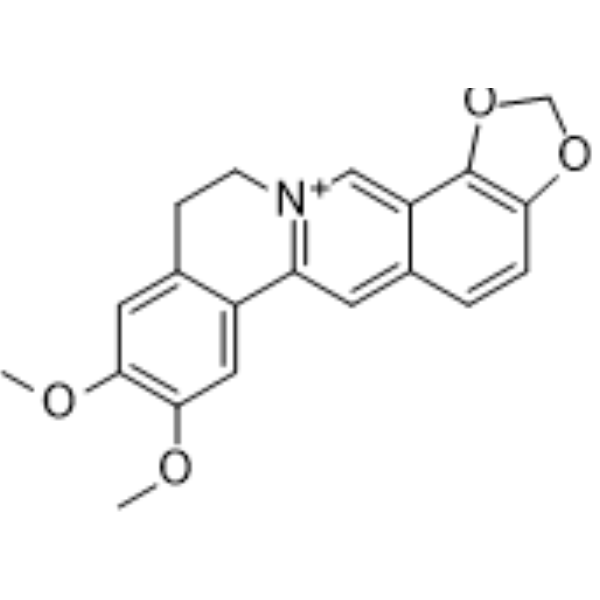
Epiberberine is an alkaloid isolated from Coptis chinensis, acts as a potent AChE and BChE inhibitor, and a non-competitive BACE1 inhibitor, with IC50s of 1.07, 6.03 and 8.55 μM, respectively. Epiberberine has antioxidant activity, with peroxynitrite ONOO- scavenging effect (IC50, 16.83 μM), and can be used for the research of Alzheimer disease. Epiberberine inhibits the early stage of differentiation of 3T3-L1 preadipocytes, downregulates the Raf/MEK1/2/ERK1/2 and AMPKα/Akt pathways. Epiberberinecan be used for the research of diabetic disease.
연구목적의 판매만을 진행합니다. 환자를 대상으로 한 판매는 하지 않습니다.
- CAS No.: 6873-09-2
- 화학식: C20H18NO4+
- 분자량:336.36
-
보관:Powder -20°C, 3 years , 4°C, 2 years ; In solvent -80°C, 2 years , -20°C, 1 year

To place orders, for customer services and technical support, please contact: MedChemExpress USA
Tel: 609-228-6898 E-mail: [email protected] [email protected]


-
 Biological Activity
-
Chemical Information
-
용액&용해도
- Protocol
- 순도&문서
- References
-
 Help & FAQs


-
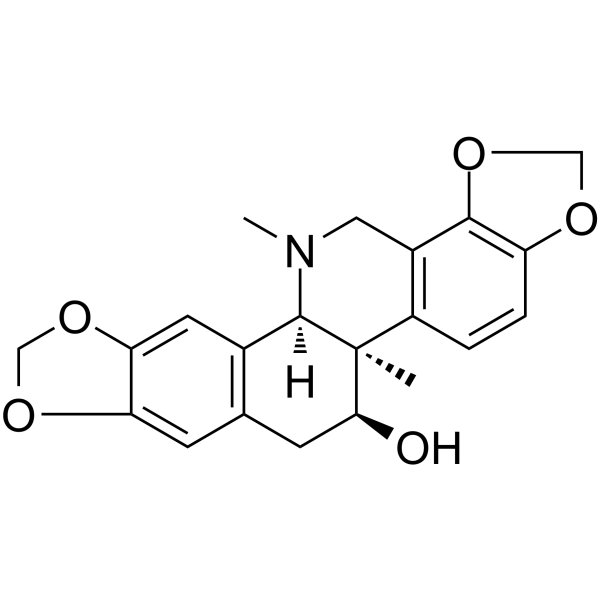
HY-N0826
CorynolineAChE Inhibitor -
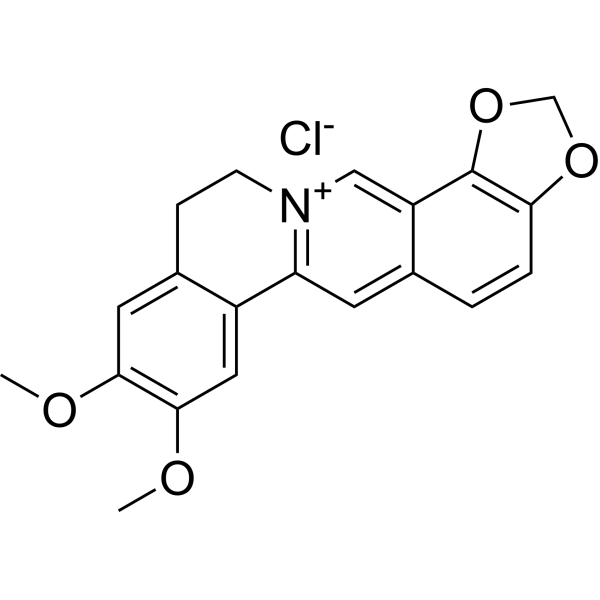
HY-N0226A
Epiberberine chlorideAChE/BChE Inhibitor -
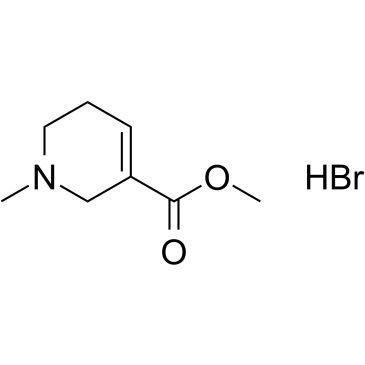
HY-B0489
Arecoline hydrobromidenAChR/mAChR Agonist -
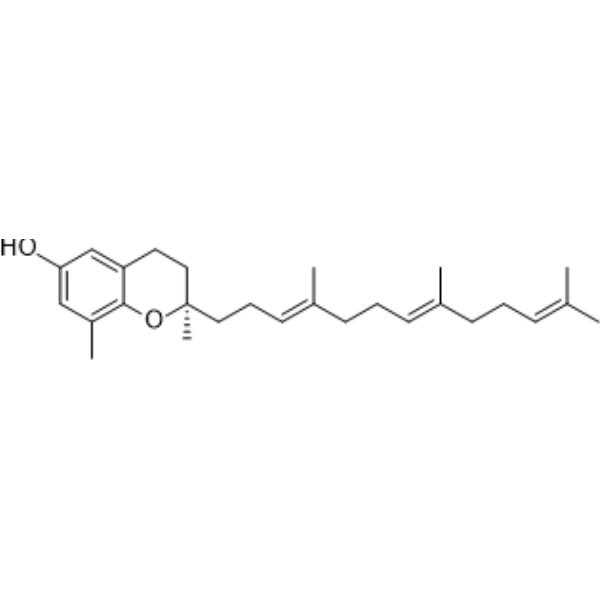
HY-122778
δ-TocotrienolVitamin E -
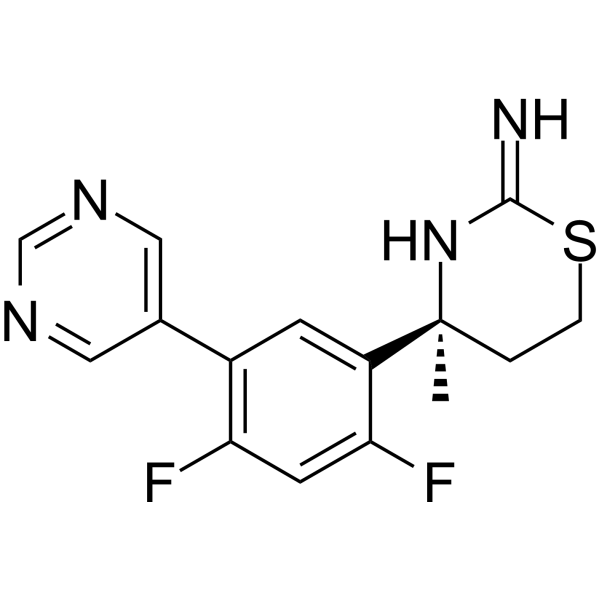
HY-10472
LY2811376BACE1 Inhibitor -
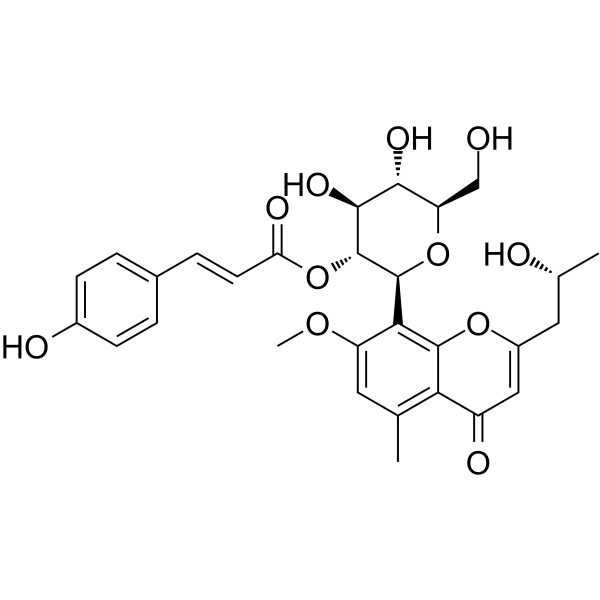
HY-N2215
Aloeresin DBACE1 Inhibitor -

HY-N0826R
Corynoline (Standard)AChE Inhibitor -

HY-N2215R
Aloeresin D (Standard)BACE1 Inhibitor -

HY-10472R
LY2811376 (Standard)Reference Standard -

HY-122778R
δ-Tocotrienol (Standard)Vitamin E -

HY-B0489R
Arecoline hydrobromide (Standard)nAChR/mAChR Agonist
Publications Citing Use of MedChemExpress (MCE) Epiberberine
More

Biological Activity
제품 설명
IC50 & Target
|
AChE |
BACE1 |
BChE |
In Vitro
Epiberberine (0, 12.5, 25, or 50 μM) dose-dependently inhibits cellular triglyceride accumulation in 3T3-L1 adipocytes, with an IC50 of 52.8 μM[2].
Epiberberine (12.5-50 μM) suppresses the Raf/MEK1/ERK1/2 and AMPKα/Akt pathways in the early stage of 3T3-L1 adipocyte differentiation[2].
Epiberberine (0.2, 1, 5 μg/mL) inhibits glucose uptake in HepG2 cells in a concentration-dependent manner[3].
MedChemExpress (MCE) has not independently confirmed the accuracy of these methods. They are for reference only. Further protocols information, click here.
In Vivo
MedChemExpress (MCE) has not independently confirmed the accuracy of these methods. They are for reference only.


Chemical Information
-
CAS No. 6873-09-2
-
Appearance Solid
-
분자량 336.36
-
화학식 C20H18NO4+
-
Color Orange red
-
SMILES
COC1=C(OC)C=C2C(CC[N+]3=C2C=C(C=C4)C(C5=C4OCO5)=C3)=C1
-
Structure Classification
-
Initial Source
-
선적
Room temperature in continental US; may vary elsewhere.
-
보관
Powder -20°C 3 years 4°C 2 years In solvent -80°C 2 years -20°C 1 year


Publications (4)
-
Journal Impact Factor
-
Most Recent
-
J Ethnopharmacol
Activation of NRF2 by epiberberine improves oxidative stress and insulin resistance in T2DM mice and IR-HepG2 cells in an AMPK dependent manner. [Abstract]2024 Jun 12:327:117931. PMID: 38382657 -
Molecules
Discovery of Nine Dipeptidyl Peptidase-4 Inhibitors from Coptis chinensis Using Virtual Screening, Bioactivity Evaluation, and Binding Studies. [Abstract]2024 May 14;29(10):2304. PMID: 38792165 -
J Biomol Struct Dyn
Role of multi-targeted bioactive natural molecules and their derivatives in the treatment of Alzheimer's disease: an insight into structure-activity relationship. [Abstract]2023 Dec;41(20):11286-11323. PMID: 36579430 -
Aging (Albany NY)
Network pharmacology for systematic understanding of Schisandrin B reduces the epithelial cells injury of colitis through regulating pyroptosis by AMPK/Nrf2/NLRP3 inflammasome. [Abstract]2021 Oct 9;13(19):23193-23209. PMID: 34628369


용액&용해도
In Vitro:
DMSO : 3.33 mg/mL (9.90 mM; ultrasonic and warming and heat to 60°C; Hygroscopic DMSO has a significant impact on the solubility of product, please use newly opened DMSO)
Please refer to the solubility information to select the appropriate solvent. Once prepared, please aliquot and store the solution to prevent product inactivation from repeated freeze-thaw cycles.
Storage method and period of stock solution: -80°C, 2 years; -20°C, 1 year. When stored at -80°C, please use it within 2 years. When stored at -20°C, please use it within 1 year.
Please refer to the solubility information to select the appropriate solvent. Once prepared, please aliquot and store the solution to prevent product inactivation from repeated freeze-thaw cycles.
Storage method and period of stock solution: -80°C, 2 years; -20°C, 1 year. When stored at -80°C, please use it within 2 years. When stored at -20°C, please use it within 1 year.
Concentration (start) × Volume (start) = Concentration (final) × Volume (final)

Protocol
-
Cell Cytotoxicity Assay
Cytotoxicity assays are usually based on the assessment of cell membrane damage, which can also be indirectly detected by measuring cell viability. Detection methods include MTT assay, CKK-8 assay, LDH assay and ATP assay, etc.
-
Alzheimer’s Disease Modeling
Alzheimer’s Disease (AD) is a neurodegenerative disorder characterized by a progressive decline in cognitive functions and loss of specific types of neurons and synapses. Alzheimer's symptoms can be simulated in mice by injecting drugs (such as Aβ) or genetically modified.


순도&문서
-
Data Sheet (277 KB)
-
SDS (254 KB)
- English - EN (254 KB)
- Français - FR (254 KB)
- Deutsch - DE (254 KB)
- Norwegian - NO (254 KB)
- Español - ES (254 KB)
- Swedish - SV (254 KB)
- Italian - IT (254 KB)
- Korean - KR (254 KB)
- Portuguese - PT (254 KB)
-
Handling Instructions (2659 KB)
References
[1]. Jung HA, et al. Anti-Alzheimer and antioxidant activities of Coptidis Rhizoma alkaloids. Biol Pharm Bull. 2009 Aug;32(8):1433-8. [Content Brief]
[2]. Choi JS, et al. Anti-adipogenic effect of epiberberine is mediated by regulation of the Raf/MEK1/2/ERK1/2 and AMPKα/Akt pathways. Arch Pharm Res. 2015 Dec;38(12):2153-62. [Content Brief]
[3]. Ma H, et al. Antihyperglycemia and Antihyperlipidemia Effect of Protoberberine Alkaloids From Rhizoma Coptidis in HepG2 Cell and Diabetic KK-Ay Mice. Drug Dev Res. 2016 Jun;77(4):163-70. [Content Brief]


Complete Stock Solution Preparation Table
Please refer to the solubility information to select the appropriate solvent. Once prepared, please aliquot and store the solution to prevent product inactivation from repeated freeze-thaw cycles.
Storage method and period of stock solution: -80°C, 2 years; -20°C, 1 year. When stored at -80°C, please use it within 2 years. When stored at -20°C, please use it within 1 year.
| Optional Solvent | Concentration Solvent Mass | 1 mg | 5 mg | 10 mg | 25 mg |
|---|---|---|---|---|---|
| DMSO | 1 mM | 2.9730 mL | 14.8650 mL | 29.7301 mL | 74.3251 mL |
| 5 mM | 0.5946 mL | 2.9730 mL | 5.9460 mL | 14.8650 mL |


Epiberberine Related Classifications
HY-N0226 Related Classifications
 Powered by Bioz