Inflammation/Immunology
-
Inflammation/Immunology Related Products (20875)
Related Products (20875)

-
Antibodies (115)
-
Related Compound Screening Libraries (4)
-
Antibacterial agent 129
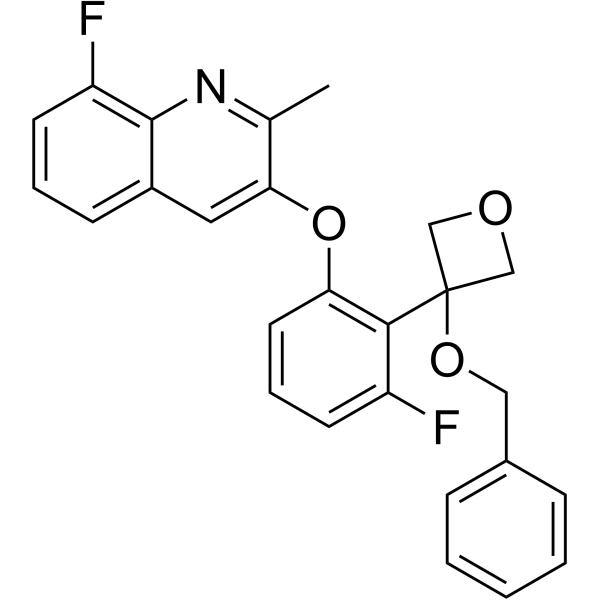 0 ImagesCat. No.: HY-152139CAS No.: 2874263-66-6
Antibacterial agent 129, an oxetanyl-quinoline derivative, has shown good antibacterial activity against P. mirabilis and B. subtilis with MICs of 31.25 μM and 31.5 μM and . Antibacterial agent 129 shows good antifungal activity against A. niger with a MIC of 31.25 μM. Antibacterial agent 129 shows excellent antimycobacterial activity with MIC 57.73 μM for M. tuberculosis H37Rv.

-
NMB-1
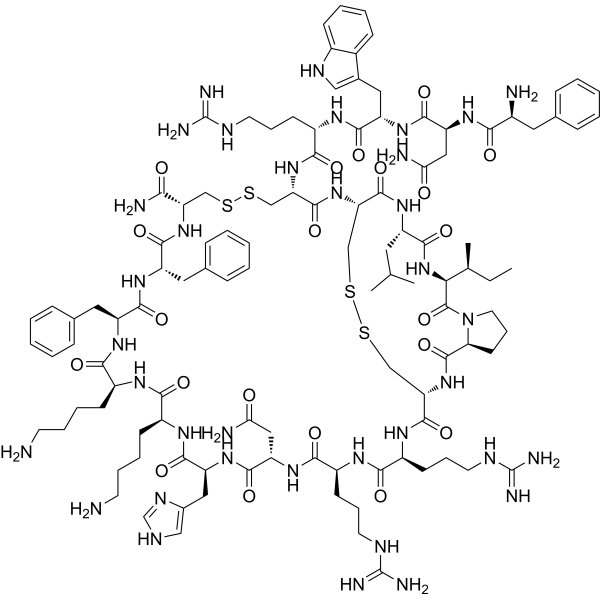 0 ImagesCat. No.: HY-P5163CAS No.: 2843557-76-4
-
MDL 105212A
 0 ImagesCat. No.: HY-105462CAS No.: 167261-60-1
MDL 105212A is a potent and orally active nonpeptide neurokinin receptor (NK-1/NK-2) tachykinin receptor antagonist. MDL 105212A can be used for the researches of inflammation, immunology and neurological disease, such as asthma.
-
Rabeprazole sulfide-d3
 0 ImagesCat. No.: HY-W003467S1CAS No.: 1185084-49-4
Rabeprazole sulfide-d3 is the deuterium labeled Rabeprazole Sulfide (HY-W003467). Rabeprazole Sulfide is a sulfide metabolite of Rabeprazole (HY-B0656). Rabeprazole Sulfide inhibits Helicobacter pylori motility. Rabeprazole Sulfide can be used for the research of Helicobacter pylori infection.
-
AhR agonist 5
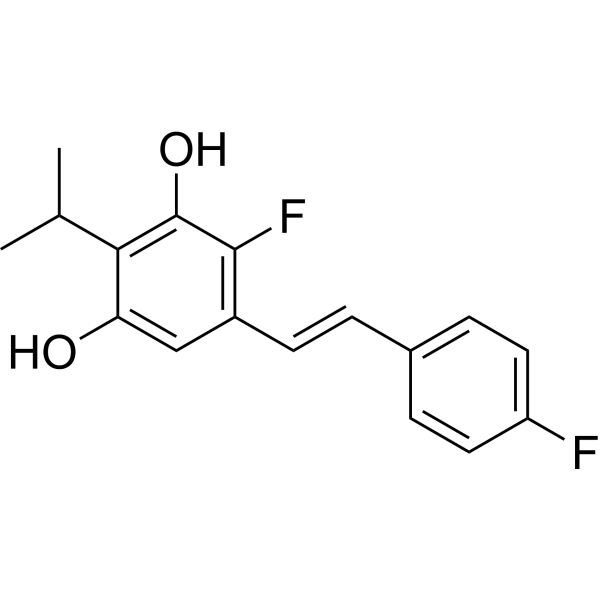 0 ImagesCat. No.: HY-158167CAS No.: 3033281-95-4
AhR agonist 5 is an AHR agonist (EC50 = 6 nM). From patent WO2024061187A1, compound 5.
-
Lepodisiran sodium
 0 ImagesCat. No.: HY-177640ACAS No.: 2766131-24-0Synonyms: LY3819469 sodium
Lepodisiran (LY3819469) sodium is a GalNAc-conjugated small interfering RNA lipid-lowering agent. Lepodisiran sodium targets the hepatic LPA gene and degrades apolipoprotein (a) mRNA to silence its expression, thereby effectively reducing the production of apolipoprotein (a) and serum lipoprotein (a) in a dose-dependent manner. Lepodisiran sodium can be used in studies related to atherosclerotic cardiovascular disease.
-
KW-4490
 0 ImagesCat. No.: HY-19390CAS No.: 260561-48-6
KW-4490 is a selective phosphodiesterase 4 (PDE4) inhibitor. KW-4490 can be used for the researches of inflammation and immunology, such as asthma.
-
TYK2-IN-11
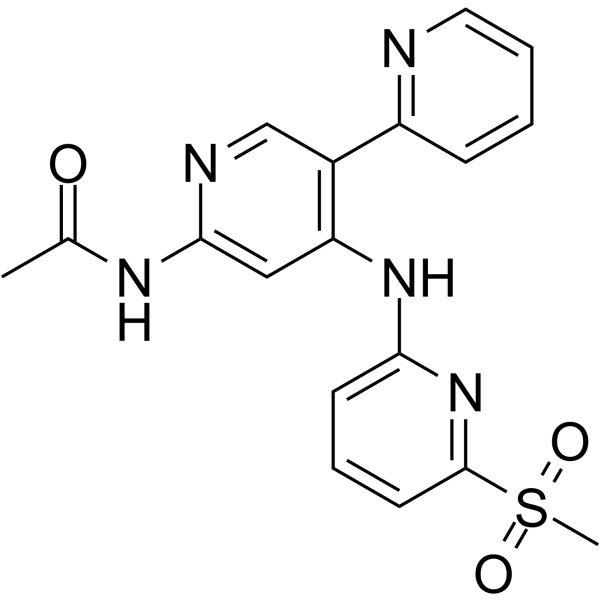 0 ImagesCat. No.: HY-144087CAS No.: 2757009-40-6
TYK2-IN-11 (Compound 5B) is a selective Tyk-2 inhibitor with IC50s of 0.016 and 0.31 nM for TYK2-JH2 and JAK1-JH2, respectively. TYK2-IN-11 can be used for the research of inflammatory or autoimmune disease.
-
Iptocigistat
 0 ImagesCat. No.: HY-184095CAS No.: 3047739-67-0Synonyms: Iptocigistatum; VENT-03
Iptocigistat (Iptocigistatum) is a cyclic GMP-AMP synthase (cGAS) inhibitor. Iptocigistat prevents excessive immune responses. Iptocigistat can be used to study inflammation-related autoimmune diseases.
-
ACC1-IN-2
 0 ImagesCat. No.: HY-161976CAS No.: 3027705-67-2
ACC1-IN-2 (Compound 16) is an ACC1 inhibitor with an IC50 of 7.3 nM. ACC1-IN-2 can be used in the study of acne.
-
Anti-LAIR1 Antibody
 0 ImagesCat. No.: HY-P992255
-
NUCC-555
 0 ImagesCat. No.: HY-122179CAS No.: 1060469-90-0
NUCC-555 is an activin antagonist. NUCC-555 interacts with Trp25, Trp28, Phe55, Tyr93, Lys103, and Asn107 in the Activin A binding pocket. NUCC-555 blocks Activin A-mediated hepatic stellate cells (HSCs) activation. NUCC-555 promotes liver regeneration and halts fibrosis progression in chronic liver disease models. NUCC-555 inhibits Activin A-mediated ovarian cell proliferation. NUCC-555 decreases FSH levels in ovariectomized mice.
![[Dehydro-Pro4] Substance P (4-11)](https://file.medchemexpress.com/product_pic/hy-p3820.gif "Click to View [Dehydro-Pro4] Substance P (4-11) Product Detail")
-
S-methyl-KE-298 (Standard)
 0 ImagesCat. No.: HY-101671RCAS No.: 143584-75-2Synonyms: M-2 (Standard)
S-methyl-KE-298 (Standard) is the analytical standard of S-methyl-KE-298. This product is intended for research and analytical applications. S-methyl-KE-298 is an active metabolite of KE-298. KE-298 inhibits matrix metalloproteinase (MMP-1) production from rheumatoid arthritis (RA) synovial cells.
-
Eltenac
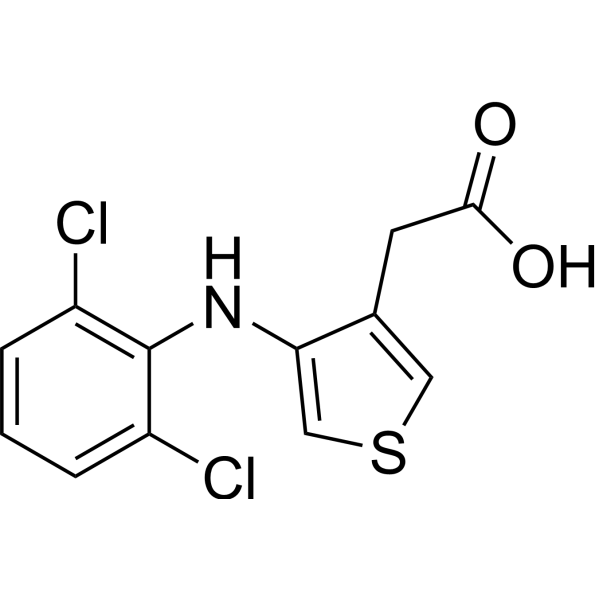 0 ImagesCat. No.: HY-106093CAS No.: 72895-88-6
Eltenac, a non-steroidal anti-inflammatory drug (NSAID), is a COX inhibitor. Eltenac shows IC50 of 0.03 μM for both COX-1 and COX-2 in isolated human whole blood.
-
3-Ethoxy-5,6-dibromosalicylaldehyde
 0 Images
3-Ethoxy-5,6-dibromosalicylaldehyde is an IRE1/ERN1 inhibitor, with an IC50 of 0.12 μM, a Ki of 71-88 nM, and a Kd of 100 nM against the ribonuclease activity of hIRE1α, as well as an IC50 of 4.8 μM against yeast Ire1. It shows selectivity toward IRE1 ribonuclease. 3-Ethoxy-5,6-dibromosalicylaldehyde blocks the IRE1/ERN1-mediated unfolded protein response (UPR) signaling pathway, including XBP-1 mRNA splicing, induction of XBP1 target genes, and activation of MAPK8/9/10, but does not alter the phosphorylation level of IRE1α or the PERK/ATF6 pathway. 3-Ethoxy-5,6-dibromosalicylaldehyde inhibits chikungunya virus replication, induces growth arrest, apoptosis and clonogenic inhibition in pancreatic cancer cells, reduces FB1 (Fumonisin B1) (HY-N6719)-induced autophagy and cell death, regulates PGG-induced senescence and apoptosis, and alleviates Sorafenib (HY-10201)-induced vacuolization and damage in hepatic stellate cells. 3-Ethoxy-5,6-dibromosalicylaldehyde can be used in research related to chikungunya virus infection, pancreatic cancer, FB1-induced nephrotoxicity, liver cancer, breast cancer, lung cancer and liver fibrosis.

-
LDDN-0003499
 0 ImagesCat. No.: HY-112369CAS No.: 331662-51-2
LDDN-0003499 is a Src family tyrosine kinase inhibitor and anti-inflammatory agent. LDDN-0003499 reduces basal and Aβ-stimulated levels of active, phosphorylated Lyn and Src kinases, and attenuates Aβ-stimulated secretion of pro-inflammatory cytokines TNFα and IL-6 in microglial cells. LDDN-0003499 can be used for the research of Alzheimer's disease.
-
Highly purified Type II collagen, from sheep articular cartilage
 0 ImagesCat. No.: HY-NP129Synonyms: Sheep Type II collagen, immunization grade
Highly purified Type II collagen, from sheep articular cartilage (Sheep Type II collagen, immunization grade) is an immune grade collagen derived from sheep articular cartilage, which can stimulate the animal's immune system to produce specific antibodies against this collagen. Collagen is also a substrate for hydrolysis by MMPs.