



Bcr-Abl
Bcr-Abl tyrosine-kinase inhibitors (TKI) are the first-line therapy for most patients with chronic myelogenous leukemia (CML). More than 90% of CML cases are caused by a chromosomal abnormality that results in the formation of a so-called Philadelphia chromosome. This abnormality is a consequence of fusion between the Abelson (Abl) tyrosine kinase gene at chromosome 9 and the break point cluster (Bcr) gene at chromosome 22, resulting in a chimeric oncogene (Bcr-Abl) and a constitutively active Bcr-Abl tyrosine kinase that has been implicated in the pathogenesis of CML. Compounds have been developed to selectively inhibit the tyrosine kinase.
Bcr-Abl Isoform Specific Products
All Product Categories
-
Bcr-Abl Inhibitors
(203)
View all products
-
Bcr-Abl Antagonist
(1)
View all products
-
Bcr-Abl Activator
(1)
View all products
-
Bcr-Abl Modulators
(2)
View all products
-
Bcr-Abl Degraders
(24)
View all products
-
Bcr-Abl Control
(1)
View all products
-
Bcr-Abl Substrate
(1)
View all products
-
ABL1 Proteins
(8)
View all products
-
Bcr-Abl Related Products (251)
Related Products (251)

-
Recombinant Proteins (8)
-
Antibodies (6)
-
Bcr-Abl Isoform Comparison
-
Kinase modulator-1
 0 ImagesCat. No.: HY-177273CAS No.: 927697-17-4Kinase modulator-1 (P142, MS: m/z445) is a kinase modulator. Kinase modulator-1 can inhibit Bcr-Abl activity, especially against drug-resistant mutant kinases (such as T315I Bcr-Abl). Kinase modulator-1 can be used for cancers like chronic myelogenous leukemia (CML) research.


-
Bosutinib hydrate (Standard)
 0 ImagesSynonyms: SKI-606 hydrate (Standard)Bosutinib (Standard) (SKI-606 (Standard)) hydrate is the analytical standard of Bosutinib hydrate (HY-10158A). This product is intended for research and analytical applications. Bosutinib hydrate is an oraly activel Src/Abl tyrosine kinase inhibito with IC50s of 1.2 nM and 1 nM, respectively.
-
Tyrosine kinase-IN-8
 0 ImagesCat. No.: HY-162489Tyrosine kinase-IN-8 (compound 4e) is a BCR‐ABL1 tyrosine kinase inhibitor (TKI). Tyrosine kinase-IN-8 shows anti-proliferative activity against K562 cells, a chronic myeloid leukemia (CML) cell line (CC50=0.8 µM). Tyrosine kinase-IN-8 can be used in the study of chronic leukemia.
-
SIAIS056
 0 ImagesCat. No.: HY-180969CAS No.: 2378581-37-2SIAIS056 is a BCR-ABL PROTAC degrader with a DC50 value of 0.18 nM. SIAIS056 time-dependently inhibits the BCR-ABL signaling pathway, accompanied by decreased phosphorylation of BCR-ABL and the downstream molecules STAT5 and CRKL in K562 cells. SIAIS056 induces the degradation of several clinically relevant resistance-conferring mutations of BCR-ABL. SIAIS056 exhibits anti-proliferative activity and induces substantial tumor regression in K562 xenograft models. SIAIS056 can be used for leukemia research.
-
VS1150
 0 ImagesCat. No.: HY-176269CAS No.: 2855238-97-8VS1150 (Compound 11) is a BCR-ABL-targeting phosphorylation-inducing chimeric small molecule (PHICS). VS1150 significantly inhibits oncogenic kinase BCR-ABL signaling by inducing inhibitory phosphorylation at its Y253 (EC50: 69 nM), subsequently triggering cell apoptosis. VS1150 also inhibits other oncogenic ABL fusions and drug-resistant mutants like T315I. VS1150 can be used for chronic myeloid leukemia (CML) and other ABL fusion-driven cancers research.
-
KW-2478 hydrochloride
 0 ImagesCat. No.: HY-13468ACAS No.: 819812-18-5KW-2478 hydrochloride is an HSP90 inhibitor (IC50 = 3.8 nM). KW-2478 hydrochloride inhibits the growth and induces apoptosis in chronic myeloid leukemia (CML) cells and liver cancer cells. KW-2478 hydrochloride weakens the BCR/ABL and MAPK signaling pathways, leading to increased p27 and p21 expression and decreased cyclin B1 expression. KW-2478 hydrochloride downregulates STAT3 expression. KW-2478 hydrochloride may be used in research on cancers such as CML and liver cancer.
-
ABL1 G250E Recombinant Human Active Protein Kinase
 0 ImagesCat. No.: HY-E70636The emergence of mutations in the BCR::ABL1 kinase domain (KD) impairs Imatinib Mesylate (HY-50946) binding capacity, thus contributing to Imatinib Mesylate resistance. Identification of these mutations is important for treatment decisions and precision medicine in chronic myeloid leukaemia (CML). ABL1 G250E Recombinant Human Active Protein Kinase is a recombinant ABL1 G250E protein that can be used to study ABL1 G250E-related functions.
-
P22D
 0 ImagesCat. No.: HY-180979CAS No.: 2635386-51-3P22D is a BCR-ABL PROTAC degrader based on Dasatinib (HY-10181), with a DC50 value of approximately 10 nM for the wild-type BCR-ABL protein. P22D cannot degrade the BCR-ABL T315I mutant. P22D has inhibitory activity against K562 cells (wild type), but is ineffective against BaF3-BCR-ABL (T315I) cells. P22D can be used for research on chronic myeloid leukemia and acute lymphocytic leukemia.
-
BCR-ABL-IN-1
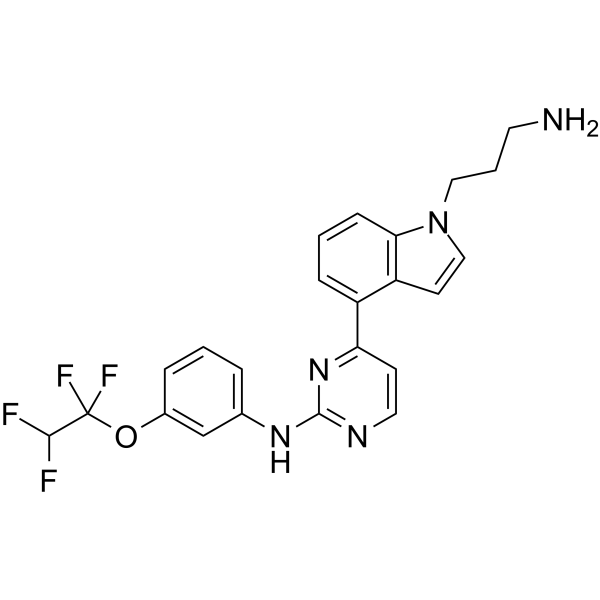 0 ImagesCat. No.: HY-100314CAS No.: 188260-50-6BCR-ABL-IN-1 is an inhibitor of BCR-ABL tyrosine kinase, with a pIC50 of 6.46, and may be used in the research of chronic myelogenous leukemia.
-
Radotinib-d6
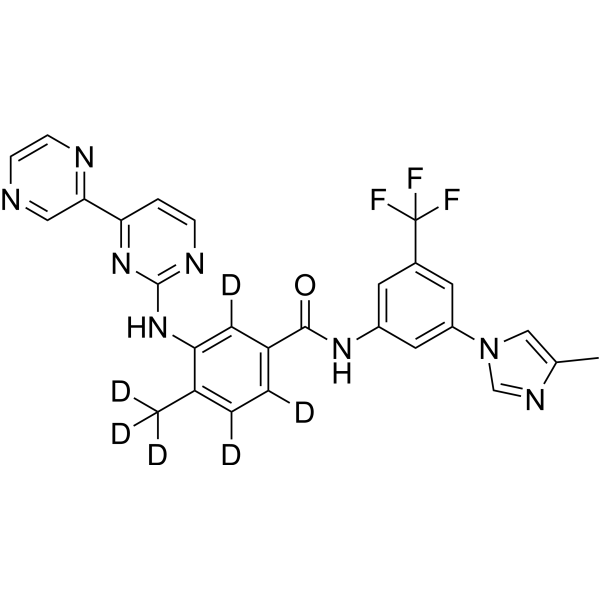 0 ImagesCat. No.: HY-15728SCAS No.: 2754051-83-5Synonyms: IY-5511-d6Radotinib-d6 is deuterium labeled Radotinib (HY-15728). Radotinib (IY-5511) is an orally active and BBB-permeable selective tyrosine kinase Bcr-Abl1 inhibitor with an IC50 of 34 nM. Radotinib has anti-prion and anti-tumor activities. Radotinib can inhibit the proliferation, induce cell cycle arrest and apoptosis of tumor cells . Radotinib can be used in the research of cancer such as chronic myeloid leukemia and multiple myeloma, as well as neurodegenerative diseases such as prion diseases.
-
BCR-ABL-IN-9
 0 ImagesCat. No.: HY-169230BCR-ABL-IN-9 (Compound B1) is a BCR-ABL inhibitor that achieves sustained BCR-ABL suppression by forming stable covalent bonds with the ABL kinase. BCR-ABL-IN-9 is also effective in inhibiting the activity of the ABL kinase (IC50 = 1.2 nM). BCR-ABL-IN-9 possesses anticancer activity.
-
ML786
 0 ImagesCat. No.: HY-14979CAS No.: 1237586-97-8
-
BCR-ABL-IN-14
 0 ImagesCat. No.: HY-185916CAS No.: 2412969-11-8BCR-ABL-IN-14 is a tyrosine kinase inhibitor targeting BCR-ABL1, ABL1 and ABL2. BCR-ABL-IN-14 inhibits chronic myeloid leukemia cells. It is applicable to research related to chronic myeloid leukemia, acute myeloid leukemia and acute lymphoblastic leukemia.

-
ABL1 H396P Recombinant Human Active Protein Kinase
 0 ImagesCat. No.: HY-E70637The emergence of mutations in the BCR::ABL1 kinase domain (KD) impairs Imatinib Mesylate (HY-50946) binding capacity, thus contributing to Imatinib Mesylate resistance. Identification of these mutations is important for treatment decisions and precision medicine in chronic myeloid leukaemia (CML). ABL1 H396P Recombinant Human Active Protein Kinase is a recombinant ABL1 H396P protein that can be used to study ABL1 H396P-related functions.
-
c-ABL-IN-2
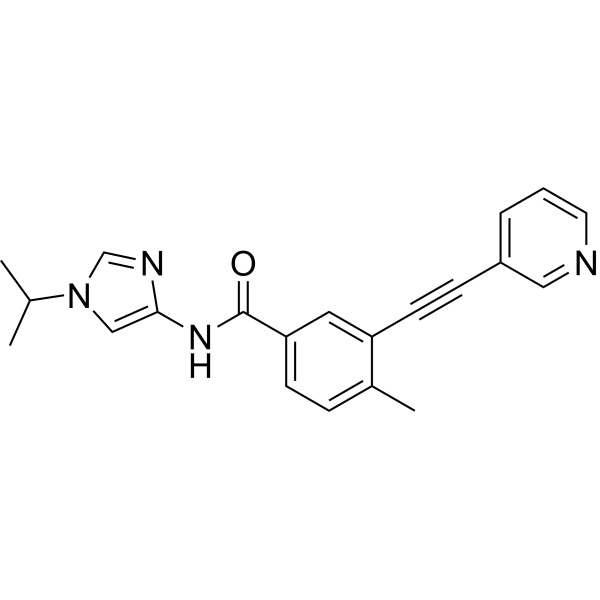 0 ImagesCat. No.: HY-146527CAS No.: 2574593-54-5c-ABL-IN-2 is a potent inhibitor of c-Abl. Activation of c-Abl has been implicated in various diseases, notably cancer. c-ABL-IN-2 has the potential for the research of neurodegenerative diseases (amyotrophic lateral sclerosis (ALS) and Parkinson’s disease (PD) and cancer (extracted from patent WO2020260871A1, compound 25). c-ABL-IN-2 is a click chemistry reagent, it contains an Alkyne group and can undergo copper-catalyzed azide-alkyne cycloaddition (CuAAc) with molecules containing Azide groups.
-
BCR-ABL-IN-6
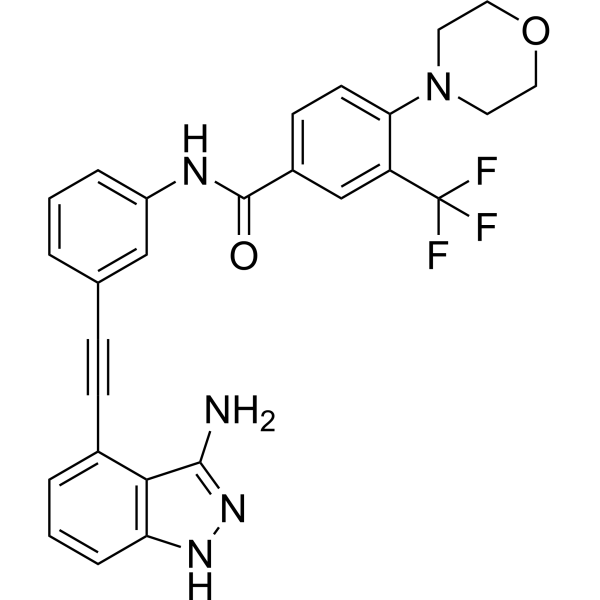 0 ImagesCat. No.: HY-150569CAS No.: 2499499-26-0BCR-ABL-IN-6 (9h) is a selective Bcr-Abl kinase inhibitor with IC50s of 4.6 and 227 nM for Bcr-AblWT and Bcr-AblT3151 respectively. BCR-ABL-IN-6 inhibits Bcr-Abl kinase with strong affinity inside the cells with an EC50 of 14.6 nM. BCR-ABL-IN-6 is an imatinib derivative which can be used for research of chronic myelogenous leukemia. BCR-ABL-IN-6 is a click chemistry reagent, it contains an Alkyne group and can undergo copper-catalyzed azide-alkyne cycloaddition (CuAAc) with molecules containing Azide groups.
-
CHMFL-ABL-039
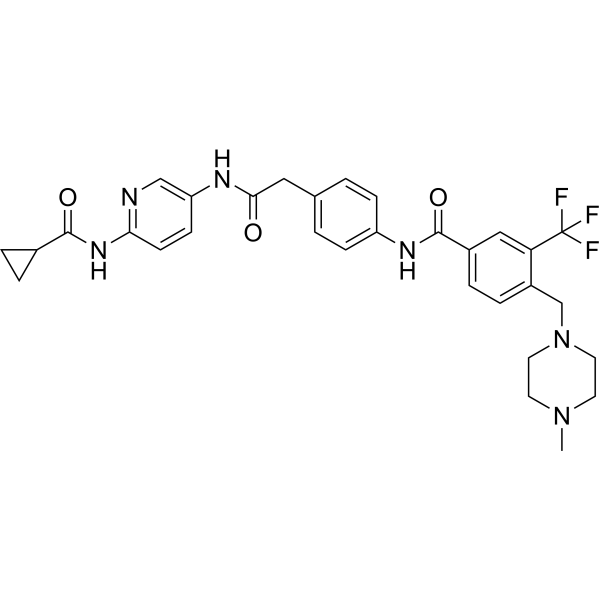 0 ImagesCat. No.: HY-126143CAS No.: 2304344-56-5




