



Caspase 8 Activator
-
EGFR-IN-134
 0 ImagesCat. No.: HY-168623
EGFR-IN-134 (compound 3f), a triazolo[3,4-a]isoquinoline derivative, is a potent EGFR inhibitor with an IC50 of 0.023 µM. EGFR-IN-134 induces apoptosis and necrosis. EGFR-IN-134 initiates cell cycle arrest at the G2/M and pre-G1 phases, downregulates anti-apoptotic protein Bcl2 and upregulates pro-apoptotic proteins: p53, Bax, and caspases 3, 8, and 9. EGFR-IN-134 shows antiproliferative and anticancer activity.
-
Ginsenoside Rh2 (Standard)
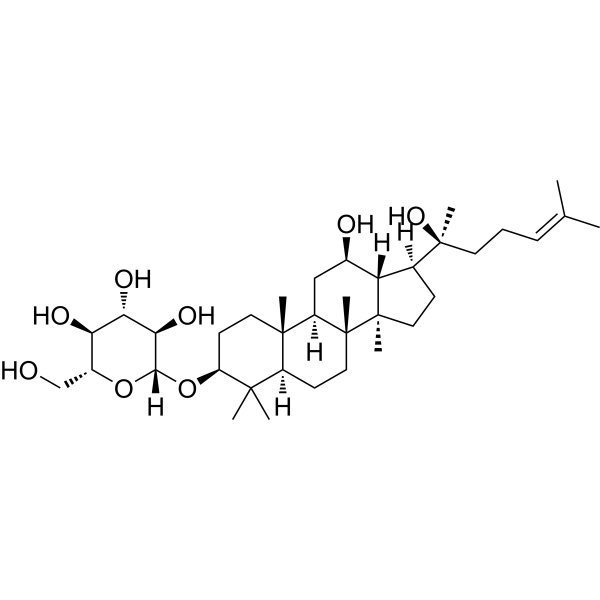 0 ImagesSynonyms: 20(S)-Ginsenoside Rh2(Standard); 20(S)-Rh2(Standard)
-
NSC 850745
 0 ImagesCat. No.: HY-175848
NSC 850745 is a selective and potent c-Met/STAT3 inhibitor with IC50 values of 210 and 670 nM. NSC 850745 can inhibit cell proliferation, induce G2/M phase arrest and induce apoptosis. NSC 850745 can downregulate AKT-1, VEGF and Bcl-2 expression and upregulate p53, Bax and caspase expression. NSC 850745 can be used for the research of cancer, such as leukemia and colon cancer.
-
Anticancer agent 306
 0 ImagesCat. No.: HY-181769CAS No.: 3043892-01-6
Anticancer agent 306 is a spiro tetramic acid derivative and a inhibitor of MMP1, MMP7 and PLK1. Anticancer agent 306 exerts antiproliferative activity against H1299, RKO and MCF-7 cells with IC50 values of 19.25 μM, 3.29 μM and 102.36 μM, respectively. Anticancer agent 306 can up-regulate p21 protein and down-regulate CCND1 and CCNB1 proteins to induce cell cycle arrest, regulate the expression of Bcl-2 and Bax to induce cell apoptosis. Anticancer agent 306 can down-regulate MMP1 and MMP7 proteins to inhibit tumor invasion and metastasis. Anticancer agent 306 can be used for the research of lung cancer, colorectal cancer, breast cancer.
-
DZ-1-DHA
 0 ImagesCat. No.: HY-184557CAS No.: 2223036-84-6
DZ-1-DHA is a conjugate of DHA (HY-B2167) and DZ-1 dye. DZ-1-DHA mediates selective cellular uptake via binding to overexpressed OATP1A2. DZ-1-DHA induces the cleavage of Caspase-3, Caspase-8, Caspase-9 and PARP-1. DZ-1-DHA induces Apoptosis and Ferroptosis. DZ-1-DHA induces ROS production through a Fenton-like mechanism, causes mitochondrial membrane depolarization, and triggers lipid peroxidation. DZ-1-DHA can be used in studies related to colorectal cancer liver metastasis.
-
GUT-70
 0 ImagesCat. No.: HY-120923CAS No.: 161633-75-6
GUT-70, a tricyclic coumarin, is a Hsp90 inhibitor. GUT-70 activates the caspase 2, 3, 8 and 9, and induces the apoptosis in leukemic cells. GUT-70 inhibits HIV-1 replication in chronically infected cells via suppression of the NF-κB pathway. GUT-70 can be used for the study of leukemic, mantle cell lymphoma (MCL) and HIV-1 infection.
-
GEA 3162 hydrochloride
 0 ImagesCat. No.: HY-120314A
GEA 3162 hydrochloride is an orally active compound that acts as a NO/ONOO⁻ donor. GEA 3162 hydrochloride significantly inhibits the activation of human polymorphonuclear leukocytes (PMNs) through the cGMP pathway, inhibits the release of inflammatory mediators, and exerts anti-inflammatory and protective effects. GEA 3162 hydrochloride induces apoptosis of neutrophils and bone marrow cells by activating caspase-2/3/8/9 through the ONOO⁻ pathway. GEA 3162 hydrochloride has a bidirectional effect in the rat gastric ulcer model: at low doses, it significantly reduces gastric mucosal damage, while at high doses, it aggravates the ulcer area. GEA 3162 hydrochloride can be used for research on inflammatory conditions such as gastric ulcers.
-
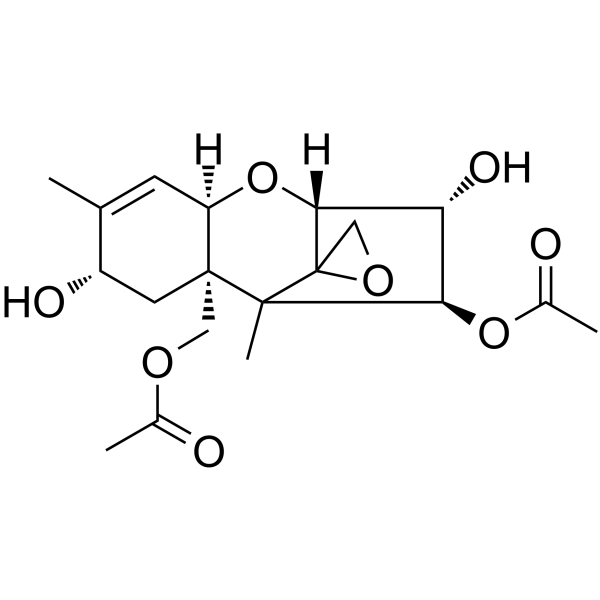
Neosolaniol
 0 Images
Neosolaniol is an orally active type A trichothecene mycotoxin, and it is a metabolite of T-2 Toxin (HY-N6792) in human cancer cells and renal epithelial cells. Neosolaniol targets Bax, Bcl-2, caspase 3, caspase 8, and cytochrome c, thereby inducing apoptosis, emesis and anorexia. Neosolaniol reduces intracellular ATP levels, elevates ROS levels, decreases mitochondrial membrane potential, induces mitochondrial damage, and exerts toxicity on Leydig cells. Neosolaniol downregulates the expression of intestinal tight junction proteins in broilers and increases the load of Salmonella enteritidis in the cecum of broilers. Neosolaniol can be used in research related to anorexia, lymphoma, Fusarium melonis rot, and Salmonella infection.
-
Clausenidin
 0 ImagesCat. No.: HY-N16771CAS No.: 28384-44-3
Clausenidin is a selective inhibitor targeting apoptosis-related pathways, including the mitochondrial pathway and death receptor pathway, and vascular endothelial growth factor (VEGF). Clausenidin induces mitochondrial membrane depolarization by activating caspase-3, caspase-8 and caspase-9, upregulating the pro-apoptotic protein Bax and downregulating the anti-apoptotic protein Bcl-2. Clausenidin also inhibits VEGF expression and blocks angiogenesis, exerting anti-tumor activity. Clausenidin has inhibitory effects against Mycobacterium tuberculosis (MIC=200 μg/mL). Clausenidin can induce apoptosis in liver cancer cells, arrest the cell cycle in the G2/M phase, and inhibit tumor angiogenesis. Clausenidin can be used in the research of malignant tumors such as liver cancer.
-
2-Hexadecanol
 0 Images
2-Hexadecanol is a fatty acid based compound. 2-Hexadecanol can be isolated from marine organism Sea pen. 2-Hexadecanol induces Apoptosis, elevates the expression of caspase-3 and caspase-8. 2-Hexadecanol exhibits anticancer activity against breast cancer and cervical cancer.

-
Benfluron hydrochloride
 0 ImagesCat. No.: HY-106419ACAS No.: 80427-58-3Synonyms: Benflurone hydrochloride
Benfluron hydrochloride is an Apoptosis inducer and inhibitor of the HIV-1 Rev-RRE complex, with an IC50 of 5.0 μM against the HIV-1 Rev-RRE complex. Benfluron hydrochloride induces p53 activation, and triggers phosphorylation of Chk1 at serine 345, Chk2 at threonine 68, as well as ERK1/2 at threonine 202 and tyrosine 204. Benfluron hydrochloride activates Caspase 8, Caspase 9 and Caspase 3/7, inhibits HIV-1 viral transcription, and acts as a substrate for 11β-HSD 1 and cytosolic carbonyl reductase. Benfluron hydrochloride can be used in research related to leukemia and HIV-1 infection.
-
Polyporenic acid C (Standard)
 0 Images
Polyporenic acid C (Standard) is an analytical standard of Polyporenic acid C (HY-N2993). This product is intended for research and analytical applications. Polyporenic acid C is a lanostane-type triterpenoid. Polyporenic acid C can be isolated from Poria cocos. Polyporenic acid C causes the cleavage of caspase-8 and caspase-3, as well as the cleavage of PARP. Polyporenic acid C reduces the phosphorylation level of Akt (Ser473), increases the phosphorylation of PTEN and p53 (Ser15), and activates JNK. Polyporenic acid C induces Apoptosis. Polyporenic acid C shows anticancer activity against non-small cell lung cancer.
-
NCP26
 0 ImagesCat. No.: HY-183004CAS No.: 2396683-89-7
NCP26 is an ATP-competitive ProRS inhibitor (with a KD of 271 nM in the absence of proline, and a KD of 0.35 nM in the presence of 100 μM proline). NCP26 activates AAR, induces G0/G1 phase arrest, Apoptosis, Caspase cleavage, and PARP cleavage. NCP26 downregulates MYC, TCF3, and CCND1. NCP26 inhibits the growth of multiple myeloma cells. NCP26 can be used for the research of multiple myeloma.
-
Linichlorin A
 0 ImagesCat. No.: HY-126757CAS No.: 62462-98-0
Linichlorin A is a p27Kip1 ubiquitination inhibitor that blocks p27Kip1 degradation by inhibiting the Skp2-Cks1–p27Kip1 interaction. Linichlorin A shows selective antiproliferative activity against tumor cells. Linichlorin A induces apoptosis in leukemia cells via cytochrome c release, caspase activation and PARP cleavage. Linichlorin A can be used in the study of leukemia, melanoma, cervical cancer and breast cancer.
-
GO-Y078
 0 ImagesCat. No.: HY-137059CAS No.: 1217503-60-0
GO-Y078 is a curcumin (HY-N0005) analog. GO-Y078 activates p38/JNK1/2. GO-Y078 activates the MAPK pathway, Caspase 3/8/9, PARP, AP-1, DR5, and TP53, while inhibiting cIAP-1, XIAP, and NF-κB. GO-Y078 induces sub-G1/G2/M phase arrest and Apoptosis. GO-Y078 impairs angiogenesis. GO-Y078 can be used in research related to osteosarcoma, cervical cancer, oral squamous cell carcinoma, and peritoneal metastasis of gastric cancer.
-
Myrothecine A
 0 ImagesCat. No.: HY-N8508CAS No.: 910292-40-9
Myrothecine A is a trichothecene mycotoxin found in M. roridum. Myrothecine A induces apoptosis, promotes the cytochrome c release, PARP-cleavage and phosphorylation of JNK, increases Bax and cleaved caspase-3, -5, and -8 levels. Myrothecine A has anticancer activities and promotes the maturation of DC cells in the microenvironment. Myrothecine A inhibits proliferation of A549, MCF-7, HepG2, and SMMC-7721 cancer cells with IC50s of 95, 70, 60, and 25 µM, respectively.
-
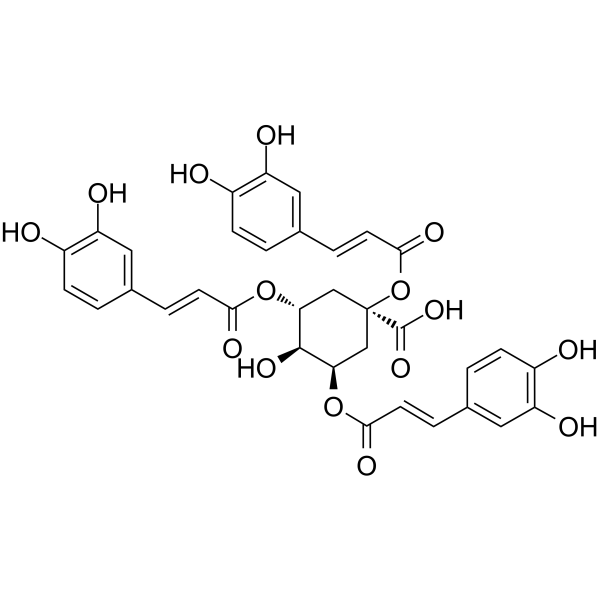
1,3,5-Tricaffeoylquinic acid
 0 ImagesCat. No.: HY-N6926CAS No.: 1073897-80-9
1,3,5-Tricaffeoylquinic acid acts as an angiogenesis inhibitor and apoptosis inducer, and exhibits anti-HIV activity. 1,3,5-Tricaffeoylquinic acid inhibits the phosphorylation of VEGFR2, ERK, PI3K, Akt and mTOR in the angiogenesis signaling pathway. 1,3,5-Tricaffeoylquinic acid regulates apoptosis-related proteins, upregulates the levels of activated caspase-8, Bax, activated PARP and caspase-3/9, while downregulates the level of Bcl-2. 1,3,5-Tricaffeoylquinic acid inhibits tube formation and shows cytotoxicity against ovarian cancer cells. 1,3,5-Tricaffeoylquinic acid can be used in studies related to ovarian cancer.
-
AD-2646
 0 ImagesCat. No.: HY-124134CAS No.: 366487-89-0Synonyms: LCL102
AD-2646 (LCL102), a ceramide analog, can kill leukemic T cells (EC50: 40 μM). AD-2646 triggers the cleavage of caspase-8, -9 and -3, as well as the caspase substrate PARP. AD-2646 is a ceramidase inhibitor. AD-2646 induces an accumulation of endogenous ceramide owing to perturbed ceramide metabolism.



