



DNA Polymerases
DNA polymerases maintain genome integrity by synthesizing DNA during replication, repair, recombination, translesion synthesis, and checkpoint-associated processes[1]. In eukaryotic DNA replication, Pol α initiates synthesis with RNA/DNA primers, while Pol δ and Pol ε extend DNA from primer ends[2]. Mechanistically, evidence supports Pol ε as the primary leading-strand replicase and Pol δ as the main lagging-strand replicase at the eukaryotic replication fork[3]. In DNA repair, base excision repair (BER) corrects oxidative, deamination, and alkylation damage, then uses polymerase-dependent repair synthesis and ligation to restore DNA continuity[4]. Compared with replicative isoforms, Pol β functions as a BER enzyme whose polymerase and dRP lyase activities coordinate gap filling and sugar-phosphate removal[5]. In mitochondria, Pol γ differs from nuclear polymerases because it is the only known human mitochondrial DNA polymerase and is essential for mitochondrial DNA replication and repair[6]. In damage-tolerance models, Pol η differs from high-fidelity replicative polymerases by enabling bypass of UV-induced thymine dimers, and POLH defects define xeroderma pigmentosum variant cells[7]. For experimental applications, aphidicolin inhibits B-family DNA polymerases and provides a tool for probing replication-dependent DNA synthesis[8].
References:
- [1]. Hubscher U, et al. Eukaryotic DNA polymerases. Annu Rev Biochem. 2002;71:133-63. [Content Brief]
- [2]. Chilkova O, et al. The eukaryotic leading and lagging strand DNA polymerases are loaded onto primer-ends via separate mechanisms but have comparable processivity in the presence of PCNA. Nucleic Acids Res. 2007;35(19):6588-97. [Content Brief]
- [3]. Miyabe I, et al. The major roles of DNA polymerases epsilon and delta at the eukaryotic replication fork are evolutionarily conserved. PLoS Genet. 2011 Dec;7(12):e1002407. [Content Brief]
- [4]. Krokan HE, et al. Base excision repair. Cold Spring Harb Perspect Biol. 2013 Apr 1;5(4):a012583. [Content Brief]
- [5]. Kumar A, et al. Interlocking activities of DNA polymerase β in the base excision repair pathway. Proc Natl Acad Sci U S A. 2022 Mar 8;119(10):e2118940119. [Content Brief]
- [6]. Vanselow C, et al. Genetic analysis of the Photosystem I subunits from the red alga, Galdieria sulphuraria. Biochim Biophys Acta. 2009 Jan;1787(1):46-59. [Content Brief]
- [7]. Masutani C, et al. The XPV (xeroderma pigmentosum variant) gene encodes human DNA polymerase eta. Nature. 1999 Jun 17;399(6737):700-4. [Content Brief]
- [8]. Baranovskiy AG, et al. Structural basis for inhibition of DNA replication by aphidicolin. Nucleic Acids Res. 2014 Dec 16;42(22):14013-21. [Content Brief]
-
DNA Polymerases Related Products (158)
Related Products (158)

-
NSC666715
 0 ImagesCat. No.: HY-120105CAS No.: 170747-33-8NSC666715 is a DNA polymerase β (Pol-β) inhibitor. NSC666715 directly and specifically interacts with Pol-β, interferes with its binding to damaged DNA, blocks its dRP lyase activity, and inhibits Pol-β-mediated SN- and LP-BER. NSC666715 induces AP site accumulation and S-phase cell cycle arrest, and triggers senescence and apoptosis (apoptosis) via the p53/p21 pathway in colorectal cancer cells. NSC666715 enhances TMZ (HY-17364)-induced DNA damage, senescence and apoptosis, and potentiates the cytotoxicity of TMZ. NSC666715 inhibits tumor growth in colon cancer xenograft models. NSC666715 can be used in research related to colorectal cancer.
-
Fazarabine
 0 ImagesCat. No.: HY-123113CAS No.: 65886-71-7Synonyms: Kymarabine; Ara-AC; NSC 281272Fazarabine (Kymarabine; Ara-AC; NSC 281272) is an orally active, blood-brain barrier permeable DNA polymerase inhibitor and antitumor agent. Fazarabine interferes with DNA synthesis via intracellular activation into a triphosphate nucleotide that directly incorporates into DNA, inducing cytotoxicity, myelosuppression, as well as moderate nausea and vomiting. Fazarabine is resistant to deamination by cytidine-deoxycytidine deaminase and undergoes spontaneous aqueous degradation. Fazarabine exerts time-dependent, broad-spectrum activity against leukemia and solid tumors. Fazarabine can be used in research related to refractory malignancies, acute leukemia, and blast-phase chronic myeloid leukemia.
-
2'-Deoxyadenosine-5'-triphosphate
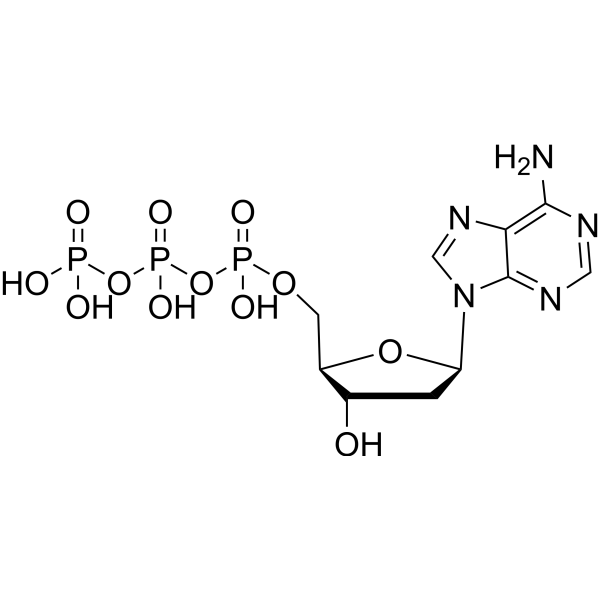 0 Images2'-Deoxyadenosine-5'-triphosphate (dATP) is a nucleotide used in cells for DNA synthesis (or replication), as a substrate of DNA polymerase.
-
Anti-MRSA agent 28
 0 ImagesCat. No.: HY-174323CAS No.: 2222727-47-9Anti-MRSA agent 28 is an antibacterial agent against multidrug resistant (MDR) gram-positive strains with MICs of 0.06-0.125 μg/mL. Anti-MRSA agent 28 can target DNA polymerase IIIC to reduce the amount of genomic DNA with the IC50 of 3.80 μg/mL. Anti-MRSA agent 28 has good antibacterial activity and reduces inflammation. Anti-MRSA agent 28 can be used against gram-positive strains and infectious conditions.
-
3′-Amino-2′,3′-dideoxy-CTP
 0 ImagesCat. No.: HY-171578CAS No.: 90053-17-13′-Amino-2′,3′-dideoxy-CTP is an analogue of nucleoside triphosphate. 3′-Amino-2′,3′-dideoxy-CTP can selectively inhibit DNA polymerase β.
-
3'-O-(2-Nitrobenzyl)-dCTP
 0 ImagesCat. No.: HY-185272CAS No.: 959755-19-23'-O-(2-Nitrobenzyl)-dCTP is a reversible terminator. 3'-O-(2-Nitrobenzyl)-dCTP can be recognized and incorporated by polymerases, thereby temporarily terminating primer extension during DNA synthesis. After incorporation into the extending DNA strand, 3'-O-(2-Nitrobenzyl)-dCTP temporarily halts the DNA polymerase extension reaction, and its 3'-O-(2-nitrobenzyl) blocking group can be removed by laser irradiation to regenerate a free 3'-OH for subsequent primer extension cycles. 3'-O-(2-Nitrobenzyl)-dCTP is applicable for resolving homopolymeric regions in DNA templates.
-
Ibezapolstat hydrochloride
 0 ImagesCat. No.: HY-128357ACAS No.: 1275582-98-3Synonyms: ACX-362E hydrochloride; GLS-362E hydrochlorideIbezapolstat hydrochloride is a first-in-class, orally active DNA polymerase IIIC (pol IIIC) inhibitor, with a Ki of 0.325 μM for the DNA pol IIIC from C. difficile. Ibezapolstat hydrochloride is developed for the research of C. difficile infection(CDI).
-
ddCTP tetrasodium
 0 ImagesCat. No.: HY-137697AddCTP tetrasodium is a type of chain-terminating deoxynucleotide. ddCTP tetrasodium can be incorporated into the extension primer chain that lacks the 3'-hydroxyl group, thereby terminating primer extension, viral genome replication, and DNA synthesis. ddCTP tetrasodium can distinguish almost identical RNA through distinguishable extension products in primer extension inhibition experiments. ddCTP tetrasodium is the active metabolite of Zalcitabine (HY-17392), which can competitively inhibit HIV reverse transcriptase, terminate the synthesis of viral DNA chains, and thereby inhibit HIV replication.
-
CI-39
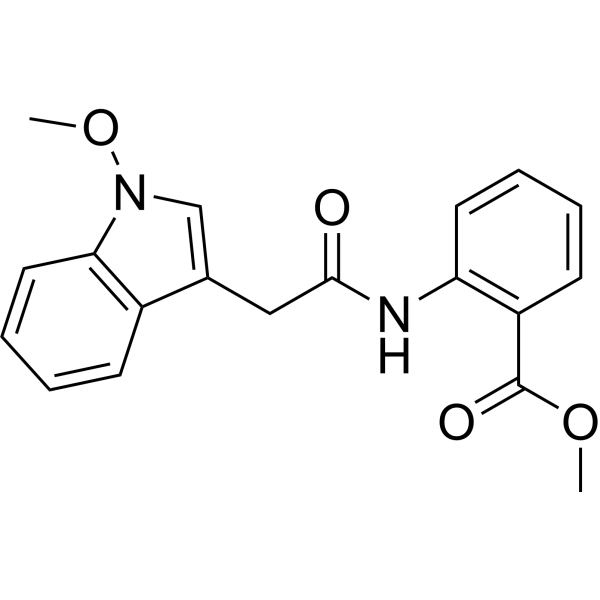 0 ImagesCat. No.: HY-146364CAS No.: 2132412-25-8CI-39 is an antiviral natural product. CI-39 is an NNRTI (non-nucleoside reverse transcriptase inhibit) antiviral agent with an EC50 of 3.40 μM and an CC50 of >30 μM for wild type HIV-1. CI-39 inhibits HIV-1 RT DNA polymerase and ribonuclease H activitiessup.
-
3'-O-(2-Nitrobenzyl)-dGTP
 0 ImagesCat. No.: HY-185273CAS No.: 959755-49-83'-O-(2-Nitrobenzyl)-dGTP is a reversible terminator. 3'-O-(2-Nitrobenzyl)-dGTP can be recognized and incorporated by DNA polymerases, thereby temporarily terminating DNA primer extension; after the 2-nitrobenzyl blocking group is removed via laser irradiation, a free 3'-OH can be regenerated to allow subsequent polymerase-mediated extension. 3'-O-(2-Nitrobenzyl)-dGTP can be used in DNA sequencing studies.
-
Rifamycin AF-013
 0 ImagesCat. No.: HY-131319CAS No.: 35225-13-9Rifamycin AF-013 is a derivative of Rifamycin (HY-B1907). Rifamycin AF-013 inhibits DNA polymerase γ by competing with dTTP and template primers for binding. Rifamycin AF-013 exhibits inhibitory activity against Rifampicin (HY-B0272)-resistant RNA polymerase. Rifamycin AF-013 inhibits non-polymerase enzymes including glutamic-oxaloacetic transaminase (GOT), glutamic-pyruvic transaminase (GPT), and Alkaline phosphatase. Rifamycin AF-013 can be used in research related to Rifampicin-resistant bacterial infections and Ehrlich ascites tumors.
-
ddATP lithium
 0 ImagesCat. No.: HY-128036DSynonyms: 2',3'-Dideoxyadenosine 5'-triphosphate lithiumddATP (lithium) (2',3'-Dideoxyadenosine 5'-triphosphate (lithium)) is an active metabolite of 2',3'-dideoxyinosine and a DNA polymerase chain elongation inhibitor. ddATP (lithium) is used in Sanger DNA sequencing and in research related to viral infection[1][2][3][4][5].
-
Naphthol AS-BS
 0 ImagesNaphthol AS-BS (Compound 1) is a human cytomegalovirus (HCMV) DNA polymerase alpha inhibitor with an IC50 of 12 μM. Naphthol AS-BS can be used for the research of infection.
-
PMEG
 0 ImagesCat. No.: HY-185150CAS No.: 114088-58-3Synonyms: 9-(2-Phosphonylmethoxy)ethylguaninePMEG is a nuclear DNA polymerases α, δ, and ε inhibitor that causes DNA chain termination, inhibits DNA synthesis, induces cytotoxicity in dividing cells. PMEG is an acyclic nucleotide phosphonate that forms an active phosphorylated metabolite, PMEG diphosphate, within cells. PMEG has activity against leukemia and melanoma in rodent models. PMEG has poor cell permeability; its prodrug is Rabacfosadine (GS-9219) (HY-13640). PMEG shows antiviral activity against against various DNA virus infections including murine cytomegalovirus (MCMV) and human cytomegalovirus (HCMV). PMEG can be used for the research of non-hodgkin's lymphoma[1][2].
-
Taq DNA polymerase 2.0
 0 ImagesCat. No.: HY-E70087Taq DNA polymerase 2.0 is a thermostable DNA polymerase that can be used in PCR.
-
5-Aza-dCTP
 0 ImagesCat. No.: HY-185899CAS No.: 72052-96-1Synonyms: 5-Aza-2'-deoxycytidine-5′-triphosphate5-Aza-dCTP (5-Aza-2'-deoxycytidine-5′-triphosphate) is a nucleotide analog that acts as a substrate for mammalian DNA polymerase α (Km = 3.0 μM) and a weak competitive inhibitor of this enzyme (Ki = 4.3 μM). 5-Aza-dCTP inhibits DNA polymerase α via incorporation into DNA through Watson-Crick base pairing, inhibits DNA methyltransferases via incorporation into hemimethylated DNA, and induces mutations in HIV-1 via incorporation into viral DNA during synthesis. 5-Aza-dCTP reverses the inhibitory effect of dTTP on dCMP deaminase, and allosterically activates dCMP deamination to the same extent as dCTP. 5-Aza-dCTP is applicable to research related to leukemia and type 1 human immunodeficiency virus infection.
-
(S)-HPMPA
 0 Images(S)-HPMPA is an antiviral agent. (S)-HPMPA can bind to and interfere with viral DNA polymerase activity, thereby inhibiting viral DNA synthesis. (S)-HPMPA can be used for the study of DNA viruses.
-
Monogalactosyldiacylglycerol
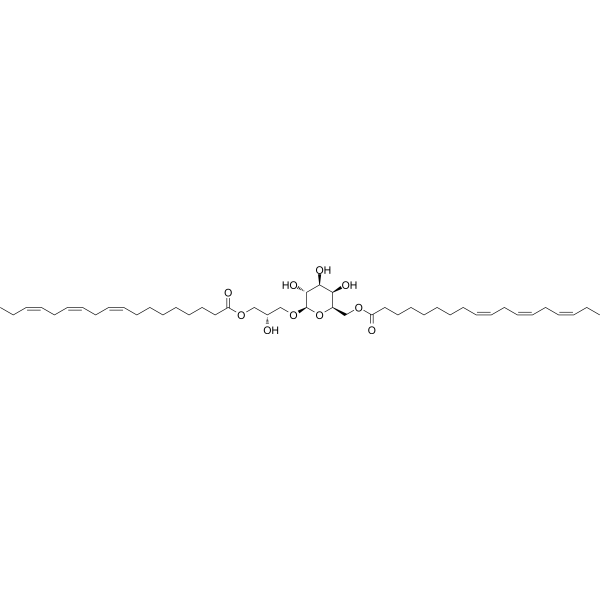 0 ImagesCat. No.: HY-N12540CAS No.: 1932659-76-1Synonyms: MGDGMonogalactosyldiacylglycerol (MGDG) is a galactolipid with anti-inflammatory and anticancer activities, which is found in photosynthetic organisms. Monogalactosyldiacylglycerol is a potent DNA polymerase inhibitor with pro-apoptotic activity. Monogalactosyldiacylglycerol inhibits the synthesis of LPS (HY-D1056)-induced inflammation-related proteins (Ex-FABP, Avidin, Serum Amyloid A). Monogalactosyldiacylglycerol exerts an anti-proliferative effect on chicken articular chondrocytes. Monogalactosyldiacylglycerol can be used in research related to osteoarthritis, cancer and inflammatory diseases.



