



mTOR
Mammalian target of Rapamycin
mTOR Isoform Specific Products
All Product Categories
-
mTOR Inhibitors
(558)
View all products
-
mTOR Agonists
(8)
View all products
-
mTOR Antagonist
(1)
View all products
-
mTOR Activators
(81)
View all products
-
mTOR Modulators
(16)
View all products
-
mTOR p53 Inhibitor
(1)
View all products
-
mTOR Degraders
(2)
View all products
-
mTOR Control
(1)
View all products
-
mTOR Substrate
(1)
View all products
-
mTOR Ligands
(2)
View all products
-
mTOR Related Products (711)
Related Products (711)

-
Antibodies (14)
-
mTOR Signaling Pathway
-
mTOR Isoform Comparison
-
Lupenone (Standard)
 0 ImagesLupenone is an orally active lupine-type triterpenoid that can be isolated from Musa basjoo. Lupenone Lupenone plays a role through the PI3K/Akt/mTOR and NF-κB signaling pathways. Lupenone has anti-inflammatory, antiviral, antidiabetic and anticancer activities.
 -
loading...Please select quantityGet Quote
August 31
-
Please select quantity
August 31
Get Quote
loading... -
-
(S)-2-Amino-5,5,5-trifluoropentanoic acid
 0 ImagesCat. No.: HY-W074912CAS No.: 122565-28-0Synonyms: (S)-5,5,5-Trifluoronorvaline; H-Nva(5,5,5-triF)-OH(S)-2-Amino-5,5,5-trifluoropentanoic acid ((S)-5,5,5-Trifluoronorvaline; H-Nva (5,5,5-triF)-OH) is a selective Sestrin-GATOR2 modulator that indirectly inhibits mTORC1 activity via a competitive binding mechanism. (S)-2-Amino-5,5,5-trifluoropentanoic acid can be used in research on cancer, metabolic diseases, neurodegenerative diseases, and muscle atrophy.\n
 -
loading...Please select quantityGet Quote
August 31
-
Please select quantity
August 31
Get Quote
loading... -
- mTOR inhibitor-24
-
loading...Please select quantityGet Quote
August 31
-
Please select quantity
August 31
Get Quote
loading... -

-
PI3K/mTOR Inhibitor-2 (Standard)
 0 ImagesCat. No.: HY-111508RCAS No.: 1848242-58-9PI3K/mTOR Inhibitor-2 (Standard) is the analytical standard of PI3K/mTOR Inhibitor-2 (HY-111508). This product is intended for research and analytical applications. PI3K/mTOR Inhibitor-2 is a potent dual pan-PI3K/mTOR inhibitor with IC50s of 3.4/34/16/1 nM for PI3Kα/PI3Kβ/PI3Kδ/PI3Kγ and 4.7 nM for mTOR. Antitumor activity.
 -
loading...Please select quantityGet Quote
August 31
-
Please select quantity
August 31
Get Quote
loading... -
-
Aschantin
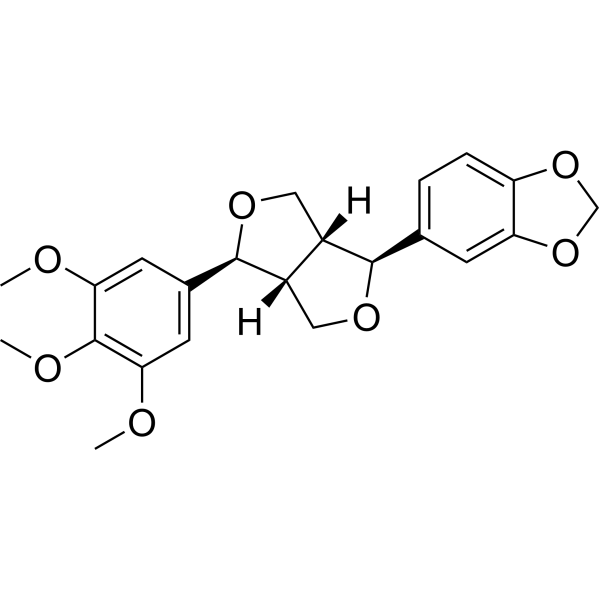 0 ImagesCat. No.: HY-N10754CAS No.: 13060-15-6Aschantin, a bisepoxylignan, can be isolated from Magnolia biondii. Aschantin has antiplasmodial, Ca2+-antagonistic, platelet activating factor-antagonistic, and chemopreventive activities. Aschantin is a mTOR kinase inhibitor. Aschantin is also an inhibitor of Cytochrome P450 and UGT enzyme.
 -
loading...Please select quantityGet Quote
August 31
-
Please select quantity
August 31
Get Quote
loading... -
-
Licoflavanone
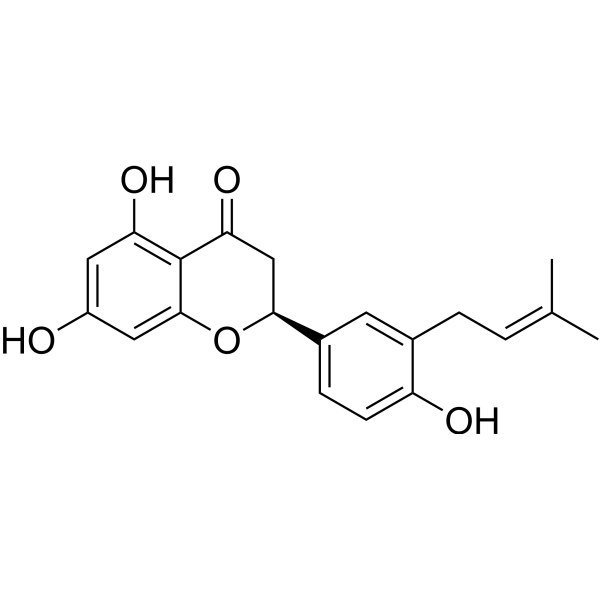 0 ImagesCat. No.: HY-N10133CAS No.: 119240-82-3Synonyms: 3′-PrenylnaringeninLicoflavanone (3′-Prenylnaringenin) is a flavanone with antioxidant, anti-inflammatory and anticancer activities. Licoflavanone can be isolated from the leaf extract of Glycyrrhiza glabra. Licoflavanone downregulates the mTOR/PI3K/AKT signaling pathway to inhibit the proliferation, migration and invasion of cancer cells, while activates Bax, Bad and multiple caspase enzymes to induce apoptosis. Its anti-inflammatory effect is manifested by reducing the nuclear translocation of NF-κB, decreasing the phosphorylation levels of p38, JNK and ERK1/2, thereby inhibiting the expression of nitric oxide, proinflammatory cytokines, COX-2 and iNOS. Licoflavanone is used in studies on nasopharyngeal carcinoma and related mechanisms.
 -
loading...Please select quantityGet Quote
August 31
-
Please select quantity
August 31
Get Quote
loading... -
-
PF-06465603
 0 ImagesCat. No.: HY-117923CAS No.: 1431626-44-6PF-06465603 is a highly potent and selective ATP-competitive kinase inhibitor and a class 1 PI3K and mTOR inhibitor. PF-06465603 is a metabolite of PF-04691502 with a terminal carboxylic acid structure.
 -
loading...Please select quantityGet Quote
August 31
-
Please select quantity
August 31
Get Quote
loading... -
-
1-Acetyl-DHAP
 0 ImagesCat. No.: HY-171229CAS No.: 2267338-53-21-Acetyl-DHA (Compound 7) is a substrate of the phosphotriesterase homology protein (PHP) and can be hydrolyzed by PHP with a kcat/km value of 100 M-1s-1. The level of 1-Acetyl-DHA is regulated by mTORC1 and is negatively correlated with the nuclear acetate level. 1-Acetyl-DHA plays an important role in cellular metabolism and the regulation of histone acetylation.
 -
loading...Please select quantityGet Quote
August 31
-
Please select quantity
August 31
Get Quote
loading... -
-
O6-Benzylguanine sodium
 0 ImagesCat. No.: HY-W002585ACAS No.: 100994-97-6O6-Benzylguanine sodium is an orally active, blood-brain barrier-penetrant inhibitor of O6-methylguanine-DNA methyltransferase (MGMT/AGT). O6-Benzylguanine sodium modulates p53 and its downstream p21 and cyclins to induce cell cycle arrest and apoptosis, and on the other hand activates mTORC1/MAPK and other signaling pathways to induce cellular senescence by inhibiting intracellular MGMT. O6-Benzylguanine sodium is used in research related to various tumors, cellular senescence, and vascular smooth muscle dysfunction.
 -
loading...Please select quantityGet Quote
August 31
-
Please select quantity
August 31
Get Quote
loading... -
-
YW3-56 hydrochloride
 0 ImagesYW3-56 (hydrochloride) is a PAD inhibitor. YW3-56 (hydrochloride) activates p53 target genes. YW3-56 (hydrochloride) activates ATF and blocks autophagy flux. YW3-56 induces ER stress through the PERK-eIF2α-ATF4 signaling cascade and inhibits the mTOR signaling. YW3-56 (hydrochloride) inhibits triple-negative breast cancer.
 -
loading...Please select quantityGet Quote
August 31
-
Please select quantity
August 31
Get Quote
loading... -
-
(rac)-Monepantel
 0 ImagesSynonyms: (rac)-AAD1566; (rac)-NUZ-001(rac)-Monepantel ((rac)-AAD1566) is the racemic form of Monepantel (HY-14774). Monepantel (AAD1566, NUZ-001), an antiparasitic agent, is an orally active mTOR inhibitor.
 -
loading...Please select quantityGet Quote
August 31
-
Please select quantity
August 31
Get Quote
loading... -
- AZD-8055 (Standard)
-
loading...Please select quantityGet Quote
August 31
-
Please select quantity
August 31
Get Quote
loading... -

-
Methyllycaconitine citrate (Standard)
 0 ImagesCat. No.: HY-N2332ARCAS No.: 351344-10-0Synonyms: MLA citrate (Standard)Methyllycaconitine citrate (Standard) is the analytical standard of Methyllycaconitine citrate (HY-N2332A). This product is intended for research and analytical applications. Methyllycaconitine (MLA) citrate is a blood-brain barrier-permeable antagonist of α7 nicotinic acetylcholine receptor (α7nAChR) with an IC50 of 2 nM. Methyllycaconitine citrate inhibits Aβ25-35-induced autophagy by restoring the mTOR pathway, and prevents reactive oxygen species (ROS) production, microglial activation, reduced dopamine uptake, loss of dopaminergic terminals and catecholamine secretion. Methyllycaconitine citrate induces hippocampal glutamate efflux, enhances long-term potentiation, and improves memory acquisition. Methyllycaconitine citrate can be used in research related to Alzheimer's disease, cerebral palsy, ParKinson's disease and schizophrenia.
 -
loading...Please select quantityGet Quote
August 31
-
Please select quantity
August 31
Get Quote
loading... -
-
PP121 (Standard)
 0 ImagesCat. No.: HY-10372RCAS No.: 1092788-83-4
 -
loading...Please select quantityGet Quote
August 31
-
Please select quantity
August 31
Get Quote
loading... -
-
O6-Benzylguanine (Standard)
 0 ImagesO6-Benzylguanine Standard is the analytical standard of O6-Benzylguanine (HY-W002585). This product is intended for research and analytical applications. O6-Benzylguanine is an orally active, blood-brain barrier-penetrant inhibitor of O6-methylguanine-DNA methyltransferase (MGMT/AGT). O6-Benzylguanine modulates p53 and its downstream p21 and cyclins to induce cell cycle arrest and apoptosis, and on the other hand activates mTORC1/MAPK and other signaling pathways to induce cellular senescence by inhibiting intracellular MGMT. O6-Benzylguanine is used in research related to various tumors, cellular senescence, and vascular smooth muscle dysfunction.
 -
loading...Please select quantityGet Quote
August 31
-
Please select quantity
August 31
Get Quote
loading... -
-
Temsirolimus (Standard)
 0 ImagesCat. No.: HY-50910RCAS No.: 162635-04-3Synonyms: CCI-779 (Standard)
 -
loading...Please select quantityGet Quote
August 31
-
Please select quantity
August 31
Get Quote
loading... -
-
D-α-Hydroxyglutaric acid disodium (Standard)
 0 ImagesCat. No.: HY-100542RCAS No.: 103404-90-6Synonyms: Disodium (R)-2-hydroxyglutarate (Standard)D-α-Hydroxyglutaric acid (disodium) (Standard) is the analytical standard of D-α-Hydroxyglutaric acid (disodium). This product is intended for research and analytical applications. D-α-Hydroxyglutaric acid disodium (Disodium (R)-2-hydroxyglutarate) is the principal metabolite accumulating in neurometabolic disease D-2-hydroxyglutaric aciduria. D-α-Hydroxyglutaric acid disodium is a weak competitive antagonist of α-ketoglutarate (α-KG) and inhibits multiple α-KG-dependent dioxygenases with a Ki of 10.87 mM. D-α-Hydroxyglutaric acid disodium increases reactive oxygen species (ROS) production. D-α-Hydroxyglutaric acid disodium binds and inhibits ATP synthase and inhibits mTOR signaling.
 -
loading...Please select quantityGet Quote
August 31
-
Please select quantity
August 31
Get Quote
loading... -
-
ETP-45658 (Standard)
 0 ImagesCat. No.: HY-110109RCAS No.: 1198357-79-7ETP-45658 (Standard) is the analytical standard of ETP-45658 (HY-110109). This product is intended for research and analytical applications. ETP-45658 is a potent PI3K inhibitor, with IC50s of 22.0 nM, 39.8 nM, 129.0 nM and 717.3 nM for PI3Kα, PI3Kδ, PI3Kβ and PI3Kγ, respectively. ETP-45658 also can inhibit DNA-PK (IC50=70.6 nM) and mTOR (IC50=152.0 nM). ETP-45658 can be used for the research of cancer.
 -
loading...Please select quantityGet Quote
August 31
-
Please select quantity
August 31
Get Quote
loading... -
-
Tulrampator (Standard)
 0 ImagesCat. No.: HY-109046RCAS No.: 1038984-31-4Synonyms: CX-1632 (Standard); S-47445 (Standard)Tulrampator (Standard) is the analytical standard of Tulrampator (HY-109046). This product is intended for research and analytical applications. Tulrampator (S-47445) is an orally active selective AMPA receptor modulator. Tulrampator possesses procognitive, enhancing synaptic plasticity, anti-depressant-anxiolytic-like, procognitive and potential neuroprotective properties. Tulrampator can be used for research of alzheimer’s disease and in major depressive disorder.
 -
loading...Please select quantityGet Quote
August 31
-
Please select quantity
August 31
Get Quote
loading... -
-
Nuvisertib (Standard)
 0 ImagesSynonyms: TP-3654 (Standard)Nuvisertib (Standard) (TP-3654 (Standard)) is the analytical standard of Nuvisertib (HY-101126). This product is intended for research and analytical applications. Nuvisertib (TP-3654) is an orally active second-generation pan-PIM kinase inhibitor with Ki values of 5 nM, 239 nM, and 42 nM against PIM-1, PIM-2, and PIM-3, respectively. Nuvisertib inhibits JAK-independent inflammatory and survival signaling pathways, reduces the production of proinflammatory cytokines, restores apoptotic sensitivity, inhibits mTORC1, MYC, and TGF-β signaling pathways, and decreases the expression of fibrosis markers. Nuvisertib selectively impairs the transport function of ABCG2, resensitizes multidrug-resistant cancer cells to cytotoxic drugs, and overcomes JAK2 inhibitor resistance. Nuvisertib can be used in research related to myelofibrosis, renal cell carcinoma, multidrug-resistant cancer, advanced solid tumors, urothelial carcinoma, and prostate adenocarcinoma.
 -
loading...Please select quantityGet Quote
August 31
-
Please select quantity
August 31
Get Quote
loading... -
No matching results
No matching results
No matching results
No matching results
No matching results
No matching results
No matching results
No matching results
No matching results
No matching results

The mammalian target of rapamycin (mTOR) signaling pathway integrates both intracellular and extracellular signals and serves as a central regulator of cell metabolism, growth, proliferation and survival[1]. mTOR is the catalytic subunit of two distinct complexes called mTORC1 and mTORC2. mTORC1 comprises DEPTOR, PRAS40, RAPTOR, mLST8, mTOR, whereas mTORC2 comprises DEPTOR, mLST8, PROTOR, RICTOR, mSIN1, mTOR[2]. Rapamycin binds to FKBP12 and inhibits mTORC1 by disrupting the interaction between mTOR and RAPTOR. mTORC1 negatively regulates autophagy through multiple inputs, including inhibitory phosphorylation of ULK1 and TFEB. mTORC1 promotes protein synthesis through activation of the translation initiation promoter S6K and through inhibition of the inhibitory mRNA cap binding 4E-BP1, and regulates glycolysis through HIF-1α. It promotes de novo lipid synthesis through the SREBP transcription factors. mTORC2 inhibits FOXO1,3 through SGK and Akt, which can lead to increased longevity. The complex also regulates actin cytoskeleton assembly through PKC and Rho kinase[3].
Growth factors: Growth factors can signal to mTORC1 through both PI3K-Akt and Ras-Raf-MEK-ERK axis. For example, ERK and RSK phosphorylate TSC2, and inhibit it.
Insulin Receptor: The activated insulin receptor recruits intracellular adaptor protein IRS1. Phosphorylation of these proteins on tyrosine residues by the insulin receptor initiates the recruitment and activation of PI3K. PIP3 acts as a second messenger which promotes the phosphorylation of Akt and triggers the Akt-dependent multisite phosphorylation of TSC2. TSC is a heterotrimeric complex comprised of TSC1, TSC2, and TBC1D7, and functions as a GTPase activating protein (GAP) for the small GTPase Rheb, which directly binds and activates mTORC1. mTORC2 primarily functions as an effector of insulin/PI3K signaling.
Wnt: The Wnt pathway activates mTORC1. Glycogen synthase kinase 3β (GSK-3β) acts as a negative regulator of mTORC1 by phosphorylating TSC2. mTORC2 is activated by Wnt in a manner dependent on the small GTPase RAC1[4].
Amino acids: mTORC1 senses both lysosomal and cytosolic amino acids through distinct mechanisms. Amino acids induce the movement of mTORC1 to lysosomal membranes, where the Rag proteins reside. A complex named Ragulator, interact with the Rag GTPases, recruits them to lysosomes through a mechanism dependent on the lysosomal v-ATPase, and is essential for mTORC1 activation. In turn, lysosomal recruitment enables mTORC1 to interact with GTP-bound RHEB, the end point of growth factor. Cytosolic leucine and arginine signal to mTORC1 through a distinct pathway comprised of the GATOR1 and GATOR2 complexes.
Stresses: mTORC1 responds to intracellular and environmental stresses that are incompatible with growth such as low ATP levels, hypoxia, or DNA damage. A reduction in cellular energy charge, for example during glucose deprivation, activates the stress responsive metabolic regulator AMPK, which inhibits mTORC1 both indirectly, through phosphorylation and activation of TSC2, as well as directly through the phosphorylation of RAPTOR. Sestrin1/2 are two transcriptional targets of p53 that are implicated in the DNA damage response, and they potently activate AMPK, thus mediating the p53-dependent suppression of mTOR activity upon DNA damage. During hypoxia, mitochondrial respiration is impaired, leading to low ATP levels and activation of AMPK. Hypoxia also affects mTORC1 in AMPK-independent ways by inducing the expression of REDD1, the protein products of which then suppress mTORC1 by promoting the assembly of TSC1-TSC2[2].
Reference:
[1]. Laplante M, et al.mTOR signaling at a glance.J Cell Sci. 2009 Oct 15;122(Pt 20):3589-94.
[2]. Zoncu R, et al. mTOR: from growth signal integration to cancer, diabetes and ageing.Nat Rev Mol Cell Biol. 2011 Jan;12(1):21-35.
[3]. Johnson SC, et al. mTOR is a key modulator of ageing and age-related disease.Nature. 2013 Jan 17;493(7432):338-45.
[4]. Shimobayashi M, et al. Making new contacts: the mTOR network in metabolism and signalling crosstalk.Nat Rev Mol Cell Biol. 2014 Mar;15(3):155-62.
Your Search Returned No Results.
Sorry. There is currently no product that acts on isoform Bcl-2, Bcl-W and Bim together.Please
try each isoform separately.



