



PGLa
PGLa, a 21-residue peptide, is an antimicrobial peptide. PGLa is a member of the magainin family of antibiotic peptides found in frog skin and its secretions.
Nos produits utilisent uniquement pour la recherche. Nous ne vendons pas aux patients.
- CAS No.: 102068-15-5
- Formule: C88H162N26O22S
- Masse moléculaire:1968.45
-
Stockage:
Please store the product under the recommended conditions in the Certificate of Analysis.

To place orders, for customer services and technical support, please contact: MedChemExpress USA
Tel: 609-228-6898 E-mail: [email protected] [email protected]


-
 Activité biologique
-
Chemical Information
- Protocole
- Pureté et documentation
- Références
-
 Help & FAQs


Voir tous les produits spécifiques à Isoform Antibiotic
More

Activité biologique
Description
IC50 & Target
Anti-bacteria[1]
Cellular Effect
|
Cell Line

|
Type | Value | Description | References |
|---|---|---|---|---|
| CEM-SS | EC50 |
>50.8 μM
Compound: PGLa
|
Antiviral activity against HIV1 3B infected in human CEM-SS cells assessed as inhibition of viral replication after 6 days by XTT assay
Antiviral activity against HIV1 3B infected in human CEM-SS cells assessed as inhibition of viral replication after 6 days by XTT assay
|
[PMID: 20086159] |
In Vitro
PGLa is a peptide starting with a glycine and ending with a leucine amide[1].
PGLa is bacteriostatic against both Gram-positive and Gram-negative bacteria with MIC values of 64 and 32 mg/L against S. aureus and E. coli, respectively[2].
MedChemExpress (MCE) has not independently confirmed the accuracy of these methods. They are for reference only.


Chemical Information
-
CAS No. 102068-15-5
-
Masse moléculaire 1968.45
-
Formule C88H162N26O22S
-
Sequence
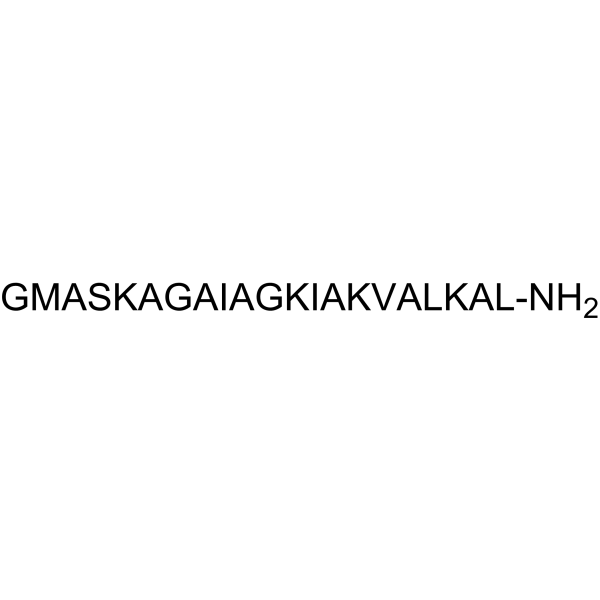
Gly-Met-Ala-Ser-Lys-Ala-Gly-Ala-Ile-Ala-Gly-Lys-Ile-Ala-Lys-Val-Ala-Leu-Lys-Ala-Leu-NH2
-
Sequence Shortening
GMASKAGAIAGKIAKVALKAL-NH2
-
Livraison
Room temperature in continental US; may vary elsewhere.
-
Stockage
Please store the product under the recommended conditions in the Certificate of Analysis.


Pureté et documentation
Références
[1]. Bechinger B, et al. Structure and dynamics of the antibiotic peptide PGLa in membranes by solution and solid-state nuclear magnetic resonance spectroscopy. Biophys J. 1998 Feb;74(2 Pt 1):981-7. [Content Brief]
[2]. Radchenko DS, et al. Does a methionine-to-norleucine substitution in PGLa influence peptide-membrane interactions? Biochim Biophys Acta. 2016 Sep;1858(9):2019-27. [Content Brief]

Calculators
Concentration (start) × Volume (start) = Concentration (final) × Volume (final)


PGLa Related Classifications
HY-P0274 Related Classifications
 Powered by Bioz