



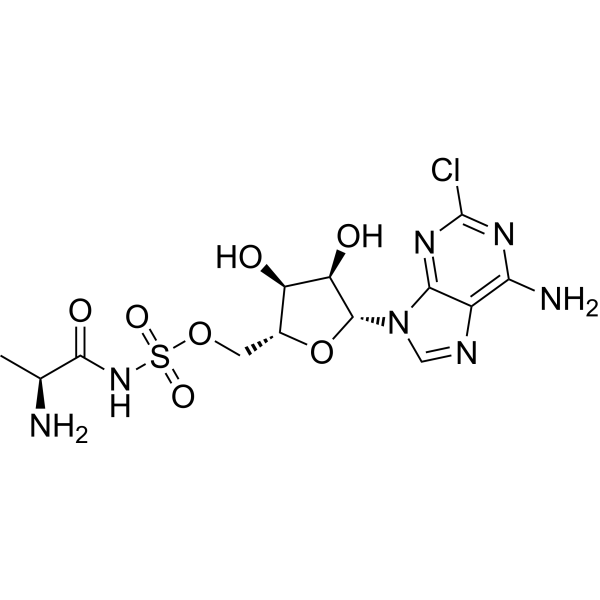
Ascamycin
Ascamycin is a 5'-O-sulfonamide ribonucleoside antibiotic produced by Streptomyces sp. JCM9888. Ascamycin has a selective antibacterial activity against Xanthomonas species with MIC values of 0.4 μg/mL, 12.5 μg/mL and 12.5 μg/mL for Xanthomonas citri, Xanthomonas oryzae and Mycobacterium phlei, respectively.
Nos produits utilisent uniquement pour la recherche. Nous ne vendons pas aux patients.
- CAS No.: 91432-48-3
- Formule: C13H18ClN7O7S
- Masse moléculaire:451.84
-
Stockage:
Please store the product under the recommended conditions in the Certificate of Analysis.

To place orders, for customer services and technical support, please contact: MedChemExpress USA
Tel: 609-228-6898 E-mail: [email protected] [email protected]


-
 Activité biologique
-
Chemical Information
- Protocole
- Pureté et documentation
- Références
-
 Help & FAQs


Voir tous les produits spécifiques à Isoform Antibiotic
More

Activité biologique
Description
IC50 & Target
MIC: 0.4 μg/mL (Xanthomonas citri), 12.5 μg/mL (Xanthomonas oryzae) and 12.5 μg/mL (Mycobacterium phlei)[1]
In Vitro
The Ascamycin has C2-chloroadenine as the base on C-1' which lacks the chlorine[1]. Ascamycin has a selective antibacterial activity against Xanthomonas species. When Ascamycin is dealanylated, Dealanylascamycin shows a broad antibacterial activity against various Gram-negative and Gram-positive bacteria. Xanthomonas citri is susceptible to Ascamycin by virtue of the Ascamycin-dealanylating enzyme on the cell surface[2].
MedChemExpress (MCE) has not independently confirmed the accuracy of these methods. They are for reference only.


Chemical Information
-
CAS No. 91432-48-3
-
Masse moléculaire 451.84
-
Formule C13H18ClN7O7S
-
SMILES
O[C@@H]([C@H]([C@H](N1C=NC2=C(N=C(Cl)N=C21)N)O3)O)[C@H]3COS(=O)(NC([C@@H](N)C)=O)=O
-
Structure Classification
-
Initial Source
Streptomyces sp
-
Livraison
Room temperature in continental US; may vary elsewhere.
-
Stockage
Please store the product under the recommended conditions in the Certificate of Analysis.


Pureté et documentation
Références
[1]. Isono K, et al. Ascamycin and dealanylascamycin, nucleoside antibiotics from Streptomyces sp. J Antibiot (Tokyo). 1984 Jun;37(6):670-2. [Content Brief]
[2]. Osada H, rt al. Purification and characterization of ascamycin-hydrolysing aminopeptidase from Xanthomonas citri. Biochem J. 1986 Jan 15;233(2):459-63. [Content Brief]
[3]. Zhao C, et al. Characterization of biosynthetic genes of ascamycin/dealanylascamycin featuring a 5'-O-sulfonamide moiety in Streptomyces sp. JCM9888. PLoS One. 2014 Dec 5;9(12):e114722. [Content Brief]

Calculators
Concentration (start) × Volume (start) = Concentration (final) × Volume (final)


Ascamycin Related Classifications
HY-121071 Related Classifications
 Powered by Bioz