



PROTAC DDa-1
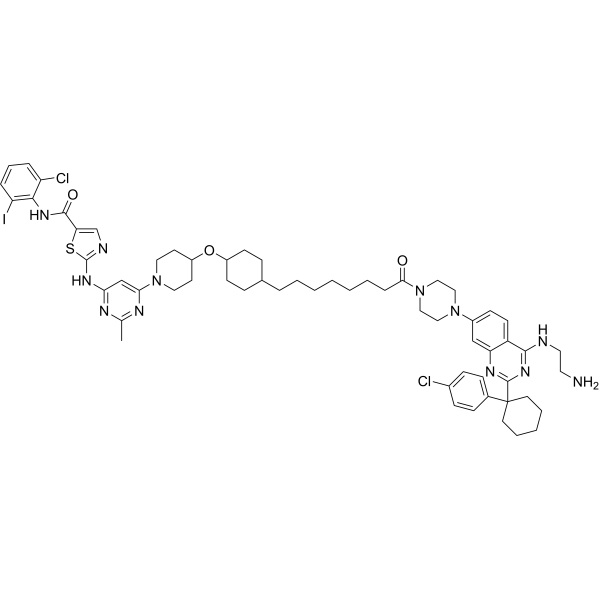
PROTAC DDa-1 is a multi-targeted DCAF1-recruiting tyrosine kinase PROTAC degrader. PROTAC DDa-1 mediates the degradation of TNK2, CSK, LIMK2, TEC, and BTK, with a DC50 of 90 nM for BTK. PROTAC DDa-1 reduces the viability of BTK-dependent diffuse large B-cell lymphoma cells. PROTAC DDa-1 can be used for the research of diffuse large B-cell lymphoma.
(Pink: Bcr-Abl and Btk and Src ligand (HY-107447); Blue: Cereblon ligand (HY-149934); Black: linker).
Nos produits utilisent uniquement pour la recherche. Nous ne vendons pas aux patients.
- CAS No.: 3036944-98-3
- Formule: C60H77Cl2N13O3S
- Masse moléculaire:1131.31
-
Stockage:
Please store the product under the recommended conditions in the Certificate of Analysis.

To place orders, for customer services and technical support, please contact: MedChemExpress USA
Tel: 609-228-6898 E-mail: [email protected] [email protected]


-
 Activité biologique
-
Chemical Information
- Protocole
- Pureté et documentation
- Références
-
 Help & FAQs


Voir tous les produits spécifiques à Isoform PROTACs
More

Activité biologique
Description
In Vitro
DDa-1 (5 µM; 6 h) reduces the abundance of CSK, LIMK2, TEC, and TNK2 proteins in HEK293T cells[1].
DDa-1 (62.5 nM-2000 nM; 24 h) potently degrades endogenous BTK with sub-µM potency in TMD8 diffuse large B-cell lymphoma cells[1].
MedChemExpress (MCE) has not independently confirmed the accuracy of these methods. They are for reference only.
-
Cell Line:HEK293T cells
-
Concentration:50 nM, 500 nM, 5000 nM
-
Incubation Time:6 h
-
Result:Caused significant reduction in CSK and LIMK2 protein levels, but did not affect LYN or ABL1 levels.
-
Cell Line:TMD8 diffuse large B-cell lymphoma cells
-
Concentration:62.5 nM, 125 nM, 250 nM, 500 nM, 1000 nM, 2000 nM
-
Incubation Time:24 h
-
Result:Caused concentration-dependent reduction of endogenous BTK protein levels with sub-µM potency.


Chemical Information
-
CAS No. 3036944-98-3
-
Masse moléculaire 1131.31
-
Formule C60H77Cl2N13O3S
-
SMILES
O=C(N1CCN(C2=CC=C3C(N=C(C4(C5=CC=C(Cl)C=C5)CCCCC4)N=C3NCCN)=C2)CC1)CCCCCCCN6CCC(OC7CCN(C8=CC(NC9=NC=C(C(NC%10=C(C)C=CC=C%10Cl)=O)S9)=NC(C)=N8)CC7)CC6
-
Livraison
Room temperature in continental US; may vary elsewhere.
-
Stockage
Please store the product under the recommended conditions in the Certificate of Analysis.


Pureté et documentation
Références

Calculators
Concentration (start) × Volume (start) = Concentration (final) × Volume (final)


PROTAC DDa-1 Related Classifications
HY-156745 Related Classifications
 Powered by Bioz