



Dehydrocrenatine
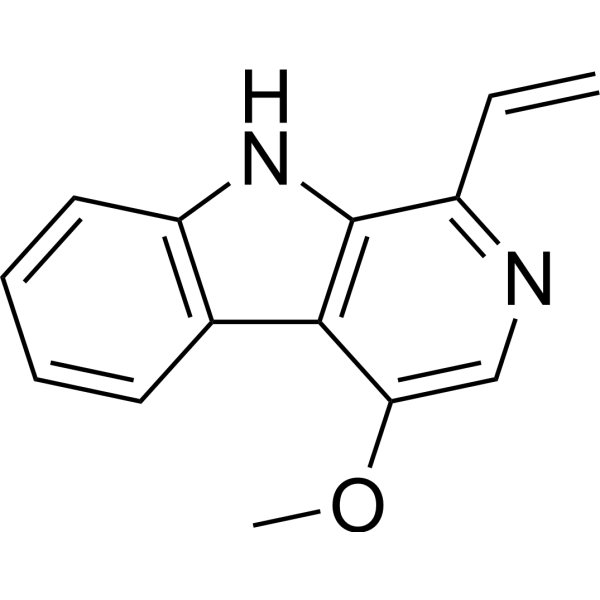
Dehydrocrenatidine, a β-carboline alkaloid that can be isolated from Picrasma quassioides. Dehydrocrenatidine induces cell apoptosis by activates ERK and JNK. Dehydrocrenatidine inhibits invasion and migration of cancer cells, it also suppresses neuronal excitability to exert analgesic effects.
Nos produits utilisent uniquement pour la recherche. Nous ne vendons pas aux patients.
- CAS No.: 26585-13-7
- Formule: C14H12N2O
- Masse moléculaire:224.26
-
Stockage:
Please store the product under the recommended conditions in the Certificate of Analysis.

To place orders, for customer services and technical support, please contact: MedChemExpress USA
Tel: 609-228-6898 E-mail: [email protected] [email protected]


-
 Activité biologique
-
Chemical Information
- Protocole
- Pureté et documentation
- Références
-
 Help & FAQs




Activité biologique
Description
Cellular Effect
|
Cell Line

|
Type | Value | Description | References |
|---|---|---|---|---|
| A2780 | IC50 |
4.77 μg/mL
Compound: 50
|
Antiproliferative activity against human A2780 cells
Antiproliferative activity against human A2780 cells
|
[PMID: 34332400] |
| SK-OV-3 | IC50 |
15.72 μg/mL
Compound: 50
|
Antiproliferative activity against human SK-OV-3 cells
Antiproliferative activity against human SK-OV-3 cells
|
[PMID: 34332400] |


Product Details
-
Structure Classification
-
Initial Source


Chemical Information
-
CAS No. 26585-13-7
-
Masse moléculaire 224.26
-
Formule C14H12N2O
-
SMILES
COC1=CN=C(C=C)C(N2)=C1C3=C2C=CC=C3
-
Livraison
Room temperature in continental US; may vary elsewhere.
-
Stockage
Please store the product under the recommended conditions in the Certificate of Analysis.
Pureté et documentation


Références
[1]. Ho HY, et al. Apoptotic effects of dehydrocrenatidine via JNK and ERK pathway regulation in oral squamous cell carcinoma. Biomed Pharmacother. 2021 May;137:111362. [Content Brief]
[2]. Hsieh MC, et al. Dehydrocrenatidine extracted from Picrasma quassioidesinduces the apoptosis of nasopharyngeal carcinoma cells through the JNK and ERK signaling pathways. Oncol Rep. 2021 Aug;46(2):166. [Content Brief]

Calculators
Concentration (start) × Volume (start) = Concentration (final) × Volume (final)


Dehydrocrenatine Related Classifications
HY-N3711 Related Classifications
 Powered by Bioz