



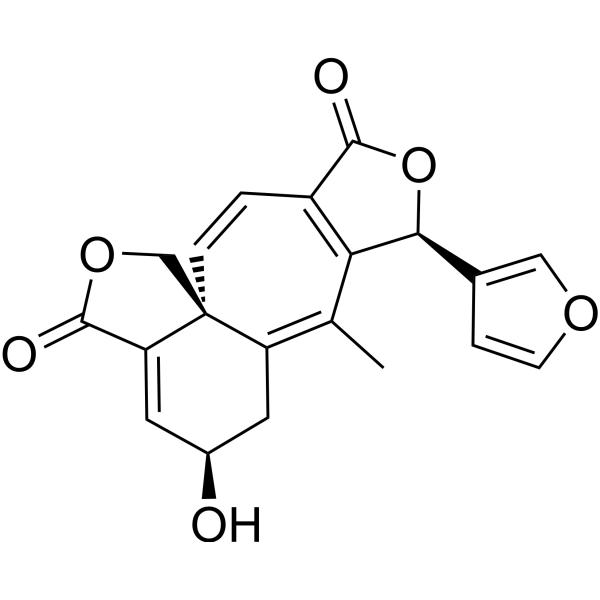
Salviandulin E
Salviandulin E is a diterpenoid compound that can be isolated from Salvia leucantha CAV.. Salviandulin E shows antitrypanosomal activity against T. b. brucei GUTat 3.1 parasites with an IC50 value of 0.72 µg/mL.
Nos produits utilisent uniquement pour la recherche. Nous ne vendons pas aux patients.
- CAS No.: 158994-32-2
- Formule: C20H16O6
- Masse moléculaire:352.34
-
Stockage:
Please store the product under the recommended conditions in the Certificate of Analysis.

To place orders, for customer services and technical support, please contact: MedChemExpress USA
Tel: 609-228-6898 E-mail: [email protected] [email protected]


-
 Activité biologique
-
Chemical Information
- Pureté et documentation
- Références
-
 Help & FAQs


Voir tous les produits spécifiques à Isoform Parasite
More

Activité biologique
Description
IC50 & Target
|
Trypanosoma |
Cellular Effect
|
Cell Line

|
Type | Value | Description | References |
|---|---|---|---|---|
| MRC5 | IC50 |
0.84 μg/mL
Compound: 1
|
Cytotoxicity against human MRC5 cells
Cytotoxicity against human MRC5 cells
|
[PMID: 24388808] |
In Vitro
Salviandulin E shows cytotoxicity in MRC-5 cells with an IC50 value of 0.84 µg/mL[2].
MedChemExpress (MCE) has not independently confirmed the accuracy of these methods. They are for reference only.


Chemical Information
-
CAS No. 158994-32-2
-
Masse moléculaire 352.34
-
Formule C20H16O6
-
SMILES
CC1=C2[C@@]3(C=CC4=C1[C@H](C5=COC=C5)OC4=O)C(C(OC3)=O)=C[C@@H](C2)O
-
Structure Classification
-
Initial Source
-
Livraison
Room temperature in continental US; may vary elsewhere.
-
Stockage
Please store the product under the recommended conditions in the Certificate of Analysis.


Pureté et documentation
Références
[1]. Narukawa Y, et al. A novel diterpenoid with a rearranged neoclerodane skeleton from Salvia leucantha CAV. J Nat Med. 2006 Jul;60(3):206-209. [Content Brief]
[2]. Aoyagi Y, et al. Semisynthesis of salviandulin E analogues and their antitrypanosomal activity. Bioorg Med Chem Lett. 2014 Jan 15;24(2):442-6. [Content Brief]

Calculators
Concentration (start) × Volume (start) = Concentration (final) × Volume (final)


Salviandulin E Related Classifications
HY-N11550 Related Classifications
 Powered by Bioz