



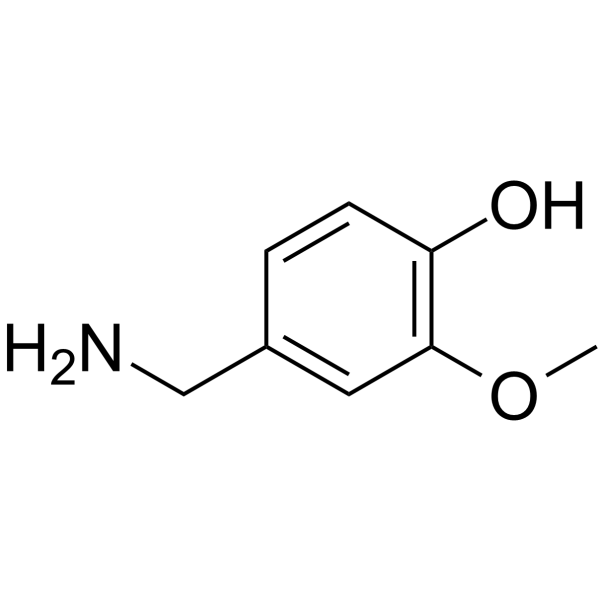
Vanillylamine
Based on 1 publication(s) in Google Scholar
Vanillylamine is an amine substrate and also a synthetic intermediate for flavors, fragrances, capsaicin (HY-10448), and other aromatic compounds. Vanillylamine can undergo amidation reactions with palmitic anhydride (HY-W093183) and nonanoic anhydride to produce palmitoyl vanillylamide and N-vanillylnonanamide. When the substrate concentration increases, Vanillylamine causes substrate inhibition of the amidation reaction catalyzed by Rhizomucor miehei lipase (Lipozyme IM). As a capsaicinoid precursor, Vanillylamine can promote the production of capsaicin and dihydrocapsaicin (HY-N0361), and can also be reversibly converted to vanillin (HY-N0098) via oxidative deamination or through the action of microbial and plant oxidases. Vanillylamine is mostly used in research related to flavor synthesis, enzyme-catalyzed reactions, and capsaicin biosynthesis.
Nos produits utilisent uniquement pour la recherche. Nous ne vendons pas aux patients.
- Pureté : 98.05%
- CAS No.: 1196-92-5
- Formule: C8H11NO2
- Masse moléculaire:153.18
-
Stockage:
4°C, protect from light, stored under nitrogen
* In solvent : -80°C, 6 months; -20°C, 1 month (protect from light, stored under nitrogen)

To place orders, for customer services and technical support, please contact: MedChemExpress USA
Tel: 609-228-6898 E-mail: [email protected] [email protected]


-
 Activité biologique
-
Chemical Information
-
Solvant et solubilité
- Pureté et documentation
- Références
-
 Help & FAQs




Activité biologique
Description
In Vitro
Vanillylamine (30 mM; 2-24 h) co-expressed with FDH in E. coli K-12 MG1655 RARE enables whole cells to achieve a 92.1% yield from 30 mM vanillin within 4 h[8].
Vanillylamine (30 mM; 24 h) in E. coli K-12 MG1655 RARE whole cells gives yields of 92.07% and 92.5% with a vanillin:ammonium formate ratio of 1:5 and 1 mM NAD+, respectively[8].
Vanillylamine (30 mM; 24 h) supports the highest yields of 94.9% and 95.8% at 37°C and pH 8.0, respectively, in the E. coli K-12 MG1655 RARE three-enzyme whole cell[8].
Vanillylamine (20-60 mM; up to 16 h) is produced by intermittent feeding of E. coli K-12 MG1655 RARE whole cells, reaching 58.4 mM from 60 mM vanillin at 16 h (97.3% yield)[8].
Vanillylamine (30-60 mM; 24 h) is produced from 30 mM isoeugenol (HY-N1952) by E. coli K-12 MG1655 RARE co-expressing CvTA, ADO, ALD, and FDH, with a yield of 73.2% and a selectivity of 100%[8].
Vanillylamine (5 mM; 23 h) reacts with 3 mM Palmitic anhydride (HY-W093183) in SC-CO2 amidation with immobilized Mucor miehei Lipozyme IM, producing the highest palmitoyl vanillylamide yield (324.2 µM) among the five lipases tested[4].
Vanillylamine (5 mM; 23 h) with 3 mM palmitic anhydride and Lipozyme IM at 50°C and 17 MPa produces 324.2 µM palmitoyl vanillylamide; extending the time or using 60°C brings only a slight increase, and the yield decreases at 24 MPa[4].
Vanillylamine (5 mM; 23 h) reacts with Lipozyme IM using palmitic anhydride as the acyl donor to produce the highest palmitoyl vanillylamide yield (324.2 µM)[4].
Vanillylamine (5 mM; 23 h) shows that increasing palmitic anhydride improves product formation, and 5/15 is selected as the practical molar ratio, yielding 574.4 µM palmitoyl vanillylamide[4].
Vanillylamine (5 mM; 23 h) reacts with 15 mM palmitic anhydride, showing that increasing Lipozyme IM from 0.5% to 1.5% increases palmitoyl vanillylamide production from 574.4 µM to 710.9 µM, but 0.5% is selected for economic considerations[4].
Vanillylamine (5 mM; 23 h) reacts with 15 mM palmitic anhydride, indicating that water is detrimental to the Lipozyme IM-catalyzed amidation reaction; therefore, pH 8 is selected, with yields of 570-660 µM at pH 7-9 and approximately 370 µM at pH 10[4].
Vanillylamine (5 mM; 23-69 h) maintains approximately 100% activity after the first 23 h cycle under optimized amidation conditions with 15 mM palmitic anhydride and Lipozyme IM, but only approximately 40% after 46 h and only approximately 15% after 69 h[4].
Vanillylamine (5 mM; 23 h) undergoes amidation with nonanoic anhydride catalyzed by Lipozyme IM in SC-CO2, with the highest yield of 40.0% at a vanillylamine/nonanoic anhydride ratio of 0.25 (170 bar, 50°C), which increases to 49.2% upon addition of 2 mM CuCl2[6].
Vanillylamine (1.25 mM; after day 3 and after day 6; continuous observation for 15 days) and ferulic acid (Ferulic acid) (HY-N0060) (1.25 mM) are intermittently co-supplemented into immobilized C. frutescens cultures; the maximum yields of capsaicin, dihydrocapsaicin, and vanillin on day 6 are 122 µg/culture, 86 µg/culture, and 160 µg/culture, respectively, whereas supplementation after day 6 produces 142.5 µg/culture vanillin on day 12[7].
MedChemExpress (MCE) has not independently confirmed the accuracy of these methods. They are for reference only.


Product Details
-
Structure Classification
-
Initial Source


Chemical Information
-
CAS No. 1196-92-5
-
Appearance Solid
-
Masse moléculaire 153.18
-
Formule C8H11NO2
-
Color Off-white to yellow
-
SMILES
COC1=C(C=CC(=C1)CN)O
-
Livraison
Room temperature in continental US; may vary elsewhere.
-
Stockage
4°C, protect from light, stored under nitrogen
* In solvent : -80°C, 6 months; -20°C, 1 month (protect from light, stored under nitrogen)


Publications (1)
-
Journal Impact Factor
-
Most Recent
-
Environ Res
Biovalorization of lignin-derived substrates to vanillylamine via a self-sufficient amino donor and cofactor recycling whole-cell platform. [Abstract]2024 Dec 15;263(Pt 2):120112. PMID: 39369779


Solvant et solubilité
In Vitro:
DMSO : 50 mg/mL (326.41 mM; Need ultrasonic; Hygroscopic DMSO has a significant impact on the solubility of product, please use newly opened DMSO)
Please refer to the solubility information to select the appropriate solvent. Once prepared, please aliquot and store the solution to prevent product inactivation from repeated freeze-thaw cycles.
Storage method and period of stock solution: -80°C, 6 months; -20°C, 1 month (protect from light, stored under nitrogen). When stored at -80°C, please use it within 6 months. When stored at -20°C, please use it within 1 month.
Concentration (start) × Volume (start) = Concentration (final) × Volume (final)
In Vivo:
Select the appropriate dissolution method based on your experimental animal and administration route.
- For the following dissolution methods, please ensure to first prepare a clear stock solution using an In Vitro approach and then sequentially add co-solvents:
- To ensure reliable experimental results, the clarified stock solution can be appropriately stored based on storage conditions. As for the working solution for In Vivo experiments, it is recommended to prepare freshly and use it on the same day.
- The percentages shown for the solvents indicate their volumetric ratio in the final prepared solution. If precipitation or phase separation occurs during preparation, heat and/or sonication can be used to aid dissolution.
Add each solvent one by one: 10% DMSO 40% PEG300 5% Tween-80 45% Saline
Solubility: ≥ 2.5 mg/mL (16.32 mM); Clear solution
This protocol yields a clear solution of ≥ 2.5 mg/mL (saturation unknown).
Taking 1 mL working solution as an example, add 100 μL DMSO stock solution (25.0 mg/mL) to 400 μL PEG300, and mix evenly; then add 50 μL Tween-80 and mix evenly; then add 450 μL Saline to adjust the volume to 1 mL.
Preparation of Saline: Dissolve 0.9 g sodium chloride in ddH₂O and dilute to 100 mL to obtain a clear Saline solution.
Add each solvent one by one: 10% DMSO 90% (20% SBE-β-CD in Saline)
Solubility: ≥ 2.5 mg/mL (16.32 mM); Clear solution
This protocol yields a clear solution of ≥ 2.5 mg/mL (saturation unknown).
Taking 1 mL working solution as an example, add 100 μL DMSO stock solution (25.0 mg/mL) to 900 μL 20% SBE-β-CD in Saline, and mix evenly.
Preparation of 20% SBE-β-CD in Saline (4°C, storage for one week): 2 g SBE-β-CD powder is dissolved in 10 mL Saline, completely dissolve until clear.
In Vivo Dissolution Calculator
Please enter the basic information of animal experiments:
-
-
-
-
Recommended: Prepare an additional quantity of animals to account for potential losses during experiments.
Please enter your animal formula composition:
-
%DMSO +
Recommended: Keep the proportion of DMSO in working solution below 2% if your animal is weak.
-
%+
-
+%Tween-80 + +
-
%Saline +
The co-solvents required include: DMSO, . All of co-solvents are available by MedChemExpress (MCE). , Tween 80. All of co-solvents are available by MedChemExpress (MCE).
Working solution concentration: 0.22 mg/mL
Method for preparing stock solution: mg drug dissolved in μL DMSO. Stock solution concentration: mg/mL. * In solvent : -80°C, 6 months; -20°C, 1 month (protect from light, stored under nitrogen)
1. Take μL DMSO stock solution;
2. Add μL .
μL , mix evenly;
3. Then add μL Tween 80, mix evenly;
4. Then add μL
Please ensure that the stock solution in the first step is dissolved to a clear state, and add co-solvents in sequence. You can use ultrasonic heating (ultrasonic cleaner, recommended frequency 20-40 kHz), vortexing, etc. to assist dissolution.
Pureté et documentation


Références

Complete Stock Solution Preparation Table
Please refer to the solubility information to select the appropriate solvent. Once prepared, please aliquot and store the solution to prevent product inactivation from repeated freeze-thaw cycles.
Storage method and period of stock solution: -80°C, 6 months; -20°C, 1 month (protect from light, stored under nitrogen). When stored at -80°C, please use it within 6 months. When stored at -20°C, please use it within 1 month.
| Optional Solvent | Concentration Solvent Mass | 1 mg | 5 mg | 10 mg | 25 mg |
|---|---|---|---|---|---|
| DMSO | 1 mM | 6.5283 mL | 32.6413 mL | 65.2827 mL | 163.2067 mL |
| 5 mM | 1.3057 mL | 6.5283 mL | 13.0565 mL | 32.6413 mL | |
| 10 mM | 0.6528 mL | 3.2641 mL | 6.5283 mL | 16.3207 mL | |
| 15 mM | 0.4352 mL | 2.1761 mL | 4.3522 mL | 10.8804 mL | |
| 20 mM | 0.3264 mL | 1.6321 mL | 3.2641 mL | 8.1603 mL | |
| 25 mM | 0.2611 mL | 1.3057 mL | 2.6113 mL | 6.5283 mL | |
| 30 mM | 0.2176 mL | 1.0880 mL | 2.1761 mL | 5.4402 mL | |
| 40 mM | 0.1632 mL | 0.8160 mL | 1.6321 mL | 4.0802 mL | |
| 50 mM | 0.1306 mL | 0.6528 mL | 1.3057 mL | 3.2641 mL | |
| 60 mM | 0.1088 mL | 0.5440 mL | 1.0880 mL | 2.7201 mL | |
| 80 mM | 0.0816 mL | 0.4080 mL | 0.8160 mL | 2.0401 mL | |
| 100 mM | 0.0653 mL | 0.3264 mL | 0.6528 mL | 1.6321 mL |


Vanillylamine Related Classifications
HY-W097899 Related Classifications
 Powered by Bioz