



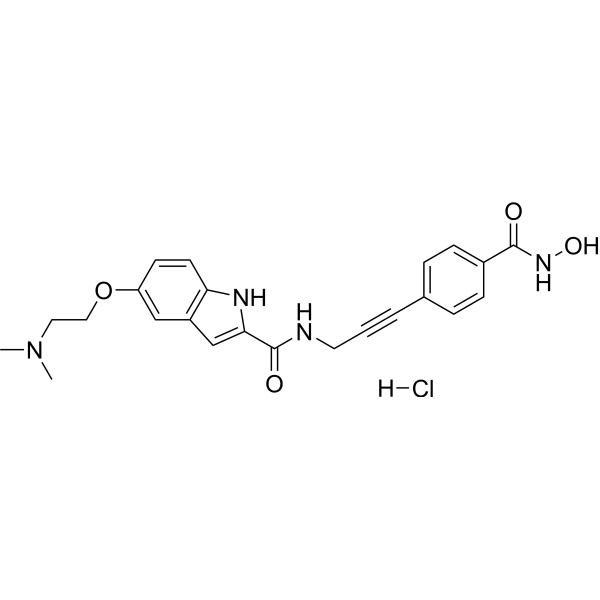
CRA-026440 hydrochloride
Based on 1 publication(s) in Google Scholar
CRA-026440 hydrochloride is a potent, broad-spectrum HDAC (HDAC) inhibitor. The Ki values against recombinant HDAC isoenzymes HDAC1, HDAC2, HDAC3, HDAC6, HDAC8, and HDAC10 are 4 nM, 14 nM, 11 nM, 15 nM, 7 nM, and 20 nM respectively. CRA-026440 hydrochloride shows antitumor and antiangiogenic activities. CRA-026440 (hydrochloride) is a click chemistry reagent, it contains an Alkyne group and can undergo copper-catalyzed azide-alkyne cycloaddition (CuAAc) with molecules containing Azide groups.
Nur für Forschungszwecke. Wir verkaufen nicht an Patienten.
- Reinheit : 98.12%
- CAS. Nr.: 847459-98-7
- Formel: C23H25ClN4O4
- Molecular Weight:456.92
-
Speicherung:Powder -20°C, 3 years , 4°C, 2 years ; In solvent -80°C, 6 months , -20°C, 1 month

To place orders, for customer services and technical support, please contact: MedChemExpress USA
Tel: 609-228-6898 E-mail: [email protected] [email protected]


-
 Biologische Aktivität
-
Chemical Information
-
Lösungsmittel & Löslichkeit
- Protokoll
- Reinheit & Dokumentation
- Verweise
-
 Help & FAQs


Publications Citing Use of MedChemExpress (MCE) CRA-026440 hydrochloride
More

Biologische Aktivität
Beschreibung
IC50 & Target
[1]|
HDAC1 4 nM (IC50) |
HDAC2 14 nM (IC50) |
HDAC3/SMRT 11 nM (IC50) |
HDAC6 15 nM (IC50) |
HDAC8 7 nM (IC50) |
HDAC10 20 nM (IC50) |
In Vitro
CRA-026440 hydrochloride has antiproliferative effect on HUVEC endothelial cells with a GI50 value of 1.41 μM[1].
CRA-026440 hydrochloride (0.1-10 μM; 18 hours) results in the accumulation of acetylated histone and acetylated tubulin, leading to an inhibition of tumor cell growth and the induction of apoptosis[1].
CRA-026440 hydrochloride (0.1-10 μM; 5 days) inhibits ex vivo angiogenesis in a dose-dependent manner[1].
MedChemExpress (MCE) has not independently confirmed the accuracy of these methods. They are for reference only. Further protocols information, click here.
-
Cell Line:HCT116 cells
-
Concentration:0.1 μM, 0.5 μM, 1 μM, 5 μM, 10 μM
-
Incubation Time:18 hours
-
Result:Resulted in the accumulation of both acetylated histones and acetylated tubulin. Induced expression of the cyclin-dependent kinase inhibitor p21Cip1/WAF1.
In Vivo
MedChemExpress (MCE) has not independently confirmed the accuracy of these methods. They are for reference only.
-
Animal Model:HCT-116 tumor-bearing nude mice[1]
-
Dosage:100 mg/kg
-
Administration:i.v.; daily; for three consecutive days
-
Result:Resulted in a statistically significant reduction in tumor growth.


Chemical Information
-
CAS. Nr. 847459-98-7
-
Appearance Solid
-
Molecular Weight 456.92
-
Formel C23H25ClN4O4
-
Color White to off-white
-
SMILES
O=C(C(N1)=CC2=C1C=CC(OCCN(C)C)=C2)NCC#CC3=CC=C(C(NO)=O)C=C3.[H]Cl
-
Versand
Room temperature in continental US; may vary elsewhere.
-
Speicherung
Powder -20°C 3 years 4°C 2 years In solvent -80°C 6 months -20°C 1 month


Publications (1)
-
Journal Impact Factor
-
Most Recent


Lösungsmittel & Löslichkeit
In Vitro:
DMSO : 100 mg/mL (218.86 mM; Need ultrasonic; Hygroscopic DMSO has a significant impact on the solubility of product, please use newly opened DMSO)
Please refer to the solubility information to select the appropriate solvent. Once prepared, please aliquot and store the solution to prevent product inactivation from repeated freeze-thaw cycles.
Storage method and period of stock solution: -80°C, 6 months; -20°C, 1 month. When stored at -80°C, please use it within 6 months. When stored at -20°C, please use it within 1 month.
Please refer to the solubility information to select the appropriate solvent. Once prepared, please aliquot and store the solution to prevent product inactivation from repeated freeze-thaw cycles.
Storage method and period of stock solution: -80°C, 6 months; -20°C, 1 month. When stored at -80°C, please use it within 6 months. When stored at -20°C, please use it within 1 month.
Konzentration (Stammlösung) × Volumen (Stammlösung) = Konzentration (Ziellösung) × Volumen (Ziellösung)

Protokoll
-
EdU Incorporation Assay (Click Chemistry-Based DNA Synthesis Measurement)
The EdU incorporation assay measures DNA synthesis by adding the thymidine analog 5-ethynyl-2′-deoxyuridine to cells or tissues, where it is incorporated into newly synthesized DNA during S phase. Incorporated EdU is detected by copper-catalyzed azide-alkyne cycloaddition, in which a fluorescent azide covalently reacts with the ethynyl group on EdU, allowing S-phase cells to be detected by fluorescence microscopy, flow cytometry, or high-content imaging. EdU detection does not require DNA denaturation or anti-BrdU antibody access, which preserves sample structure and improves compatibility with immunostaining and multiparameter cytometry compared with BrdU-based detection. EdU can be cytotoxic in a cell-type- and exposure-dependent manner, so pulse duration, concentration, and continuous-labeling designs should be validated for each cell type.


Reinheit & Dokumentation
-
Data Sheet (272 KB)
-
SDS (251 KB)
- English - EN (251 KB)
- Français - FR (251 KB)
- Deutsch - DE (251 KB)
- Norwegian - NO (251 KB)
- Español - ES (251 KB)
- Swedish - SV (251 KB)
- Italian - IT (251 KB)
- Korean - KR (251 KB)
- Portuguese - PT (251 KB)
-
Handling Instructions (2659 KB)
Verweise


Complete Stock Solution Preparation Table
Please refer to the solubility information to select the appropriate solvent. Once prepared, please aliquot and store the solution to prevent product inactivation from repeated freeze-thaw cycles.
Storage method and period of stock solution: -80°C, 6 months; -20°C, 1 month. When stored at -80°C, please use it within 6 months. When stored at -20°C, please use it within 1 month.
| Optional Solvent | Concentration Solvent Mass | 1 mg | 5 mg | 10 mg | 25 mg |
|---|---|---|---|---|---|
| DMSO | 1 mM | 2.1886 mL | 10.9428 mL | 21.8857 mL | 54.7142 mL |
| 5 mM | 0.4377 mL | 2.1886 mL | 4.3771 mL | 10.9428 mL | |
| 10 mM | 0.2189 mL | 1.0943 mL | 2.1886 mL | 5.4714 mL | |
| 15 mM | 0.1459 mL | 0.7295 mL | 1.4590 mL | 3.6476 mL | |
| 20 mM | 0.1094 mL | 0.5471 mL | 1.0943 mL | 2.7357 mL | |
| 25 mM | 0.0875 mL | 0.4377 mL | 0.8754 mL | 2.1886 mL | |
| 30 mM | 0.0730 mL | 0.3648 mL | 0.7295 mL | 1.8238 mL | |
| 40 mM | 0.0547 mL | 0.2736 mL | 0.5471 mL | 1.3679 mL | |
| 50 mM | 0.0438 mL | 0.2189 mL | 0.4377 mL | 1.0943 mL | |
| 60 mM | 0.0365 mL | 0.1824 mL | 0.3648 mL | 0.9119 mL | |
| 80 mM | 0.0274 mL | 0.1368 mL | 0.2736 mL | 0.6839 mL | |
| 100 mM | 0.0219 mL | 0.1094 mL | 0.2189 mL | 0.5471 mL |


CRA-026440 hydrochloride Related Classifications
HY-19754A Related Classifications
 Powered by Bioz