



Insecticide
-
Insecticide (66)


- Formula: C21H23NO5
- Molecular Weight: 369.41
Cryptopine is a non-narcotic isoquinoline alkaloid. Cryptopine can reduce the activities of glutathione S-transferase (GST) and glutathione reductase (GR), depletes intracellular glutathione levels, stimulates lipid peroxidation, and induces cytotoxicity by disrupting the cellular defense system. Cryptopine binds stably to key targets of liver cancer and also exhibits anthelmintic activity against Dactylogyrus intermedius. Cryptopine can be used in studies related to liver cancer and Dactylogyrus intermedius infection.

- Formula: C22H16Cl2F4N4O3
- Molecular Weight: 531.29
GABA receptor antagonist 3 is a GABA receptor antagonist with insecticidal activity. GABA receptor antagonist 3 binds deeply inside the receptor pore, forms stable interactions with key residues to disrupt channel gating, and inhibits GABA-induced currents. GABA receptor antagonist 3 exhibits insecticidal activity against Spodoptera frugiperda. GABA receptor antagonist 3 can be used in pest control research.

- Formula: C29H47N5O9
- Molecular Weight: 609.71
Destruxin D2 is a cyclic hexadepsipeptide secondary metabolite and insecticide-phytotoxin produced by Metarhizium species fungus. Destruxin D2 can be found in the entomopathogenic fungus Metarhizium robertsii (isolate MT008).

- Formula: C17H16N4O
- Molecular Weight: 292.34
Indazapyroxamet is an orally active insect TRPV channel (Nan/Iav subunit) modulator and insecticide. Indazapyroxamet antagonizes nicotinamide-induced calcium influx, inhibits insect motor function, and impairs negative geotaxis in wild-type Drosophila melanogaster via functional TRPV channels.

- Formula: C20H24O3
- Molecular Weight: 312.40
Anti-infective agent 13 is a naphthoquinone-based insecticide/acaricide. Anti-infective agent 13 exhibits insecticidal activity against Bemisia tabaci (sweetpotato whitefly) and Tetranychus urticae (two-spotted spider mite). Anti-infective agent 13 can be used in research related to insect and mite control.

- Formula: C15H24
- Molecular Weight: 204.36
(Z)-γ-Bisabolene is a monocyclic bisabolane-type sesquiterpene hydrocarbon found in the essential oil of Galinsoga parviflora, acting as a mosquito larvicide and oviposition deterrent. (Z)-γ-Bisabolene induces acute toxicity in larvae of six mosquito species. (Z)-γ-Bisabolene deters oviposition in gravid females of six mosquito species. (Z)-γ-Bisabolene can be used for the research of malaria, dengue, japanese encephalitis, zika virus.

- Formula: C21H15Cl2F7N4O2S
- Molecular Weight: 591.33
Insecticidal agent 31 is an insecticide targeting the γ-aminobutyric acid receptor (GABAR). Insecticidal agent 31 exhibits insecticidal activity against Plutella xylostella, Spodoptera frugiperda and Spodoptera exigua. Insecticidal agent 31 can serve as a lead compound for the design and synthesis of novel isoxazole-based insecticides.

- Formula: C26H30O6
- Molecular Weight: 438.51
7-Oxogedunin (Compound 7DG; Compound 16) is a small molecule that protects macrophages from cell pyroptosis induced by anthrax lethal toxin (LT). Its target is protein kinase R (PKR). 7-Oxogedunin can widely inhibit the assembly of various inflammasomes (NLRP1 and NLRP3) and the activation of caspase-1 by inhibiting the kinase-independent function of PKR. 7-Oxogedunin has growth inhibitory activity on European corn borer larvae. 7-Oxogedunin can be used for LT toxicity inhibition and pest control research.

- Formula: C17H14ClF7O2
- Molecular Weight: 418.73
Tefluthrin is a pyrethroid insecticide. Tefluthrin prolongs the opening time of Nav1.6 sodium channels, leading to membrane depolarization and conductance block in the insect nervous system, thereby disrupting neural function.

- Formula: C37H42N4O8
- Molecular Weight: 670.75
PROTAC ACC degrader-1 is an Acetyl-CoA Carboxylase PROTAC degrader with insecticidal activity, which induces ACC protein degradation via the ubiquitin-proteasome system. PROTAC ACC degrader-1 exhibits significant dose-dependent insecticidal activity against Aphis craccivora nymphs. PROTAC ACC degrader-1 can be used in studies related to Aphis craccivora infestation.
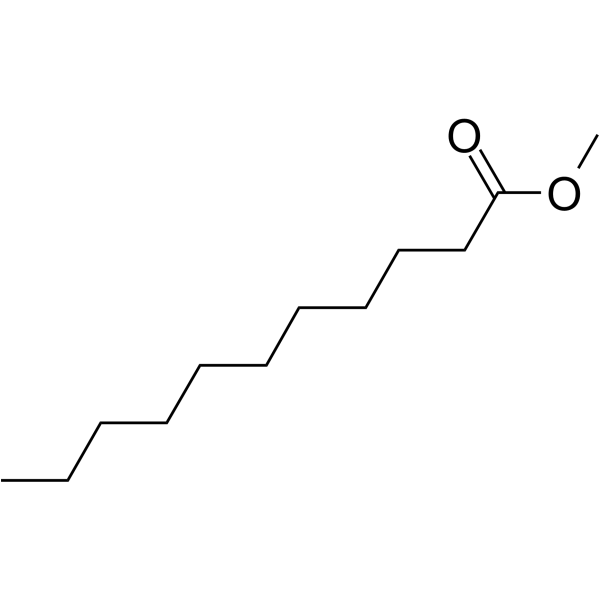
- Formula: C12H24O2
- Molecular Weight: 200.32
Methyl undecanoate is a synthetic undecanoic acid ester analog with biting deterrent and repellent activity against Aedes aegypti mosquitoes, with a biting deterrent index (BDI) of 0.88 and minimum effective dose (MED) of 25 µg/cm2. Methyl undecanoate can be used for the research of mosquito-borne diseases transmitted by Aedes aegypti.
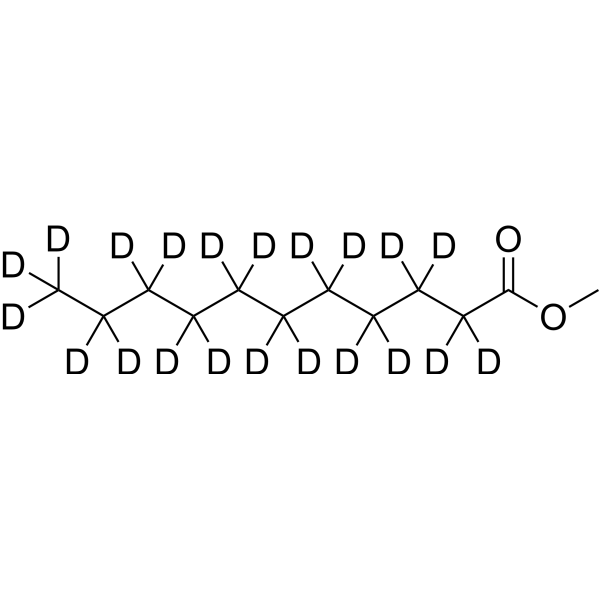
- Formula: C12H3D21O2
- Molecular Weight: 221.45
Methyl undecanoate-d21 is the d21-labeled Methyl undecanoate (HY-W004285). Methyl undecanoate is a synthetic undecanoic acid ester analog with biting deterrent and repellent activity against Aedes aegypti mosquitoes, with a biting deterrent index (BDI) of 0.88 and minimum effective dose (MED) of 25 µg/cm2. Methyl undecanoate can be used for the research of mosquito-borne diseases transmitted by Aedes aegypti.
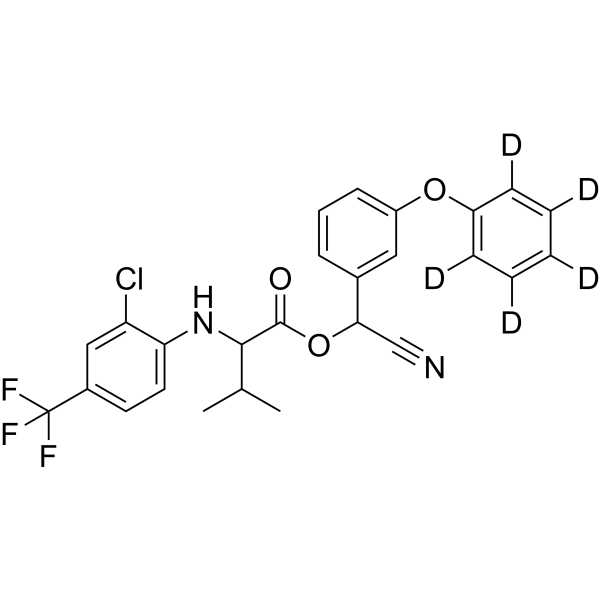
- Formula: C26H17D5ClF3N2O3
- Molecular Weight: 507.94
Fluvalinate-d5 is the deuterated-labeled Fluvalinate (HY-123320). Fluvalinate is an orally active acaricide classified as a sodium channel inhibitor. Fluvalinate delays sodium channel closure, prolongs cell membrane depolarization, inhibits the excitability of honeybee brain neurons, and exerts a central nervous system inhibitory effect. Fluvalinate negatively affects the learning ability, memory ability, sucrose responsiveness, and survival of honeybees. Fluvalinate potentiates pentobarbital-induced hypnosis, reduces spontaneous activity in mice, and decreases the total white blood cell count and absolute lymphocyte count in mice. Fluvalinate induces acute toxic symptoms in rats, acts as a cholinergic stimulant, and induces the production of hepatic enzymes in rats. Fluvalinate causes the death of Varroa jacobsoni sensitive to τ-Fluvalinate (HY-B2021). Fluvalinate can be used in studies related to mite pest control.

- Formula: C26H22ClF3N2O3
- Molecular Weight: 502.91
Fluvalinate is an orally active acaricide classified as a sodium channel inhibitor. Fluvalinate delays sodium channel closure, prolongs cell membrane depolarization, inhibits the excitability of honeybee brain neurons, and exerts a central nervous system inhibitory effect. Fluvalinate negatively affects the learning ability, memory ability, sucrose responsiveness, and survival of honeybees. Fluvalinate potentiates pentobarbital-induced hypnosis, reduces spontaneous activity in mice, and decreases the total white blood cell count and absolute lymphocyte count in mice. Fluvalinate induces acute toxic symptoms in rats, acts as a cholinergic stimulant, and induces the production of hepatic enzymes in rats. Fluvalinate causes the death of Varroa jacobsoni sensitive to τ-Fluvalinate (HY-B2021). Fluvalinate can be used in studies related to mite pest control.

- Formula: C11H16O2
- Molecular Weight: 180.24
Pyrethrolone is a pyrethrolone-type component found in the flowers of Tanacetum cinerariifolium and constitutes a component of natural pyrethrins. Pyrethrolone is generated through the desaturation of jasmolone catalyzed by the cytochrome P450 enzyme TcPYS (CYP82Q3). Pyrethrolone is used in insecticide-related research.

- Formula: C16H17NO2
- Molecular Weight: 255.31
Insecticidal agent 43 is an insecticide derived from Celangulin V (HY-N7202) that targets the V-ATPase H subunit of Mythimna separata. Insecticidal agent 43 exhibits stomach toxicity toward the 3rd-instar larvae of Mythimna separata and demonstrates insecticidal activity. Insecticidal agent 43 can be used in research related to pest control.

- Formula: C20H10Cl2F6N4O2S
- Molecular Weight: 555.28
Vaniliprole (MMV1794214) is a phenylpyrazole compound with anti-Toxoplasma gondii activity, with an EC50 of 0.07 μM. Vaniliprole can be used in research related to parasitic infections.
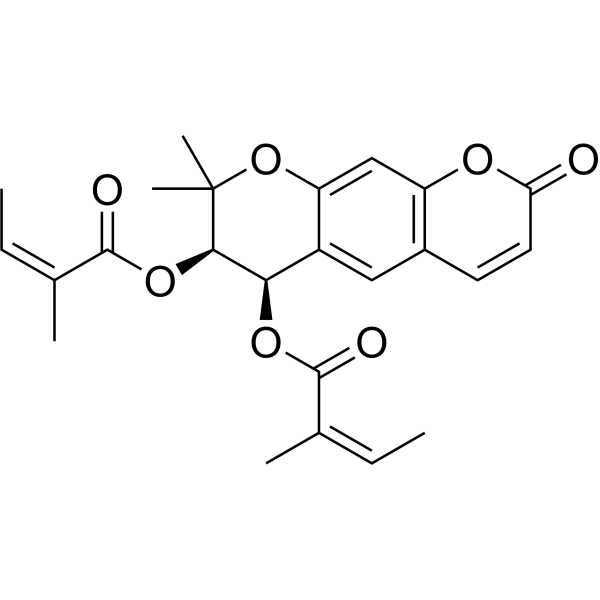
- Formula: C24H26O7
- Molecular Weight: 426.46
Xanthalin is a naturally occurring, orally active linear dihydropyranocoumarin. Xanthalin acts as an inhibitor of Spodoptera littoralis neonate larval growth and reduces larval body weight. Xanthalin is used in research related to pest control.

- Formula: C9H6O3
- Molecular Weight: 162.14
6-Hydroxycoumarin (Standard) is the analytical standard of 6-Hydroxycoumarin (HY-N6656). This product is intended for research and analytical applications. 6-Hydroxycoumarin is a plant-derived secondary metabolite of the coumarin class, possessing insecticidal, antitumor, and other biological activities. 6-Hydroxycoumarin targets the midgut tissue of the red imported fire ant (Solenopsis invicta), inhibits CYP450, induces elevated activities of GST, CarE, and SOD, disrupts mitochondrial ultrastructure, triggers apoptosis, and also impairs insect neuromuscular behavior. 6-Hydroxycoumarin exhibits photoallergic properties and serves as an intermediate for the synthesis of isoxazolyl and triazolyl derivatives. 6-Hydroxycoumarin is applicable to research related to red imported fire ant control.

- Formula: C17H19N3O5S
- Molecular Weight: 377.41
Omeprazole sulfone N-Oxide is an Omeprazole (HY-B0113) analog with binding affinity to Nilaparvata lugens choline acetyltransferase (ChAT).



