



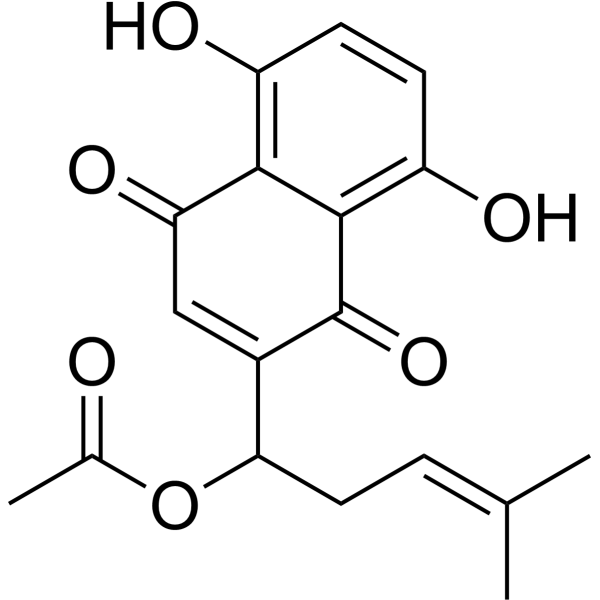
DL-Acetylshikonin
DL-Acetylshikonin is a non-selective, reversible cytochrome P450 inhibitor with IC50 values of 1.4-4.0 μM. DL-Acetylshikonin has anti-cancer and anti-inflammatory activities.
연구목적의 판매만을 진행합니다. 환자를 대상으로 한 판매는 하지 않습니다.
- CAS No.: 54984-93-9
- 화학식: C18H18O6
- 분자량:330.33
-
보관:
Please store the product under the recommended conditions in the Certificate of Analysis.

To place orders, for customer services and technical support, please contact: MedChemExpress USA
Tel: 609-228-6898 E-mail: [email protected] [email protected]


-
 Biological Activity
-
Chemical Information
- Protocol
- 순도&문서
- References
-
 Help & FAQs




Biological Activity
제품 설명
IC50 & Target
[1]|
CYP2C8 1.4 μM (IC50) |
CYP2B6 2.0 μM (IC50) |
CYP3A 2.3 μM (IC50) |
CYP2C19 2.5 μM (IC50) |
CYP2D6 2.5 μM (IC50) |
CYP2E1 2.7 μM (IC50) |
CYP2C9 3.3 μM (IC50) |
CYP2J2 3.3 μM (IC50) |
CYP2A6 3.8 μM (IC50) |
CYP1A2 4.0 μM (IC50) |
Cellular Effect
|
Cell Line

|
Type | Value | Description | References |
|---|---|---|---|---|
| RD | CC50 |
9.4 μM
Compound: AS
|
Cytotoxicity against human RD cells assessed as reduction in cell viability after 12 hrs by CCK8 assay
Cytotoxicity against human RD cells assessed as reduction in cell viability after 12 hrs by CCK8 assay
|
[PMID: 31063370] |
In Vitro
DL-Acetylshikonin inhibits CYP3A-mediated testosterone and Nifedipine (HY-B0284) metabolism with IC50 values of 5.2 μM and 3.0 μM, respectively, indicating that it inhibits CYP3A activity in a substrate-independent manner[1].
DL-Acetylshikonin is not a time-dependent inhibitor[1].
MedChemExpress (MCE) has not independently confirmed the accuracy of these methods. They are for reference only. Further protocols information, click here.


Chemical Information
-
CAS No. 54984-93-9
-
분자량 330.33
-
화학식 C18H18O6
-
SMILES
C/C(C)=C\CC(OC(C)=O)C1=CC(C2=C(O)C=CC(O)=C2C1=O)=O
-
Structure Classification
-
Initial Source
-
선적
Room temperature in continental US; may vary elsewhere.
-
보관
Please store the product under the recommended conditions in the Certificate of Analysis.

Protocol
-
Research Protocol for Inflammation-related Diseases
The NLRP3 inflammasome is a cytosolic innate immune signaling platform that integrates priming signals and danger-signal activation to promote caspase-1 activation, maturation of IL-1β and IL-18, and gasdermin D-mediated pyroptotic cell death. The core experimental logic is to determine whether inflammatory disease phenotypes are driven by increased NLRP3 expression, ASC-containing inflammasome assembly, caspase-1 cleavage, GSDMD cleavage, and extracellular release of IL-1β/IL-18 rather than by nonspecific cell injury alone. The pathway is strongly linked to inflammation-related disease phenotypes because monosodium urate crystals activate NALP3/NLRP3 inflammasome signaling in gout-like crystal inflammation, cholesterol crystals activate NLRP3 inflammasomes in atherogenesis models, and DSS-induced intestinal inflammation has been reported to involve NLRP3 inflammasome activity. However, experimental colitis studies also show context-dependent protective effects of NLRP3 inflammasome co


순도&문서
References

Calculators
Concentration (start) × Volume (start) = Concentration (final) × Volume (final)


DL-Acetylshikonin Related Classifications
HY-N2181A Related Classifications
 Powered by Bioz