



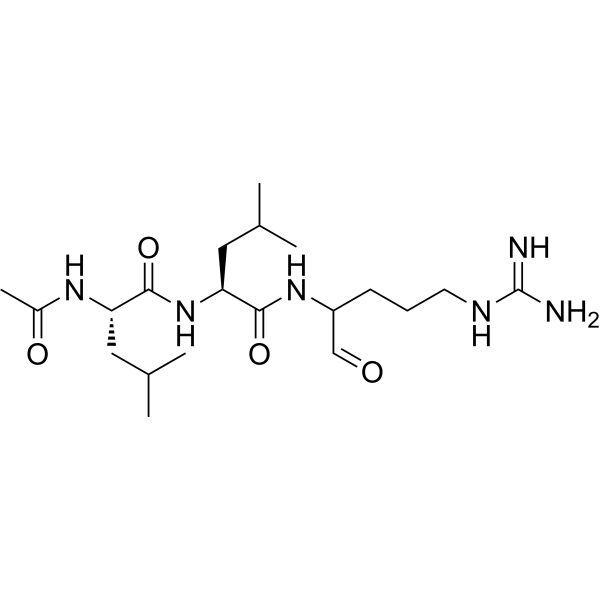
Leupeptin Ac-LL
Leupeptin Ac-LL is a broad-spectrum protease inhibitor. Leupeptin Ac-LL inhibits serine, cysteine and threonine proteases, and regulates autophagy. Leupeptin Ac-LL reduces the expression levels of LC3B, iNOS, Cox-2, Beclin-1 and the level of endopeptidases; increases the levels of p62, Arg 1, Msr 1 and Mrc−1; and blocks the upregulation of p-PTEN, p-NF-κB, p-PI3K, p-Akt, p-p38 and ERK1/2. Leupeptin Ac-LL inhibits NO, ROS, proinflammatory cytokines, the IFN-γ/IL-10 ratio, phagolysosome fusion, mammalian lysosomal hydrolase activity and SARS-CoV-2 replication; and reverses impaired autophagic flux. Leupeptin Ac-LL is applicable to research related to chronic inflammatory diseases, edema, skin tumorigenesis, COVID-19 and respiratory infections.
For research use only. We do not sell to patients.
- CAS No.: 24365-47-7
- Formula: C20H38N6O4
- Molecular Weight:426.55
-
Storage:
Please store the product under the recommended conditions in the Certificate of Analysis.

To place orders, for customer services and technical support, please contact: MedChemExpress USA
Tel: 609-228-6898 E-mail: [email protected] [email protected]


-
 Biological Activity
-
Chemical Information
- Purity & Documentation
- References
-
 Help & FAQs


All Cathepsin Isoforms
More

Biological Activity
|
SARS-CoV-2 Mpro 127.2 μM (IC50) |
Kallikrein 70-75 μg/mL (IC50) |
Plasmin 6-100 μg/mL (IC50) |
Thrombokinase 15-18 μg/mL (IC50) |
papain 0.03-0.51 μg/mL (IC50) |
trypsin 0.1-136 μg/mL (IC50) |
PI3K |
ERK1 |
NF-κB |
iNOS |
Akt |
HTRA1 |
COX-2 |
Threonine Protease |
Cysteine Protease |
ERK2 |
LC3B |
Beclin-1 |
p62 |
Arg 1 |
Msr 1 |
Mrc−1 |
p-PTEN |
Leupeptin (5.3 mM; 5 min at 70 °C for oxidation; 0.53 μM; 2 h at 22 °C for reduction; 625 nM for MS analysis) Ac-LL has its molecular weights of natural, oxidized, and reduced forms confirmed by mass spectrometry as 426.3 Da, 442.3 Da, and 428.3 Da, respectively[8].
Leupeptin (0.14-1.62 μM for natural form; 8-127 μM for oxidized form; 10-413 μM for reduced form) Ac-LL potently inhibits porcine pancreas trypsin with a Ki of 88 nM in its natural form, while its oxidized (Ki = 2.7 μM) and reduced (Ki = 270 μM) forms exhibit significantly weaker trypsin inhibition[8].
MedChemExpress (MCE) has not independently confirmed the accuracy of these methods. They are for reference only.
Leupeptin (40 mg/kg; i.p.; single dose; sacrificed 3 h post-injection) Ac-LL detects a 45% increase in macroautophagic flux in calorie-starved mouse liver and significant suppression of flux in refed mouse liver, with a 3-hour flux value of 53.94 ng/mg total protein in starved mice[4].
Leupeptin (40 mg/kg; i.p.; single dose; sacrificed 60 min or 180 min post-injection) Ac-LL detects a significant reduction in p62 flux (but not statistically significant reduction in LC3b-II flux) in beclin 1+/- mouse liver compared to wild-type littermates, with an 180-minute p62 flux value of 18 ng/mg total protein in heterozygous mice[4].
MedChemExpress (MCE) has not independently confirmed the accuracy of these methods. They are for reference only.
-
Animal Model:C57BL/6NCrl (male, 6-8 weeks old, 20-25 g)[4]
-
Dosage:9 mg/kg; 18 mg/kg; 20 mg/kg; 36 mg/kg; 40 mg/kg
-
Administration:i.p.; single dose; sacrificed 1 h, 4 h, 60 min, 90 min, 120 min, 180 min, or 240 min post-injection; administered 60 min prior to cycloheximide injection, sacrificed 60 min post-cycloheximide injection
-
Result:Produced a dose-dependent increase in LC3b-II levels in mouse liver total extracts and lysosome-enriched (LE) fractions, with the 36 mg/kg dose inducing the strongest signal.
Led to time-dependent LC3b-II accumulation across multiple organs, with liver reaching 69.1 ng/mg total protein in LE fractions at 60 min, a flux of 42.1 ng/mg total protein, and spleen reaching 37.1 ng/mg total protein in LE fractions at 60 min, a flux of 11.0 ng/mg total protein.
Increased LC3a-II and p62 levels in liver LE fractions, but did not increase levels of GABARAP or GATE-16.
Induced a 6.88-fold increase in cross-sectional area of late autophagosome/lysosomal compartments in hepatocytes, with this increase correlating with LC3b-II levels in LE fractions.
Increased LC3b-II and LC3a-II content in dense, lysosome-enriched fractions of lung homogenates.
Stabilized LC3b-II and LC3a-II levels in liver LE fractions (but not cytosolic fractions) following cycloheximide-induced translational inhibition.
-
Animal Model:C57BL/6NCrl (male, 6-8 weeks old, 20-25 g)[4]
-
Dosage:40 mg/kg
-
Administration:i.p.; single dose; sacrificed 1 h or 3 h post-injection
-
Result:Induced an LC3b-II flux of 37.21 ng/mg total protein at 3 h post-injection in ad libitum-fed mice.
Induced an LC3b-II flux of 53.94 ng/mg total protein at 3 h post-injection in calorie-starved mice, representing a 45% increase compared to ad libitum-fed mice (p = 0.04).
Induced an LC3b-II flux of only 3.00 ng/mg total protein at 3 h post-injection in refed mice, significantly suppressed compared to ad libitum-fed mice (p < 0.001).
-
Animal Model:Beclin 1+/+; beclin 1+/- (male, 6-8 weeks old)[4]
-
Dosage:40 mg/kg
-
Administration:i.p.; single dose; sacrificed 60 min or 180 min post-injection
-
Result:Showed an LC3b-II flux of ~25 ng/mg total protein in beclin 1+/- mice at 60 min post-injection, compared to ~38 ng/mg total protein in beclin 1+/+ mice (no statistical significance reported).
Showed an LC3b-II flux of ~56 ng/mg total protein in beclin 1+/- mice at 180 min post-injection, compared to ~73 ng/mg total protein in beclin 1+/+ mice (no statistical significance reported).
Showed a p62 flux of ~4 ng/mg total protein in beclin 1+/- mice at 60 min post-injection, compared to ~2 ng/mg total protein in beclin 1+/+ mice.
Showed a p62 flux of ~18 ng/mg total protein in beclin 1+/- mice at 180 min post-injection, compared to ~35 ng/mg total protein in beclin 1+/+ mice (p < 0.05).


Chemical Information
-
CAS No. 24365-47-7
-
Molecular Weight 426.55
-
Formula C20H38N6O4
-
Shipping
Room temperature in continental US; may vary elsewhere.
-
Storage
Please store the product under the recommended conditions in the Certificate of Analysis.


Purity & Documentation
References
[1]. Sharma A, et al. Leupeptin maintains redox homeostasis via targeting ROS-autophagy-inflammatory axis in LPS-stimulated macrophages and cytokines dichotomy in Con-A challenged lymphocyte. Peptides. 2023 Oct;168:171066. [Content Brief]
[2]. Aoyagi T, et al. Biological activities of leupeptins. J Antibiot. 1969 Nov;22:558-568.
[3]. Hozumi M, et al. Inhibition of tumorigenesis in mouse skin by leupeptin, a protease inhibitor from Actinomycetes. Cancer Res. 1972 Aug;32(8):1725-8. [Content Brief]
[4]. Haspel J, et al. Characterization of macroautophagic flux in vivo using a leupeptin-based assay. Autophagy. 2011 Jun;7(6):629-42. [Content Brief]
[5]. Fu L, et al. Mechanism of Microbial Metabolite Leupeptin in the Treatment of COVID-19 by Traditional Chinese Medicine Herbs. mBio. 2021 Oct 26;12(5):e0222021. [Content Brief]
[6]. Li JH, et al. Making and Breaking Leupeptin Protease Inhibitors in Pathogenic Gammaproteobacteria. Angew Chem Int Ed Engl. 2020 Oct 5;59(41):17872-17880. [Content Brief]
[7]. Thelen M, et al. SILAC-Based Comparative Proteomic Analysis of Lysosomes from Mammalian Cells Using LC-MS/MS. Methods in molecular biology (Clifton, N.J.). 2017;1594:1-18. [Content Brief]
[8]. Billinger E, et al. Inhibition properties of free and conjugated leupeptin analogues. FEBS open bio. 2020 Dec;10(12):2605-2615. [Content Brief]

Calculators
Concentration (start) × Volume (start) = Concentration (final) × Volume (final)


Leupeptin Ac-LL Related Classifications
HY-18234B Related Classifications
 Powered by Bioz
- Leupeptin Ac-LL
- 24365-47-7
- Ser/Thr Protease
- Cathepsin
- Autophagy
- SARS-CoV
- Atg8/LC3
- NO Synthase
- COX
- p62
- Arginase
- PTEN
- NF-κB
- PI3K
- Akt
- p38 MAPK
- ERK
- Reactive Oxygen Species (ROS)
- serine protease
- Kallikrein
- threonine protease
- Actinomycetes
- Trypsin
- Papain
- Plasmin
- SARS-CoV-2 Mpro
- Thrombokinase
- cysteine protease
- Inhibitor
- inhibitor
- inhibit