



Dabogratinib

Based on 1 Customer Validation
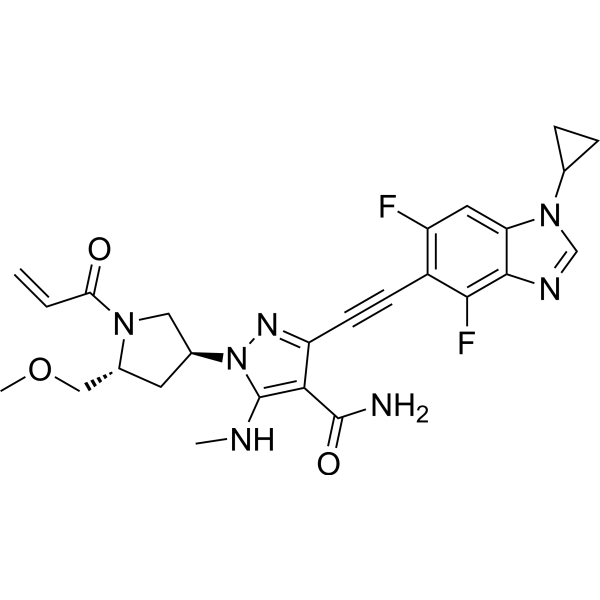
Dabogratinib (TYRA-300) is an orally active, selective FGFR3 inhibitor with an IC50 of 11 nM. Dabogratinib exhibits antitumor activity against urothelial carcinoma and solid tumors. Dabogratinib downregulates the FGFR3 and ERK1/2 signaling pathways, and induces tumor growth inhibition and regression in FGFR3-altered xenograft models. Dabogratinib promotes chondrocyte proliferation and differentiation, drives endochondral bone formation and overall body growth, partially restores long bone proportions, and improves craniofacial and spinal morphology. Dabogratinib can be used for the research of metastatic urothelial carcinoma, achondroplasia and hypochondroplasia.
Nos produits utilisent uniquement pour la recherche. Nous ne vendons pas aux patients.
- Pureté: 99.90%
- CAS No.: 2800223-30-5
- Formule: C25H24Cl2N6O3S
- Masse moléculaire:559.47
-
Stockage:Powder -20°C, 3 years , 4°C, 2 years ; In solvent -80°C, 6 months , -20°C, 1 month


To place orders, for customer services and technical support, please contact: MedChemExpress USA
Tel: 609-228-6898 E-mail: [email protected] [email protected]


-
 Activité biologique
-
Chemical Information
-
Solvant et solubilité
- Pureté et documentation
- Références
-
 Help & FAQs


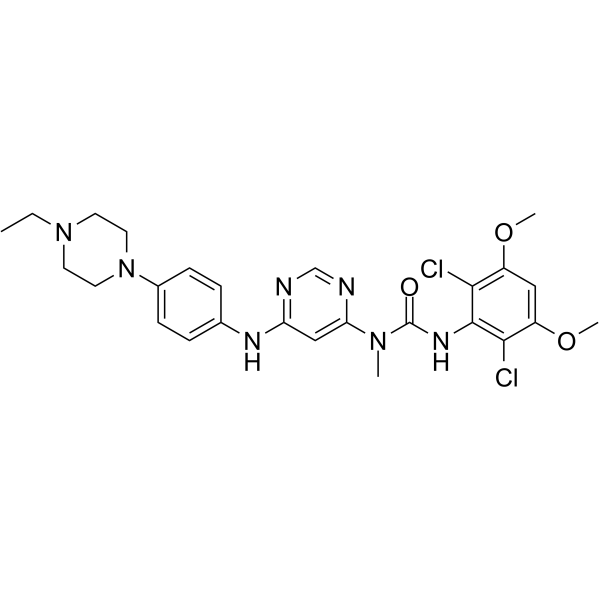
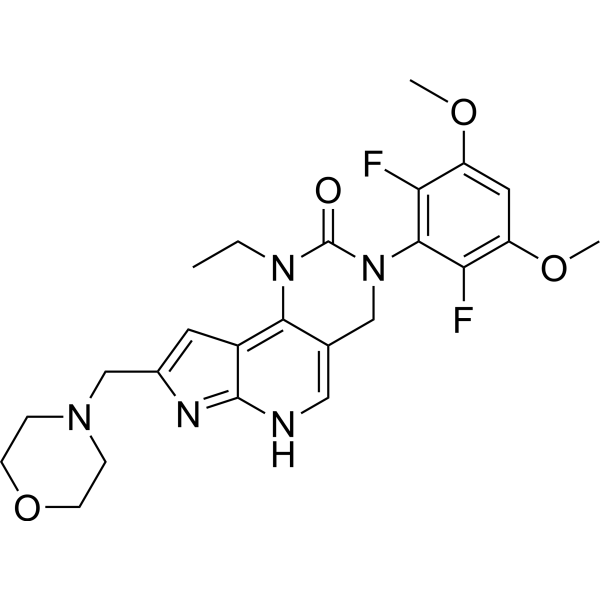
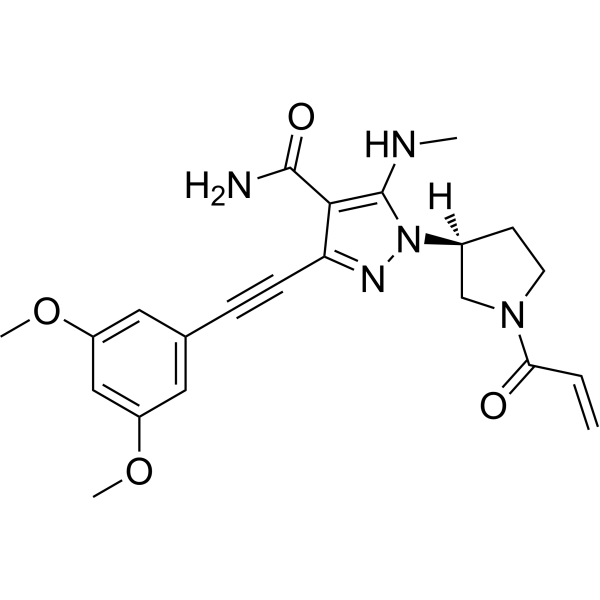
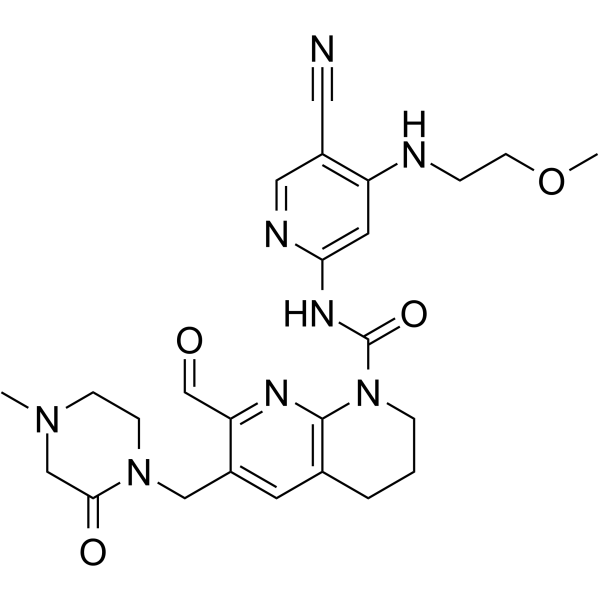


Activité biologique
|
FGFR3 11 nM (IC50) |
FGFR2 157 nM (IC50) |
FGFR1 278 nM (IC50) |
FGFR4 4045 nM (IC50) |
|
Cell Line

|
Type | Value | Description | References |
|---|---|---|---|---|
| DMS-114 | IC50 |
205 nM
Compound: 22
|
Inhibition of cell viability in human DMS-114 cells harboring FGFR1-amplification incubated for 72 to 120 hrs by Cell Titer Glo assay
Inhibition of cell viability in human DMS-114 cells harboring FGFR1-amplification incubated for 72 to 120 hrs by Cell Titer Glo assay
|
[PMID: 39258897] |
| KG-1 | IC50 |
109 nM
Compound: 22
|
Inhibition of cell viability in human KG-1 cells harboring FGFR1-fusion incubated for 72 to 120 hrs by Cell Titer Glo assay
Inhibition of cell viability in human KG-1 cells harboring FGFR1-fusion incubated for 72 to 120 hrs by Cell Titer Glo assay
|
[PMID: 39258897] |
| RT-4 | IC50 |
10 nM
Compound: 22
|
Inhibition of cell viability in human RT-4 cells harboring FGFR3/TACC3 fusion incubated for 72 to 120 hrs by Cell Titer Glo assay
Inhibition of cell viability in human RT-4 cells harboring FGFR3/TACC3 fusion incubated for 72 to 120 hrs by Cell Titer Glo assay
|
[PMID: 39258897] |
Dabogratinib (0.046 nM-3 μM; 2 h) induces dose-dependent downregulation of the FGFR3 downstream signaling pathway (assessed by pERK1/2 levels) in RT112/84, RT112/84-V555M and UM-UC-14 bladder cancer cell lines[1].
Dabogratinib inhibits the viability of FGFR3-driven bladder cancer cell lines, with IC50 values of 9 nM for the RT112/84 cell line, 17 nM for the RT112/84-V555M cell line, and 16 nM for the UM-UC-14 cell line[1].
MedChemExpress (MCE) has not independently confirmed the accuracy of these methods. They are for reference only.
-
Cell Line:RT112/84, RT112/84-V555M, and UM-UC-14 bladder cancer cell lines
-
Concentration:0.046, 0.18, 0.73, 2.9, 12, 47, 188, 750, 3000 nM
-
Incubation Time:2 hours
-
Result:Induced a dose-dependent decrease in pERK1/2 levels in all three cell lines; showed similar dose-response patterns in gatekeeper-mutant RT112/84-V555M cell line as in RT112/84 and UM-UC-14 cell lines harboring only activating alterations.
Dabogratinib (12.5 mg/kg; p.o.; twice daily) induces tumor regression in FGFR3::TACC3 fusion urothelial carcinoma xenograft models and FGFR3V555M urothelial carcinoma xenograft models[1].
Dabogratinib (8-14 mg/kg; p.o.; once daily; 4 weeks) dose-dependently increases the growth rate of wild-type mice and promotes their long bone growth in vivo[2].
Dabogratinib (1.2 mg/kg; s.c.; once daily; 15 days) promotes bone growth, improves skeletal proportions, optimizes growth plate structure, and increases the foramen magnum size in the Fgfr3Y367C/+ mouse model of achondroplasia (ACH)[2].
Dabogratinib (1.8 mg/kg; s.c.; once daily; 21 days) increases bone length, enlarges foramen magnum size and improves intervertebral disc morphology in the Fgfr3N534K/+ mouse model of HCH[2].
MedChemExpress (MCE) has not independently confirmed the accuracy of these methods. They are for reference only.
-
Animal Model:athymic nude (nu/nu) (female, 6 to 8 weeks old)[1]
-
Dosage:3, 6 and 9 mg/kg (twice daily); 6, 12 and18 mg/kg (once daily)
-
Administration:p.o.; twice daily; 21 days; p.o.; once daily; 21 days
-
Result:Observed no tumor growth inhibition (TGI) at 3 mg/kg twice daily; Achieved 53% TGI at 6 mg/kg twice daily, 90% TGI at 9 mg/kg twice daily, 46% TGI at 6 mg/kg once daily, 80% TGI at 12 mg/kg once daily, and 96% TGI at 18 mg/kg once daily.
Detected significant tumor volume reduction with 12, 18 mg/kg once daily and 9 mg/kg twice daily compared with vehicle.
Observed more tumor regression with 18 mg/kg once daily than erdafitinib 12.5 mg/kg twice daily.
Recorded no body weight loss in any treatment group.
-
Animal Model:C57BL/6J (female, 4-8 weeks of age)[2]
-
Dosage:8, 10, 12, 14 mg/kg
-
Administration:p.o.; once daily; 4 weeks
-
Result:Increased nasoanal length by 7.3% with 14 mg/kg compared with vehicle; increased tibia length by 3.9% and femur length by 5.0% with 12 mg/kg compared with vehicle. Increased tibia length by 6.4% and femur length by 8.2% with 14 mg/kg compared with vehicle.
Induced significant increases in nasoanal length, tibia length, and femur length with 8 mg/kg and 10 mg/kg compared with vehicle.
-
Animal Model:Tg-CMV^Cre/+ / Fgfr3^Y367C/+ (mixed male and female, 1 day of age, Achondroplasia modeling)[2]
-
Dosage:1.2 mg/kg
-
Administration:s.c.; once daily; 15 days
-
Result:Increased nasoanal length by 17.88%, tail length by 25.10%, and body weight by 52.9% compared with vehicle-treated mutant mice; increased tibia length by 33.01%, femur length by 22.55%, ulna length by 23.51%, and humerus length by 15.52% compared with vehicle. Increased skull length by 10.08%, skull width by 3.74%, skull anteroposterior length by 8.92%, and skull nasio-occipital length by 7.87% compared with vehicle; increased foramen magnum transverse diameter by 13.05%, sagittal diameter by 9.28%, and area by 25.17% compared with vehicle. Improved the grade of skull base synchondroses, increased the size of hypertrophic zone chondrocytes (HZCs), increased proliferation of proliferating zone chondrocytes (PZCs), increased bone mineral density (BMD) by 21.4%, and increased bone volume-to-tissue volume ratio (BV/TV) by 73.3% compared with vehicle; increased L4-L6 lumbar vertebrae segment length by 23.49% compared with vehicle.
-
Animal Model:Tg-CMV^Cre/+ / Fgfr3^N534K/+ (mixed male and female, 3 days of age, Hypochondroplasia modeling)[2]
-
Dosage:1.8 mg/kg
-
Administration:s.c.; once daily; 21 days
-
Result:Increased femur length by 3.70%, tibia length by 3.75%, ulna length by 5.03%, and humerus length by 3.22% compared with vehicle-treated mutant mice.
Increased foramen magnum area by 7.51% and sagittal diameter by 6.35% compared with vehicle; reduced the grade of skull base synchondroses from grade V (completely fused) to grade IV (completely fused with cartilage margin remnants) in most mice and improved intervertebral disc shape compared with vehicle.


Chemical Information
-
CAS No. 2800223-30-5
-
Appearance Solid
-
Masse moléculaire 559.47
-
Formule C25H24Cl2N6O3S
-
Color White to off-white
-
SMILES
O=S(N(C1)CC1(C2)CN2C(N=C3)=CC=C3C4=NNC5=CC=C(O[C@H](C)C6=C(Cl)C=NC=C6Cl)C=C54)(C)=O
-
Synonyms
TYRA-300
-
Livraison
Room temperature in continental US; may vary elsewhere.
-
Stockage
Powder -20°C 3 years 4°C 2 years In solvent -80°C 6 months -20°C 1 month


Solvant et solubilité
DMSO : 100 mg/mL (178.74 mM; ultrasonic and warming and heat to 60°C; Hygroscopic DMSO has a significant impact on the solubility of product, please use newly opened DMSO)
Please refer to the solubility information to select the appropriate solvent. Once prepared, please aliquot and store the solution to prevent product inactivation from repeated freeze-thaw cycles.
Storage method and period of stock solution: -80°C, 6 months; -20°C, 1 month. When stored at -80°C, please use it within 6 months. When stored at -20°C, please use it within 1 month.
Please refer to the solubility information to select the appropriate solvent. Once prepared, please aliquot and store the solution to prevent product inactivation from repeated freeze-thaw cycles.
Storage method and period of stock solution: -80°C, 6 months; -20°C, 1 month. When stored at -80°C, please use it within 6 months. When stored at -20°C, please use it within 1 month.
Concentration (start) × Volume (start) = Concentration (final) × Volume (final)
Select the appropriate dissolution method based on your experimental animal and administration route.
- For the following dissolution methods, please ensure to first prepare a clear stock solution using an In Vitro approach and then sequentially add co-solvents:
- To ensure reliable experimental results, the clarified stock solution can be appropriately stored based on storage conditions. As for the working solution for In Vivo experiments, it is recommended to prepare freshly and use it on the same day.
- The percentages shown for the solvents indicate their volumetric ratio in the final prepared solution. If precipitation or phase separation occurs during preparation, heat and/or sonication can be used to aid dissolution.
Add each solvent one by one: 10% DMSO 40% PEG300 5% Tween-80 45% Saline
Solubility: ≥ 5 mg/mL (8.94 mM); Clear solution
This protocol yields a clear solution of ≥ 5 mg/mL (saturation unknown).
Taking 1 mL working solution as an example, add 100 μL DMSO stock solution (50.0 mg/mL) to 400 μL PEG300, and mix evenly; then add 50 μL Tween-80 and mix evenly; then add 450 μL Saline to adjust the volume to 1 mL.
Preparation of Saline: Dissolve 0.9 g sodium chloride in ddH₂O and dilute to 100 mL to obtain a clear Saline solution.
Please enter the basic information of animal experiments:
-
-
-
-
Recommended: Prepare an additional quantity of animals to account for potential losses during experiments.
Please enter your animal formula composition:
-
%DMSO +
Recommended: Keep the proportion of DMSO in working solution below 2% if your animal is weak.
-
%+
-
+%Tween-80 + +
-
%Saline +
The co-solvents required include: DMSO, . All of co-solvents are available by MedChemExpress (MCE). , Tween 80. All of co-solvents are available by MedChemExpress (MCE).
Working solution concentration: 0.22 mg/mL
Method for preparing stock solution: mg drug dissolved in μL DMSO. Stock solution concentration: mg/mL.
1. Take μL DMSO stock solution;
2. Add μL .
μL , mix evenly;
3. Then add μL Tween 80, mix evenly;
4. Then add μL
Please ensure that the stock solution in the first step is dissolved to a clear state, and add co-solvents in sequence. You can use ultrasonic heating (ultrasonic cleaner, recommended frequency 20-40 kHz), vortexing, etc. to assist dissolution.


Pureté et documentation
-
Fiche technique (284 KB)
-
SDS (254 KB)
- English - EN (254 KB)
- Français - FR (254 KB)
- Deutsch - DE (254 KB)
- Norwegian - NO (254 KB)
- Español - ES (254 KB)
- Swedish - SV (254 KB)
- Italian - IT (254 KB)
- Korean - KR (254 KB)
- Portuguese - PT (254 KB)
-
Instruction de manipulation (2659 KB)
Références
[1]. Starrett JH, et al. Dabogratinib (TYRA-300), an FGFR3 isoform-selective inhibitor: preclinical and initial clinical evidence of anti-tumor activity. Mol Cancer Ther. Published online October 14, 2025. [Content Brief]
[2]. Starrett JH, et al. TYRA-300, an FGFR3-selective inhibitor, promotes bone growth in two FGFR3-driven models of chondrodysplasia. JCI Insight. 2025;10(9):e189307. Published 2025 Apr 3. [Content Brief]


Complete Stock Solution Preparation Table
Please refer to the solubility information to select the appropriate solvent. Once prepared, please aliquot and store the solution to prevent product inactivation from repeated freeze-thaw cycles.
Storage method and period of stock solution: -80°C, 6 months; -20°C, 1 month. When stored at -80°C, please use it within 6 months. When stored at -20°C, please use it within 1 month.
| Optional Solvent | Concentration Solvent Mass | 1 mg | 5 mg | 10 mg | 25 mg |
|---|---|---|---|---|---|
| DMSO | 1 mM | 1.7874 mL | 8.9370 mL | 17.8741 mL | 44.6852 mL |
| 5 mM | 0.3575 mL | 1.7874 mL | 3.5748 mL | 8.9370 mL | |
| 10 mM | 0.1787 mL | 0.8937 mL | 1.7874 mL | 4.4685 mL | |
| 15 mM | 0.1192 mL | 0.5958 mL | 1.1916 mL | 2.9790 mL | |
| 20 mM | 0.0894 mL | 0.4469 mL | 0.8937 mL | 2.2343 mL | |
| 25 mM | 0.0715 mL | 0.3575 mL | 0.7150 mL | 1.7874 mL | |
| 30 mM | 0.0596 mL | 0.2979 mL | 0.5958 mL | 1.4895 mL | |
| 40 mM | 0.0447 mL | 0.2234 mL | 0.4469 mL | 1.1171 mL | |
| 50 mM | 0.0357 mL | 0.1787 mL | 0.3575 mL | 0.8937 mL | |
| 60 mM | 0.0298 mL | 0.1490 mL | 0.2979 mL | 0.7448 mL | |
| 80 mM | 0.0223 mL | 0.1117 mL | 0.2234 mL | 0.5586 mL | |
| 100 mM | 0.0179 mL | 0.0894 mL | 0.1787 mL | 0.4469 mL |


Dabogratinib Related Classifications
HY-159642 Related Classifications
 Powered by Bioz