



FR900098 sodium

Based on 1 Customer Validation
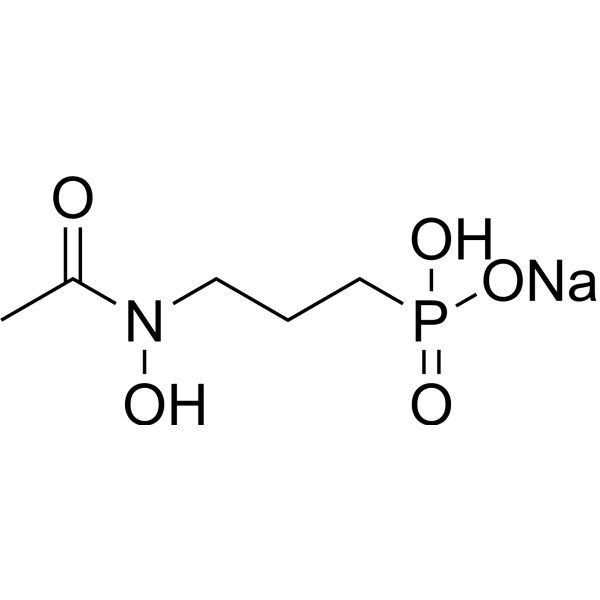
FR900098 sodium is an antimalarial agent that inhibits 1-deoxy-d-xylulose-5-phosphate (DXP) reductoisomerase. FR900098 sodium has no significant acute toxicity or genotoxicity, and does not have the ability to cause chromosome breakage or heterogeneity. FR900098 sodium has no effect on bone marrow red blood cells in NMRI mice.
For research use only. We do not sell to patients.
- Purity : 99.77%
- CAS No.: 73226-73-0
- Formula: C5H11NNaO5P
- Molecular Weight:219.11
-
Storage:
-20°C, sealed storage, away from moisture
* In solvent : -80°C, 6 months; -20°C, 1 month (sealed storage, away from moisture)

To place orders, for customer services and technical support, please contact: MedChemExpress USA
Tel: 609-228-6898 E-mail: [email protected] [email protected]


-
 Biological Activity
-
Chemical Information
- Protocols
- Purity & Documentation
- References
-
 Help & FAQs


-
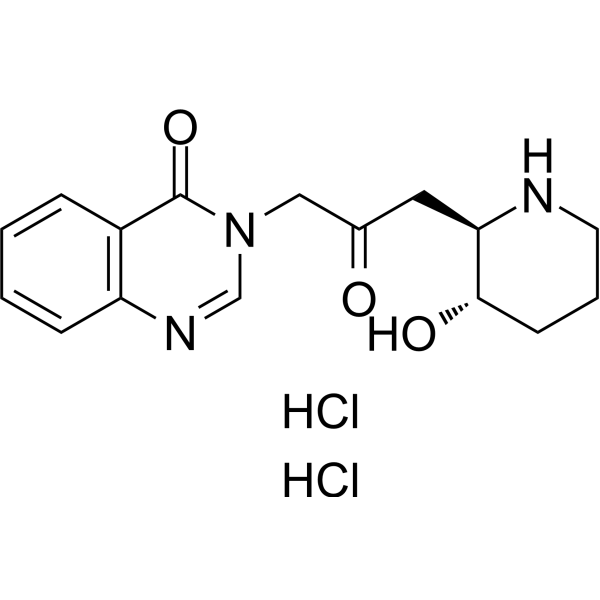
HY-N2384A
Febrifugine dihydrochlorideAntimalarial Agent -

HY-N15187
AcronycidineAntimalarial Agent -
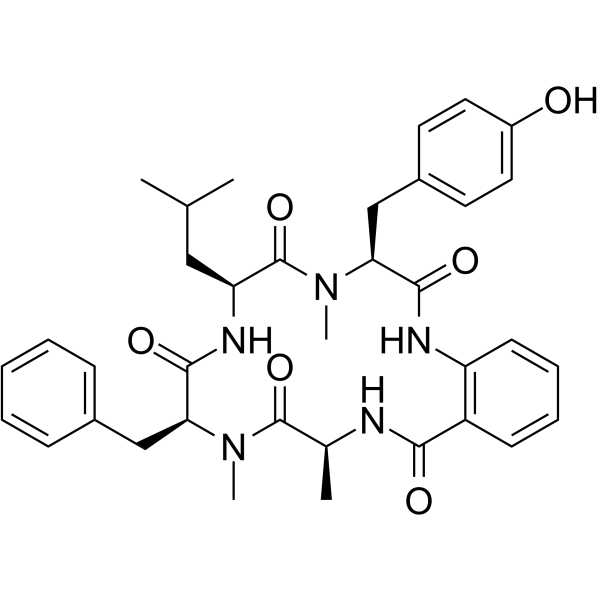
HY-125298
Cycloaspeptide AAntiparasitic Agent -

HY-121575
Lythridine -

HY-N8465
NoracronycineAntimalarial Agent -
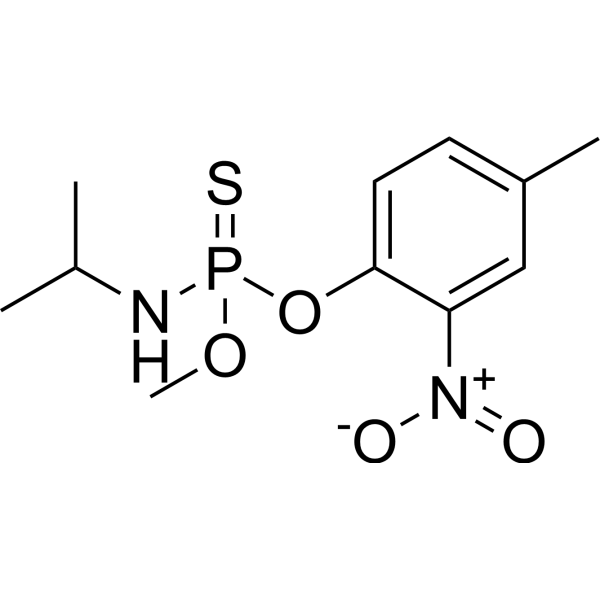
HY-111939
Amiprofos methylPlant Microtubule Polymerization Inhibitor -
HY-118495
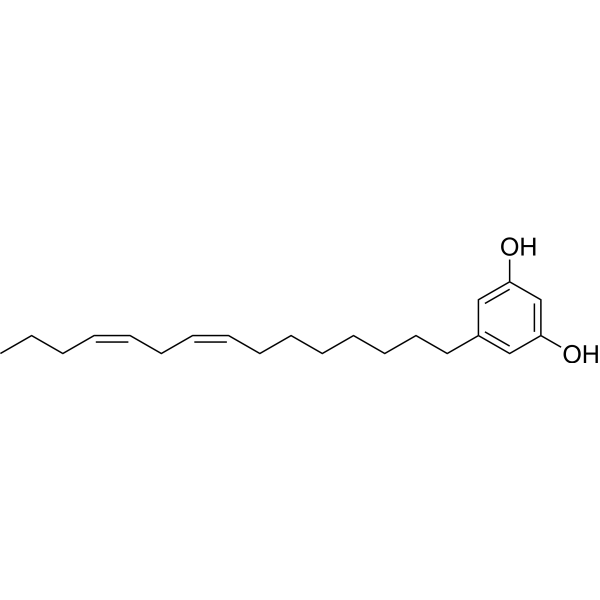
Cardol dieneAntiparasitic Agent -

HY-111939R
Amiprofos methyl (Standard)Plant Microtubule Polymerization Inhibitor


Biological Activity
Description


Chemical Information
-
CAS No. 73226-73-0
-
Appearance Solid
-
Molecular Weight 219.11
-
Formula C5H11NNaO5P
-
Color Off-white to light yellow
-
SMILES
O=C(C)N(CCCP(O)(O[Na])=O)O
-
Shipping
Room temperature in continental US; may vary elsewhere.
-
Storage
-20°C, sealed storage, away from moisture
* In solvent : -80°C, 6 months; -20°C, 1 month (sealed storage, away from moisture)

Protocols
-
Acute Systemic Toxicity Study
Acute systemic toxicity studies evaluate adverse effects occurring after a single exposure, or repeated exposure within a short acute window, and the main in vivo readouts are mortality, moribund condition, clinical signs, body-weight change, and gross pathological findings; acute oral toxicity methods were developed to replace classical LD50 testing with reduced-animal designs such as fixed-dose procedure, acute toxic class method, and up-and-down procedure. The fixed-dose procedure classifies acute toxicity by administering predefined dose levels and observing evident toxicity rather than using death as the primary endpoint, whereas the acute toxic class method uses sequential groups of three animals per step and the up-and-down procedure doses animals sequentially to estimate an LD50 with fewer animals than conventional LD50 testing.
-
Genotoxicity/Mutagenicity Study
The bacterial reverse mutation assay detects point mutations that restore amino-acid prototrophy in auxotrophic Salmonella typhimurium or Escherichia coli tester strains; after exposure to a test article, mutagenic activity is read out as an increased number of revertant colonies on minimal agar compared with the vehicle control. The assay uses tester strains with different mutation targets so that base-substitution and frameshift mutagens can be detected, and testing is performed with and without exogenous mammalian metabolic activation because some chemicals require biotransformation to become mutagenic.


Purity & Documentation
-
Data Sheet (267 KB)
-
SDS (252 KB)
- English - EN (252 KB)
- Français - FR (252 KB)
- Deutsch - DE (252 KB)
- Norwegian - NO (252 KB)
- Español - ES (252 KB)
- Swedish - SV (252 KB)
- Italian - IT (252 KB)
- Korean - KR (252 KB)
- Portuguese - PT (252 KB)
-
Handling Instructions (2659 KB)
References
[1]. Okuhara M, et al. Studies on new phosphonic acid antibiotics. I. FR-900098, isolation and characterization. J Antibiot (Tokyo). 1980 Jan;33(1):13-7. [Content Brief]
[2]. Wiesner J, et al. FR-900098, an antimalarial development candidate that inhibits the non-mevalonate isoprenoid biosynthesis pathway, shows no evidence of acute toxicity and genotoxicity. Virulence. 2016 Aug 17;7(6):718-28. [Content Brief]
[3]. Verbrugghen T, et al. Synthesis and evaluation of α-halogenated analogues of 3-(acetylhydroxyamino) propylphosphonic acid (FR900098) as antimalarials[J]. Journal of medicinal chemistry, 2010, 53(14): 5342-5346. [Content Brief]

Calculators
Concentration (start) × Volume (start) = Concentration (final) × Volume (final)


FR900098 sodium Related Classifications
HY-122817 Related Classifications
 Powered by Bioz