



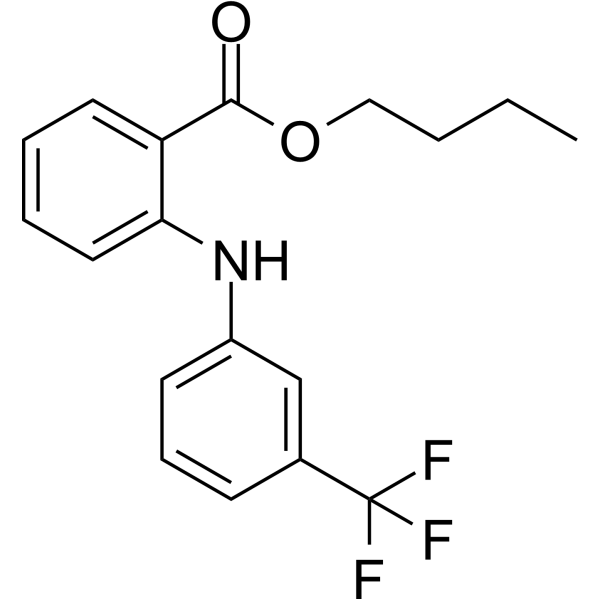
Ufenamate

Based on 1 Customer Validation
Ufenamate (Flufenamic acid butyl ester) is an anthranilic acid-based anti-inflammatory drug that can be used in the study of skin diseases such as acute and chronic eczema, contact dermatitis, diaper dermatitis, miliary rashes and atopic dermatitis. Ufenamate has a certain photoprotective effect, reduces the degree of skin erythema and swelling in the photoaging model, downregulates the expression level of COX-2 and can promote the healing of mouse skull defects by secreting BMP2.
For research use only. We do not sell to patients.
- Purity : 99.89%
- CAS No.: 67330-25-0
- Formula: C18H18F3NO2
- Molecular Weight:337.34
-
Storage:Pure form -20°C, 3 years , 4°C, 2 years ; In solvent -80°C, 6 months , -20°C, 1 month

To place orders, for customer services and technical support, please contact: MedChemExpress USA
Tel: 609-228-6898 E-mail: [email protected] [email protected]


-
 Biological Activity
-
Chemical Information
-
Solvent & Solubility
- Protocols
- Purity & Documentation
- References
-
 Help & FAQs




Biological Activity
Description
IC50 & Target
|
COX-2 |
In Vivo
Ufenamate (Ointment application, single dose) has a certain photoprotective effect, reduces the degree of skin erythema and swelling in the photoaging mice model and downregulates the expression level of COX-2[3].
Ufenamat (Ointment application, 6 and 8 weeks) promotes the healing of skull injuries in mice[4].
MedChemExpress (MCE) has not independently confirmed the accuracy of these methods. They are for reference only.
-
Animal Model:UV-induced acute sunburn model, photoaging model and skin squamous cell carcinoma model in SKH-1 hairless mice[3]
-
Dosage:Ointment application
-
Administration:Ointment application; single dose; 30 min
-
Result:Inhibited acute swelling and redness caused by UV irradiation and reduced COX-2 expression.
At 12 weeks of irradiation, skin aging was alleviated, the collagen density of the dermis was higher, the expression of Bcl-2 was weakened, and the expression of Bax and Caspase 3 was enhanced.
At 28 weeks of irradiation, the appearance of tumors was delayed.
-
Animal Model:Intact and damaged skin of rats[2]
-
Dosage:2µL/cm2
-
Administration:Ointment application; single dose
-
Result:Applied on the damaged skin, contained in the epidermis was approximately 50% and 25% of that in the intact skin after LP and water, respectively, with the content being 5 times and 10 times higher than in the intact skin.
Permeated UF five times more than LP in the intact skin. Reduced significantly the permeation of UF by both LP and water due to the defatting effect of SC.
-
Animal Model:Skull defect mice[4]
-
Dosage:Ointment application
-
Administration:Ointment application; 6 weeks and 8 weeks
-
Result:Promoted the formation of new bone in the defect area, and the effect was stronger after 8 weeks than at 6 weeks, improving the BV/TV and BMD in the defect area.


Chemical Information
-
CAS No. 67330-25-0
-
Appearance Liquid (Density: 1.2230 g/cm3)
-
Molecular Weight 337.34
-
Formula C18H18F3NO2
-
Color Colorless to light yellow
-
SMILES
O=C(OCCCC)C1=CC=CC=C1NC2=CC=CC(C(F)(F)F)=C2
-
Synonyms
Flufenamic acid butyl ester; Butyl flufenamate
-
Shipping
Room temperature in continental US; may vary elsewhere.
-
Storage
Pure form -20°C 3 years 4°C 2 years In solvent -80°C 6 months -20°C 1 month


Solvent & Solubility
In Vitro:
DMSO : ≥ 44 mg/mL (130.43 mM; Hygroscopic DMSO has a significant impact on the solubility of product, please use newly opened DMSO)
* "≥" means soluble, but saturation unknown.
Please refer to the solubility information to select the appropriate solvent. Once prepared, please aliquot and store the solution to prevent product inactivation from repeated freeze-thaw cycles.
Storage method and period of stock solution: -80°C, 6 months; -20°C, 1 month. When stored at -80°C, please use it within 6 months. When stored at -20°C, please use it within 1 month.
Please refer to the solubility information to select the appropriate solvent. Once prepared, please aliquot and store the solution to prevent product inactivation from repeated freeze-thaw cycles.
Storage method and period of stock solution: -80°C, 6 months; -20°C, 1 month. When stored at -80°C, please use it within 6 months. When stored at -20°C, please use it within 1 month.
Concentration (start) × Volume (start) = Concentration (final) × Volume (final)

Protocols
-
RNA extraction experimental
By lysing cells, releasing RNA, and removing impurities such as proteins and DNA, high-purity RNA products are finally obtained. The commonly used traditional method is the guanidine isothiocyanate/phenol/chloroform method (Trizol), which is suitable for a variety of animal materials including animal tissues, microorganisms, cultured cells, etc., and most plant materials.
-
TPA/Croton Oil Ear Edema and Dermatitis
The TPA (12-O-tetradecanoylphorbol-13-acetate) and croton oil-induced mouse ear edema model is a well-established acute cutaneous inflammation system used to evaluate topical anti-inflammatory activity by measuring edema formation, neutrophil infiltration, vascular permeability, and cytokine-mediated skin responses in vivo. The inflammatory response is triggered by topical application of phorbol esters (TPA) or croton oil constituents, leading to rapid activation of protein kinase C signaling, leukocyte recruitment, and increased vascular permeability, which can be quantified by ear thickness, weight, dye extravasation, and biochemical markers such as myeloperoxidase (MPO) activity and pro-inflammatory mediators in ear tissue homogenates. This model is widely used for screening anti-inflammatory agents, where reductions in edema and inflammatory biomarkers reflect suppression of acute dermal inflammation and immune cell infiltration. Histological evaluation typically confirms epidermal
-
Contact Hypersensitivity Dermatitis
Contact hypersensitivity (CHS) dermatitis is a T cell-mediated delayed-type (Type IV) immune reaction in which low-molecular-weight haptens applied to the skin bind host proteins to form complete antigens, triggering sensitization followed by a secondary inflammatory response upon re-exposure (elicitation phase), which is commonly quantified by ear swelling as a readout of skin inflammation in murine models. This model is widely used to study allergic contact dermatitis because it is antigen-specific, reproducible, and reflects key immunological events including dendritic cell activation, T cell priming in draining lymph nodes, and effector T cell-driven tissue inflammation. DNFB- and oxazolone-induced CHS models are standard systems for evaluating both acute and chronic T cell-dependent skin inflammation and for testing immunomodulatory interventions.
-
Research Protocol for Inflammation-related Diseases
The NLRP3 inflammasome is a cytosolic innate immune signaling platform that integrates priming signals and danger-signal activation to promote caspase-1 activation, maturation of IL-1β and IL-18, and gasdermin D-mediated pyroptotic cell death. The core experimental logic is to determine whether inflammatory disease phenotypes are driven by increased NLRP3 expression, ASC-containing inflammasome assembly, caspase-1 cleavage, GSDMD cleavage, and extracellular release of IL-1β/IL-18 rather than by nonspecific cell injury alone. The pathway is strongly linked to inflammation-related disease phenotypes because monosodium urate crystals activate NALP3/NLRP3 inflammasome signaling in gout-like crystal inflammation, cholesterol crystals activate NLRP3 inflammasomes in atherogenesis models, and DSS-induced intestinal inflammation has been reported to involve NLRP3 inflammasome activity. However, experimental colitis studies also show context-dependent protective effects of NLRP3 inflammasome co


Purity & Documentation
-
Data Sheet (277 KB)
-
SDS (396 KB)
- English - EN (396 KB)
- Français - FR (396 KB)
- Deutsch - DE (396 KB)
- Norwegian - NO (396 KB)
- Español - ES (396 KB)
- Swedish - SV (396 KB)
- Italian - IT (396 KB)
- Korean - KR (396 KB)
- Portuguese - PT (396 KB)
-
Handling Instructions (2659 KB)
References
[1]. Iino H, et al. Penetration of Ufenamate into Intact, Stripped, or Delipidized Skin Using Different Vehicles. Biol Pharm Bull. 2015;38(10):1645-8. [Content Brief]
[2]. Hayato Iino, et al. Penetration of Ufenamate into Intact, Stripped, or Delipidized Skin Using Different Vehicles. Bio Pharm Bull. 2015;38(10):1645-8. [Content Brief]
[4]. Fan Yang, et al. Topical Application of Butyl Flufenamate Ointment Promotes Cranial Defect Healing in Mice by Inducing BMP2 Secretion in Skin Mesenchymal Stem Cells. Cells. 2022 Nov 15;11(22):3620. [Content Brief]


Complete Stock Solution Preparation Table
Please refer to the solubility information to select the appropriate solvent. Once prepared, please aliquot and store the solution to prevent product inactivation from repeated freeze-thaw cycles.
Storage method and period of stock solution: -80°C, 6 months; -20°C, 1 month. When stored at -80°C, please use it within 6 months. When stored at -20°C, please use it within 1 month.
| Optional Solvent | Concentration Solvent Mass | 1 mg | 5 mg | 10 mg | 25 mg |
|---|---|---|---|---|---|
| DMSO | 1 mM | 2.9644 mL | 14.8218 mL | 29.6437 mL | 74.1092 mL |
| 5 mM | 0.5929 mL | 2.9644 mL | 5.9287 mL | 14.8218 mL | |
| 10 mM | 0.2964 mL | 1.4822 mL | 2.9644 mL | 7.4109 mL | |
| 15 mM | 0.1976 mL | 0.9881 mL | 1.9762 mL | 4.9406 mL | |
| 20 mM | 0.1482 mL | 0.7411 mL | 1.4822 mL | 3.7055 mL | |
| 25 mM | 0.1186 mL | 0.5929 mL | 1.1857 mL | 2.9644 mL | |
| 30 mM | 0.0988 mL | 0.4941 mL | 0.9881 mL | 2.4703 mL | |
| 40 mM | 0.0741 mL | 0.3705 mL | 0.7411 mL | 1.8527 mL | |
| 50 mM | 0.0593 mL | 0.2964 mL | 0.5929 mL | 1.4822 mL | |
| 60 mM | 0.0494 mL | 0.2470 mL | 0.4941 mL | 1.2352 mL | |
| 80 mM | 0.0371 mL | 0.1853 mL | 0.3705 mL | 0.9264 mL | |
| 100 mM | 0.0296 mL | 0.1482 mL | 0.2964 mL | 0.7411 mL |


Ufenamate Related Classifications
HY-100009 Related Classifications
 Powered by Bioz