



DFMTI

Based on 1 Customer Validation
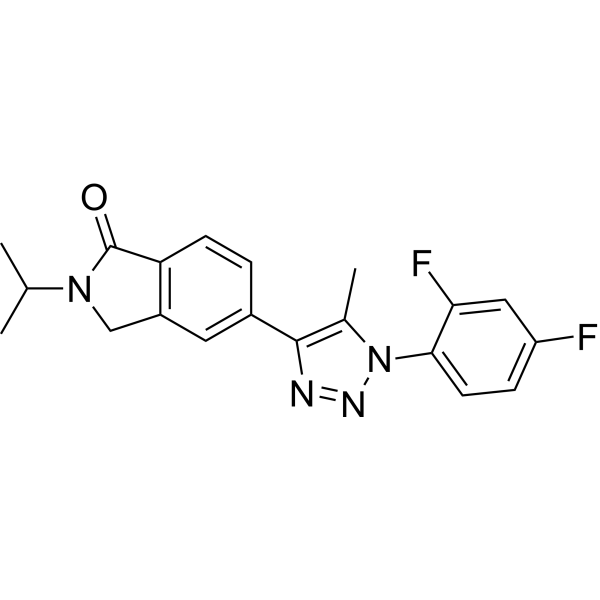
DFMTI (MK5435) is a blood-brain barrier-penetrant mGluR1 inhibitor. DFMTI abolishes the tobacco mosaic virus (TMV) resistance phenotype of NbAS-B-overexpressing plants by inhibiting glutamate production required for the activation of the Salicylic acid (HY-B0167) pathway. DFMTI disrupts prepulse inhibition in rats. DFMTI can be used in research related to psychiatric disorders and tobacco mosaic virus infection.
商品は「研究用試薬」です。人や動物の医療用・臨床診断用・食品用の製品ではありません。
研究用途以外に使用した場合、当社は一切の責任を負いかねます。
- 純度 : 98.00%
- CAS 番号: 864864-86-8
- 分子式: C20H18F2N4O
- 分子量:368.38
-
保管条件:Powder -20°C, 3 years , 4°C, 2 years ; In solvent -80°C, 2 years , -20°C, 1 year

To place orders, for customer services and technical support, please contact: MedChemExpress USA
Tel: 609-228-6898 E-mail: [email protected] [email protected]


-
 生物活性
生物活性
-
化学情報
-
溶剤 & 溶解度
- プロトコル
- 純度とドキュメンテーション
- 参考文献
-
 Help & FAQs




生物活性
製品説明
IC50 & Target
[1]|
mGluR1 |
Cellular Effect
|
Cell Line

|
Type | Value | Description | References |
|---|---|---|---|---|
| CHO | IC50 |
>10000 nM
Compound: 23
|
Antagonist activity at human mGluR2 receptor expressed in CHO cell membranes assessed as inhibition of L-glutamate-induced calcium mobilization by FLIPR
Antagonist activity at human mGluR2 receptor expressed in CHO cell membranes assessed as inhibition of L-glutamate-induced calcium mobilization by FLIPR
|
[PMID: 19692242] |
| CHO | IC50 |
>10000 nM
Compound: 23
|
Antagonist activity at human mGluR8 receptor expressed in CHO cell membranes assessed as inhibition of L-glutamate-induced calcium mobilization by FLIPR
Antagonist activity at human mGluR8 receptor expressed in CHO cell membranes assessed as inhibition of L-glutamate-induced calcium mobilization by FLIPR
|
[PMID: 19692242] |
| CHO | IC50 |
3.6 nM
Compound: 23
|
Antagonist activity at rat mGluR1 receptor expressed in CHO cell membranes assessed as inhibition of L-glutamate-induced calcium mobilization by FLIPR
Antagonist activity at rat mGluR1 receptor expressed in CHO cell membranes assessed as inhibition of L-glutamate-induced calcium mobilization by FLIPR
|
[PMID: 19692242] |
| CHO | IC50 |
>10000 nM
Compound: 23
|
Antagonist activity at human mGluR1 receptor quisqualic acid binding site expressed in CHO cell membranes assessed as inhibition of L-glutamate-induced calcium mobilization by FLIPR
Antagonist activity at human mGluR1 receptor quisqualic acid binding site expressed in CHO cell membranes assessed as inhibition of L-glutamate-induced calcium mobilization by FLIPR
|
[PMID: 19692242] |
体外実験
DFMTI abolishes the Tobacco Mosaic Virus (TMV) resistance phenotype of Nicotiana benthamiana overexpressing NbAS-B by inhibiting glutamate production required for the activation of the Salicylic acid (HY-B0167) pathway[1].
DFMTI (MK5435) (incubated for 5 min) potently inhibits human mGluR1a-mediated intracellular Ca2+ mobilization in CHO cells, with an IC50 of 4.3 nM, and exhibits low activity against human mGluR5[2].
DFMTI (10 μM) displaces specific [18F]MK-1312 binding in rhesus monkey and human brain slices, and effectively determines the non-displaceable binding of [18F]MK-1312 in rhesus monkey and human cerebellar homogenates, confirming that it interacts specifically with mGluR1 in these tissues[2].
DFMTI (compound 3) potently inhibits glutamate-induced calcium mobilization in TREx293 cells, with IC50 values of 8 nM, 31 nM, 21 nM, and 14 nM in cells expressing rmGlu1 WT, hmGlu1 WT, rmGlu1 V757L, and hmGlu1 L757V, respectively; the potency differs by approximately 4-fold between human and rat wild-type receptors[3].
DFMTI acts as a non-competitive allosteric antagonist against rmGlu1 WT, rmGlu1 V757L, hmGlu1 WT, and hmGlu1 L757V, with subtle variations in its potency depending on the amino acid at position 757[3].
MedChemExpress (MCE) has not independently confirmed the accuracy of these methods. They are for reference only. Further protocols information, click here.
体内実験
MedChemExpress (MCE) has not independently confirmed the accuracy of these methods. They are for reference only.
-
Animal Model:Rhesus monkey (adult, sedated with dissociative anesthetic and short-acting intravenous anesthetic)[2]
-
Dosage:0.015 mg/kg (i.v. bolus) plus 0.0075 mg/kg/h (i.v. infusion); 0.45 mg/kg (i.v. bolus) plus 0.2 mg/kg/h (i.v. infusion)
-
Administration:i.v. bolus plus
i.v. infusion -
Result:Reduced [18F]MK-1312 uptake in all gray matter brain regions in a dose-dependent manner.
Yielded an Occ50 (plasma concentration for 50% occupancy) of 76 nM via Hill equation modeling of plasma concentration and mGluR1 receptor occupancy relationship.
Required a plasma concentration of 285 nM to achieve 75% mGluR1 occupancy in the cerebellum.


化学情報
-
CAS 番号 864864-86-8
-
性状 Solid
-
分子量 368.38
-
分子式 C20H18F2N4O
-
Color White to off-white
-
SMILES
O=C(N(C(C)C)C1)C2=C1C=C(C3=C(C)N(C4=CC=C(F)C=C4F)N=N3)C=C2
-
別名
MK5435
-
輸送条件
Room temperature in continental US; may vary elsewhere.
-
保管条件
Powder -20°C 3 years 4°C 2 years In solvent -80°C 2 years -20°C 1 year


溶剤 & 溶解度
体外:
DMSO : 25 mg/mL (67.86 mM; ultrasonic and warming and heat to 60°C; Hygroscopic DMSO has a significant impact on the solubility of product, please use newly opened DMSO)
Please refer to the solubility information to select the appropriate solvent. Once prepared, please aliquot and store the solution to prevent product inactivation from repeated freeze-thaw cycles.
Storage method and period of stock solution: -80°C, 2 years; -20°C, 1 year. When stored at -80°C, please use it within 2 years. When stored at -20°C, please use it within 1 year.
Please refer to the solubility information to select the appropriate solvent. Once prepared, please aliquot and store the solution to prevent product inactivation from repeated freeze-thaw cycles.
Storage method and period of stock solution: -80°C, 2 years; -20°C, 1 year. When stored at -80°C, please use it within 2 years. When stored at -20°C, please use it within 1 year.
濃度 (開始) × 体積 (開始) = 濃度 (終了) × 体積 (終了)

プロトコル
-
Research Protocol for Infectious Diseases
Infectious-disease experiments test how pathogens interact with host barriers, innate immune receptors, inflammatory signaling, pathogen replication, and tissue injury; pattern-recognition receptors such as TLRs, RIG-I-like receptors, NOD-like receptors, and inflammasomes detect microbial molecules and activate NF-κB, interferon, and cytokine responses. The central hypothesis is that infection severity reflects the balance between pathogen burden and host response: protective inflammation restricts pathogen growth, whereas excessive or mislocalized inflammation contributes to tissue damage and disease phenotype. Unresolved questions include which host pathways are protective versus pathogenic, why some infection models fail to translate to human disease, and which combined readouts best predict clinically relevant infection outcomes.


純度とドキュメンテーション
-
データシート (284 KB)
-
SDS (251 KB)
- English - EN (251 KB)
- Français - FR (251 KB)
- Deutsch - DE (251 KB)
- Norwegian - NO (251 KB)
- Español - ES (251 KB)
- Swedish - SV (251 KB)
- Italian - IT (251 KB)
- Korean - KR (251 KB)
- Portuguese - PT (251 KB)
-
取扱説明書 (2659 KB)
参考文献
[2]. Hostetler ED, et al. Synthesis, characterization, and monkey PET studies of [¹⁸F]MK-1312, a PET tracer for quantification of mGluR1 receptor occupancy by MK-5435. Synapse (New York, N.Y.). 2011 Feb;65(2):125-35. [Content Brief]
[3]. Cho HP, et al. A novel class of succinimide-derived negative allosteric modulators of metabotropic glutamate receptor subtype 1 provides insight into a disconnect in activity between the rat and human receptors. ACS chemical neuroscience. 2014 Jul 16;5(7):597-610. [Content Brief]


Complete Stock Solution Preparation Table
Please refer to the solubility information to select the appropriate solvent. Once prepared, please aliquot and store the solution to prevent product inactivation from repeated freeze-thaw cycles.
Storage method and period of stock solution: -80°C, 2 years; -20°C, 1 year. When stored at -80°C, please use it within 2 years. When stored at -20°C, please use it within 1 year.
| Optional Solvent | Concentration Solvent Mass | 1 mg | 5 mg | 10 mg | 25 mg |
|---|---|---|---|---|---|
| DMSO | 1 mM | 2.7146 mL | 13.5729 mL | 27.1459 mL | 67.8647 mL |
| 5 mM | 0.5429 mL | 2.7146 mL | 5.4292 mL | 13.5729 mL | |
| 10 mM | 0.2715 mL | 1.3573 mL | 2.7146 mL | 6.7865 mL | |
| 15 mM | 0.1810 mL | 0.9049 mL | 1.8097 mL | 4.5243 mL | |
| 20 mM | 0.1357 mL | 0.6786 mL | 1.3573 mL | 3.3932 mL | |
| 25 mM | 0.1086 mL | 0.5429 mL | 1.0858 mL | 2.7146 mL | |
| 30 mM | 0.0905 mL | 0.4524 mL | 0.9049 mL | 2.2622 mL | |
| 40 mM | 0.0679 mL | 0.3393 mL | 0.6786 mL | 1.6966 mL | |
| 50 mM | 0.0543 mL | 0.2715 mL | 0.5429 mL | 1.3573 mL | |
| 60 mM | 0.0452 mL | 0.2262 mL | 0.4524 mL | 1.1311 mL |


DFMTI 関連分類
HY-100404 関連分類
 Powered by Bioz