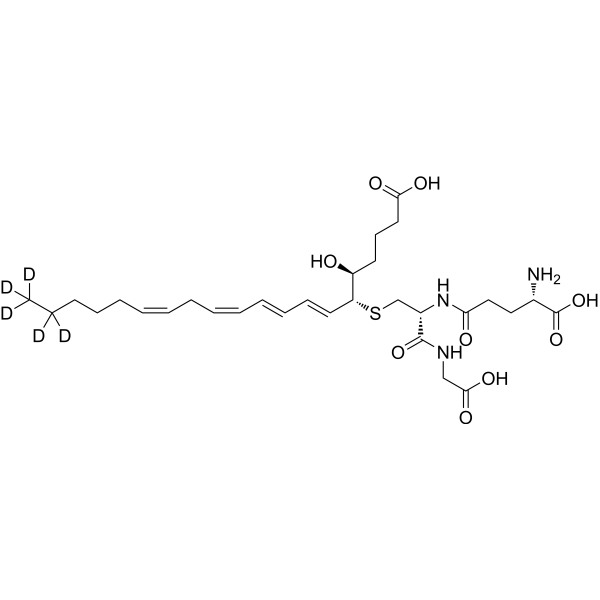
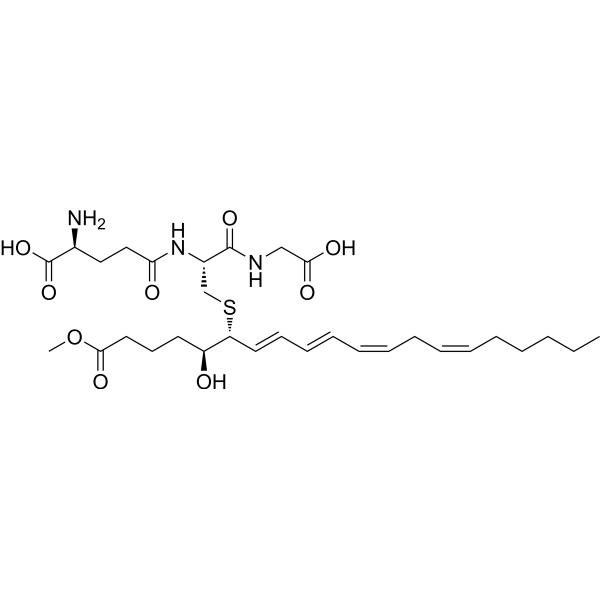
Leukotriene E4-d5
Based on 1 Customer Validation
Leukotriene E4-d5 (LTE4-d5) is the d-5-labeled Leukotriene E4 (HY-113465). Leukotriene E4 is a stable final metabolite of cysteinyl leukotrienes, produced by immune cells such as mast cells and eosinophils. Leukotriene E4 serves as a key biomarker for evaluating asthma severity, Aspirin (HY-14654) sensitivity, and mast cell activation disorders. Leukotriene E4 is a full functional agonist of CysLT1R, which induces sustained intracellular calcium mobilization and Erk phosphorylation. Leukotriene E4 mediates inflammation in a P2Y12 receptor-dependent manner. Leukotriene E4 can be used in the research of asthma and non-steroidal anti-inflammatory drug-exacerbated respiratory diseases.
For research use only. We do not sell to patients.
- CAS No.: 1240398-14-4
- Formula: C23H32D5NO5S
- Molecular Weight:444.64
-
Storage:
Solution, -20°C, 2 years

All Endogenous Metabolite Isoforms
MoreAll Leukotriene Receptor Isoforms
MoreAll Calcium Channel Isoforms
MoreAll P2Y Receptor Isoforms
More
Biological Activity
Description
Application
1. This compound can be used as a tracer
2. This compound can be used as an internal standard for quantitative analysis by NMR, GC-MS, or LC-MS.
Chemical Information
-
CAS No. 1240398-14-4
-
Unlabeled CAS 75715-89-8
-
Appearance Liquid
-
Molecular Weight 444.64
-
Formula C23H32D5NO5S
-
Color Colorless to light yellow
-
SMILES
OC(CCC[C@H](O)[C@@H](/C=C/C=C/C=C\C/C=C\CCCC([2H])([2H])C([2H])([2H])[2H])SC[C@H](N)C(O)=O)=O
-
Synonyms
LTE4-d5
-
Shipping
Room temperature in continental US; may vary elsewhere.
-
Storage
Solution, -20°C, 2 years
Protocols
-
Kinase activity and phosphorylation assays
Kinase activity assays measure the ability of kinases to transfer phosphate groups from ATP to specific substrates, while phosphorylation assays detect the presence and levels of phosphorylated proteins. Common methods include radiolabeled ATP incorporation (e. g. ,), ADP release detection via bioluminescence (e. g. ,[3]), enzyme-linked immunosorbent assays (ELISA) for phospho-specific epitopes (e. g. ,[6]), and microtiter-based formats for high-throughput screening (e. g. ,[8]). The ADP-Glo assay quantifies kinase activity by measuring ADP produced during phosphorylation using a luciferase-based system. Radiometric assays involve autoradiography or scintillation counting after incorporation of 32P-labeled ATP into substrate proteins. ELISA-based approaches rely on phospho-specific antibodies to detect activated kinases in cell lysates or purified samples.
-
Western Blot
Western blotting (WB) is a commonly used experimental method in molecular biology, biochemistry, and immunogenetics for identifying and quantifying target proteins. It combines gel electrophoresis with immunoassay, enabling researchers to analyze protein expression, post-translational modifications, and molecular weight.
-
Calcium Spark Assay
Calcium sparks are localized, transient increases in intracellular calcium concentration ([Ca2+]i) that occur in cardiac myocytes and represent elementary events underlying excitation-contraction coupling. These events are generated by the coordinated opening of clusters of ryanodine receptors (RyRs) on the sarcoplasmic reticulum membrane, leading to a brief release of Ca2+ into the cytosol. The detection and analysis of calcium sparks provide insights into the mechanisms of calcium handling and signaling in cardiac cells. Imaging techniques using fluorescent calcium indicators such as Fluo-3 are employed to visualize these subcellular calcium transients with high spatial and temporal resolution. The protocol is based on established methodologies described in primary literature for both experimental measurement and automated analysis of calcium sparks.
-
Ca2+ Staining Technique
Ca2+ staining is an experimental technique that utilizes specific fluorescent probes (such as Fluo-4 AM, Fura-2, etc.) to qualitatively or quantitatively detect dynamic changes in intracellular Ca2+ concentrations; this is achieved by monitoring the changes in fluorescent signals generated when these probes bind to free intracellular calcium ions. The underlying principle relies primarily on the presence of chelating groups within the probe's molecular structure that possess high affinity for calcium ions.
-
Protocol for Kinase activity and phosphorylation assays
Kinase activity assays measure transfer of phosphate from ATP to a protein or peptide substrate, generating phosphorylated substrate, ADP, or incorporated radiolabeled phosphate as the readout; phosphorylation assays measure site-specific phosphorylation in cells or tissues as a proxy for kinase-pathway activation, inhibition, or substrate regulation. Phosphorylation can be detected by phospho-specific Western blot, immunoprecipitation kinase assay, phospho-immunofluorescence, phospho-flow cytometry, luminescent ADP detection, radiolabeled ATP incorporation, or reporter-based pathway assays, and these readouts can be applied to cancer cells, primary neurons, mouse tumors, organoids, inflammatory macrophages, ferroptosis studies, and mitophagy studies when the kinase target is biologically relevant.
-
Research Protocol for Inflammation-related Diseases
The NLRP3 inflammasome is a cytosolic innate immune signaling platform that integrates priming signals and danger-signal activation to promote caspase-1 activation, maturation of IL-1β and IL-18, and gasdermin D-mediated pyroptotic cell death. The core experimental logic is to determine whether inflammatory disease phenotypes are driven by increased NLRP3 expression, ASC-containing inflammasome assembly, caspase-1 cleavage, GSDMD cleavage, and extracellular release of IL-1β/IL-18 rather than by nonspecific cell injury alone. The pathway is strongly linked to inflammation-related disease phenotypes because monosodium urate crystals activate NALP3/NLRP3 inflammasome signaling in gout-like crystal inflammation, cholesterol crystals activate NLRP3 inflammasomes in atherogenesis models, and DSS-induced intestinal inflammation has been reported to involve NLRP3 inflammasome activity. However, experimental colitis studies also show context-dependent protective effects of NLRP3 inflammasome co
Purity & Documentation
-
Data Sheet (263 KB)
-
SDS (419 KB)
- English - EN (419 KB)
- Français - FR (419 KB)
- Deutsch - DE (419 KB)
- Norwegian - NO (419 KB)
- Español - ES (419 KB)
- Swedish - SV (419 KB)
- Italian - IT (419 KB)
- Korean - KR (419 KB)
- Portuguese - PT (419 KB)
-
Handling Instructions (2659 KB)
References
Calculators
Concentration (start) × Volume (start) = Concentration (final) × Volume (final)
Keywords
- Leukotriene E4-d5
- 1240398-14-4
- LTE4-d5
- Isotope-Labeled Compounds
- Endogenous Metabolite
- Leukotriene Receptor
- Calcium Channel
- ERK
- P2Y Receptor
- CysLT1
- HEK293T cells
- BALB/c mice
- C57BL/6 mice
- P2Y12
- NSAID-exacerbated respiratory disease
- Chinese hamster ovary cells
- LAD2 human mast cells
- LUVA human mast cells
- asthma
- Inhibitor
- inhibitor
- inhibit