



LQ23
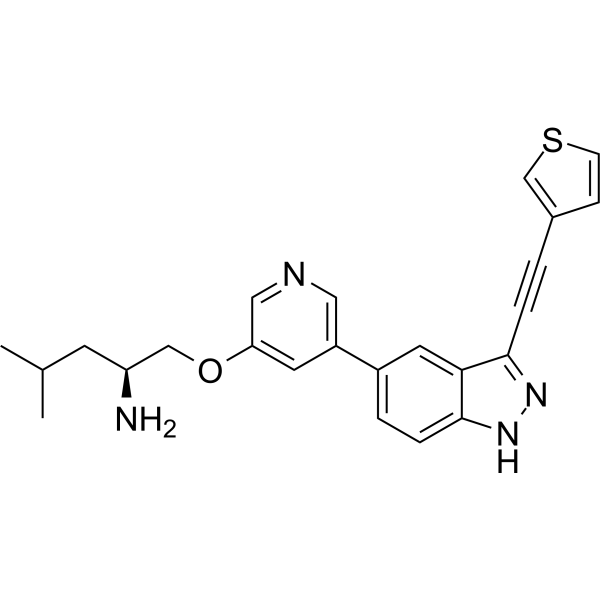
LQ23 is a selective inhibitor for CDC2-like kinase 2 (CLK2) with an IC50 of 1.4 nM. LQ23 exhibits anti-inflammatory activity.
Nur für Forschungszwecke. Wir verkaufen nicht an Patienten.
- CAS. Nr.: 2997615-62-8
- Formel: C24H24N4OS
- Molecular Weight:416.54
-
Speicherung:
Please store the product under the recommended conditions in the Certificate of Analysis.

To place orders, for customer services and technical support, please contact: MedChemExpress USA
Tel: 609-228-6898 E-mail: [email protected] [email protected]


-
 Biologische Aktivität
-
Chemical Information
- Protokoll
- Reinheit & Dokumentation
- Verweise
-
 Help & FAQs




Biologische Aktivität
Beschreibung
IC50 & Target
IC50: 1.4 nM (CLK2), 2.1 nM (CLK1), 3.2 nM (CLK4), 21.7 nM (DYRK1A), >100 nM (CLK3)
In Vitro
LQ23 (10-100 nM) dose-dependently inhibits SR protein phosphorylation in chondrocytes, and thereby regulates the selective cleavage of genes[1].
LQ23 (10-100 nM) dose-dependently inhibits CHIR99021-stimulated Wnt-signaling in HEK-293T cells with IC50 of 2.9 μM[1].
LQ23 (30 nM) ameliorates osteoarthritis through promotes the bone mesenchymal stem cells (BMSC) differentation into chondrocytes and suppresses the cartilage degradation[1].
MedChemExpress (MCE) has not independently confirmed the accuracy of these methods. They are for reference only.
-
Cell Line:Chondrocytes
-
Concentration:10-100 nM
-
Incubation Time:1 h
-
Result:Reduced phosphorylated SRSF4, SRSF5 and SRSF6.
Reduced levels of β-catenin and c myc.
In Vivo
MedChemExpress (MCE) has not independently confirmed the accuracy of these methods. They are for reference only.
-
Animal Model:MIA-/ACLT-pMMx-induced osteoarthritis in Sprague-Dawley rats model[1]
-
Dosage:1.5 μg/ kg
-
Administration:Single IA injection
-
Result:Ameliorated the surface of the articular cartilage and the cell arrangement, reduced the thickness of the synovium, increased the gap between the femur and the tibia.
Reduced the levels of inflammatory cytokines and catabolic enzymes.


Chemical Information
-
CAS. Nr. 2997615-62-8
-
Molecular Weight 416.54
-
Formel C24H24N4OS
-
SMILES
N[C@H](COC1=CC(C2=CC=C(C3=C2)NN=C3C#CC4=CSC=C4)=CN=C1)CC(C)C
-
Versand
Room temperature in continental US; may vary elsewhere.
-
Speicherung
Please store the product under the recommended conditions in the Certificate of Analysis.


Reinheit & Dokumentation
Verweise

Calculators
Konzentration (Stammlösung) × Volumen (Stammlösung) = Konzentration (Ziellösung) × Volumen (Ziellösung)


LQ23 Related Classifications
HY-162398 Related Classifications
 Powered by Bioz