



Lufenuron
Based on 1 publication(s) in Google Scholar
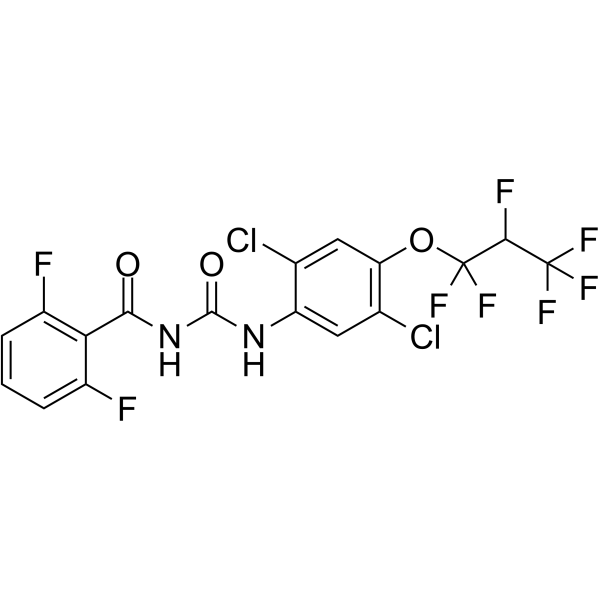
Lufenuron is an orally active lipophilic benzoylurea insecticide and a chitin synthesis inhibitor that can used for flea and fish lice control. Lufenuron inhibits moulting of arthropods. Lufenuron induces reproductive toxicity, genotoxic effects and oxidative stresses in pregnant albino rats and their fetuses.
For research use only. We do not sell to patients.
- Purity : 99.20%
- CAS No.: 103055-07-8
- Formula: C17H8Cl2F8N2O3
- Molecular Weight:511.15
-
Storage:Powder -20°C, 3 years , 4°C, 2 years ; In solvent -80°C, 6 months , -20°C, 1 month

To place orders, for customer services and technical support, please contact: MedChemExpress USA
Tel: 609-228-6898 E-mail: [email protected] [email protected]


-
 Biological Activity
-
Chemical Information
-
Solvent & Solubility
- Protocols
- Purity & Documentation
- References
-
 Help & FAQs



Publications Citing Use of MedChemExpress (MCE) Lufenuron
MoreAll Parasite Isoforms
More

Biological Activity
Description
In Vivo
Lufenuron (0.4 or 0.8 mg/kg of body weight, oral gavage, once daily at the same time over the seven days of the second gestation period (from 7 to 13th gestational day)) induces reproductive toxicity and genotoxic effects in pregnant albino rats and their fetuses[3].
MedChemExpress (MCE) has not independently confirmed the accuracy of these methods. They are for reference only.
-
Animal Model:Pregnant albino rats[3]
-
Dosage:0.4 or 0.8 mg/kg of body weight
-
Administration:oral gavage, once daily at the same time over the seven days of the second gestation period (from 7 to 13th gestational day)
-
Result:The fetuses extracted from Lufenuron-treated dams showed visible dead cases and multiple morphologic malformations; including hematoma, total foot loss in pregnant albino rats.


Chemical Information
-
CAS No. 103055-07-8
-
Appearance Solid
-
Molecular Weight 511.15
-
Formula C17H8Cl2F8N2O3
-
Color Off-white to light yellow
-
SMILES
O=C(NC(NC1=CC(Cl)=C(OC(F)(F)C(F)C(F)(F)F)C=C1Cl)=O)C2=C(F)C=CC=C2F
-
Shipping
Room temperature in continental US; may vary elsewhere.
-
Storage
Powder -20°C 3 years 4°C 2 years In solvent -80°C 6 months -20°C 1 month


Publications (1)
-
Journal Impact Factor
-
Most Recent
-
Insect Sci
Genetic and pharmacological inhibition of the Kir2A channel in diamondback moth exhibits ovicidal activity. [Abstract]2026 May 11. PMID: 42116718


Solvent & Solubility
In Vitro:
DMSO : 125 mg/mL (244.55 mM; Need ultrasonic; Hygroscopic DMSO has a significant impact on the solubility of product, please use newly opened DMSO)
Please refer to the solubility information to select the appropriate solvent. Once prepared, please aliquot and store the solution to prevent product inactivation from repeated freeze-thaw cycles.
Storage method and period of stock solution: -80°C, 6 months; -20°C, 1 month. When stored at -80°C, please use it within 6 months. When stored at -20°C, please use it within 1 month.
Please refer to the solubility information to select the appropriate solvent. Once prepared, please aliquot and store the solution to prevent product inactivation from repeated freeze-thaw cycles.
Storage method and period of stock solution: -80°C, 6 months; -20°C, 1 month. When stored at -80°C, please use it within 6 months. When stored at -20°C, please use it within 1 month.
Concentration (start) × Volume (start) = Concentration (final) × Volume (final)
In Vivo:
Select the appropriate dissolution method based on your experimental animal and administration route.
- For the following dissolution methods, please ensure to first prepare a clear stock solution using an In Vitro approach and then sequentially add co-solvents:
- To ensure reliable experimental results, the clarified stock solution can be appropriately stored based on storage conditions. As for the working solution for In Vivo experiments, it is recommended to prepare freshly and use it on the same day.
- The percentages shown for the solvents indicate their volumetric ratio in the final prepared solution. If precipitation or phase separation occurs during preparation, heat and/or sonication can be used to aid dissolution.
Add each solvent one by one: 10% DMSO 40% PEG300 5% Tween-80 45% Saline
Solubility: ≥ 2.08 mg/mL (4.07 mM); Clear solution
This protocol yields a clear solution of ≥ 2.08 mg/mL (saturation unknown).
Taking 1 mL working solution as an example, add 100 μL DMSO stock solution (20.8 mg/mL) to 400 μL PEG300, and mix evenly; then add 50 μL Tween-80 and mix evenly; then add 450 μL Saline to adjust the volume to 1 mL.
Preparation of Saline: Dissolve 0.9 g sodium chloride in ddH₂O and dilute to 100 mL to obtain a clear Saline solution.
In Vivo Dissolution Calculator
Please enter the basic information of animal experiments:
-
-
-
-
Recommended: Prepare an additional quantity of animals to account for potential losses during experiments.
Please enter your animal formula composition:
-
%DMSO +
Recommended: Keep the proportion of DMSO in working solution below 2% if your animal is weak.
-
%+
-
+%Tween-80 + +
-
%Saline +
The co-solvents required include: DMSO, . All of co-solvents are available by MedChemExpress (MCE). , Tween 80. All of co-solvents are available by MedChemExpress (MCE).
Working solution concentration: 0.22 mg/mL
Method for preparing stock solution: mg drug dissolved in μL DMSO. Stock solution concentration: mg/mL.
1. Take μL DMSO stock solution;
2. Add μL .
μL , mix evenly;
3. Then add μL Tween 80, mix evenly;
4. Then add μL
Please ensure that the stock solution in the first step is dissolved to a clear state, and add co-solvents in sequence. You can use ultrasonic heating (ultrasonic cleaner, recommended frequency 20-40 kHz), vortexing, etc. to assist dissolution.

Protocols
-
Reproductive and Developmental Toxicity Study
Reproductive and developmental toxicity studies detect adverse effects of prenatal or peri/postnatal exposure on maternal condition, pregnancy maintenance, embryo-fetal survival, fetal growth, structural development, and offspring reproductive or developmental endpoints; classic rat protocols generate readouts by comparing treated groups with vehicle, pair-fed, or untreated controls for implantation, resorption, fetal weight, crown-rump length, external morphology, visceral morphology, skeletal ossification, anogenital distance, nipple/areola retention, and postnatal cohort outcomes.
-
Protocol for Fluorescence In Situ Hybridization (FISH)
Fluorescence in situ hybridization detects specific DNA or RNA sequences inside fixed cells or tissue sections by hybridizing fluorescently labeled nucleic-acid probes to complementary target sequences, allowing the target’s copy number, chromosomal position, spatial distribution, or transcript abundance to be visualized microscopically. DNA-FISH detects genomic loci, chromosomal gains/losses, amplifications, deletions, and rearrangements, while RNA-FISH detects RNA molecules or transcript localization; in cancer cells, mouse tumors, neurons, organoids, macrophages, or drug-screening samples, the readout is fluorescent puncta, fusion/split signals, or localized RNA signal interpreted relative to validated controls.
-
Genotoxicity/Mutagenicity Study
The bacterial reverse mutation assay detects point mutations that restore amino-acid prototrophy in auxotrophic Salmonella typhimurium or Escherichia coli tester strains; after exposure to a test article, mutagenic activity is read out as an increased number of revertant colonies on minimal agar compared with the vehicle control. The assay uses tester strains with different mutation targets so that base-substitution and frameshift mutagens can be detected, and testing is performed with and without exogenous mammalian metabolic activation because some chemicals require biotransformation to become mutagenic.


Purity & Documentation
-
Data Sheet (273 KB)
-
SDS (597 KB)
- English - EN (597 KB)
- Français - FR (597 KB)
- Deutsch - DE (597 KB)
- Norwegian - NO (597 KB)
- Español - ES (597 KB)
- Swedish - SV (597 KB)
- Italian - IT (597 KB)
- Korean - KR (597 KB)
- Portuguese - PT (597 KB)
-
Handling Instructions (2659 KB)
References
[1]. T C M Brock, et al. Toxicity of Sediment-Bound Lufenuron to Benthic Arthropods in Laboratory Bioassays. Aquat Toxicol. 2018 May;198:118-128. [Content Brief]
[2]. Cai Wang, et al. Lufenuron Suppresses the Resistance of Formosan Subterranean Termites (Isoptera: Rhinotermitidae) to Entomopathogenic Bacteria. J Econ Entomol. 2013 Aug;106(4):1812-8. [Content Brief]
[3]. Basal WT, et al. Lufenuron induces reproductive toxicity and genotoxic effects in pregnant albino rats and their fetuses. Sci Rep. 2020 Nov 11;10(1):19544. [Content Brief]


Complete Stock Solution Preparation Table
Please refer to the solubility information to select the appropriate solvent. Once prepared, please aliquot and store the solution to prevent product inactivation from repeated freeze-thaw cycles.
Storage method and period of stock solution: -80°C, 6 months; -20°C, 1 month. When stored at -80°C, please use it within 6 months. When stored at -20°C, please use it within 1 month.
| Optional Solvent | Concentration Solvent Mass | 1 mg | 5 mg | 10 mg | 25 mg |
|---|---|---|---|---|---|
| DMSO | 1 mM | 1.9564 mL | 9.7819 mL | 19.5637 mL | 48.9093 mL |
| 5 mM | 0.3913 mL | 1.9564 mL | 3.9127 mL | 9.7819 mL | |
| 10 mM | 0.1956 mL | 0.9782 mL | 1.9564 mL | 4.8909 mL | |
| 15 mM | 0.1304 mL | 0.6521 mL | 1.3042 mL | 3.2606 mL | |
| 20 mM | 0.0978 mL | 0.4891 mL | 0.9782 mL | 2.4455 mL | |
| 25 mM | 0.0783 mL | 0.3913 mL | 0.7825 mL | 1.9564 mL | |
| 30 mM | 0.0652 mL | 0.3261 mL | 0.6521 mL | 1.6303 mL | |
| 40 mM | 0.0489 mL | 0.2445 mL | 0.4891 mL | 1.2227 mL | |
| 50 mM | 0.0391 mL | 0.1956 mL | 0.3913 mL | 0.9782 mL | |
| 60 mM | 0.0326 mL | 0.1630 mL | 0.3261 mL | 0.8152 mL | |
| 80 mM | 0.0245 mL | 0.1223 mL | 0.2445 mL | 0.6114 mL | |
| 100 mM | 0.0196 mL | 0.0978 mL | 0.1956 mL | 0.4891 mL |


Lufenuron Related Classifications
HY-115584 Related Classifications
 Powered by Bioz