



Mezlocillin
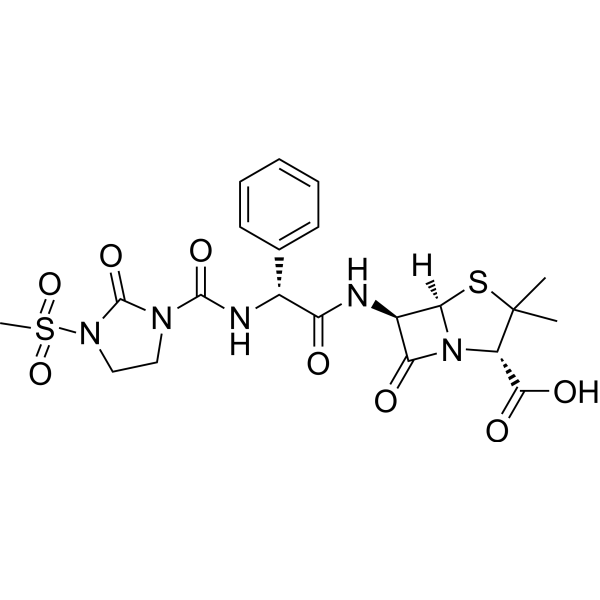
Mezlocillin (BAY-f 1353) is a β-lactam antibiotic, a semisynthetic and extended-spectrum antibiotic. Mezlocillin is active against both gram-negative and gram-positive bacteria. Mezlocillin can be used in bacterial infection research.
Nur für Forschungszwecke. Wir verkaufen nicht an Patienten.
- CAS. Nr.: 51481-65-3
- Formel: C21H25N5O8S2
- Molecular Weight:539.58
-
Speicherung:
Please store the product under the recommended conditions in the Certificate of Analysis.

To place orders, for customer services and technical support, please contact: MedChemExpress USA
Tel: 609-228-6898 E-mail: [email protected] [email protected]


-
 Biologische Aktivität
-
Chemical Information
- Protokoll
- Reinheit & Dokumentation
- Verweise
-
 Help & FAQs


Alle Antibiotic Isoform-spezifische Produkte anzeigen
More

Biologische Aktivität
Beschreibung
IC50 & Target
|
β-lactam |
In Vivo
MedChemExpress (MCE) has not independently confirmed the accuracy of these methods. They are for reference only.
-
Animal Model:Male Balb/c mice[1]
-
Dosage:1.7, 4.3, and 5.7 mg/kg
-
Administration:Subcutaneous injection; 1.7, 4.3, and 5.7 mg/kg; twice daily; 7 days
-
Result:Suppressed the IgM and IgG responses and the delayed-type hypersensitivity reaction treated with all doses.
Observed a loss of hair in the majority of animals treated with all doses.
Inhibited lymphocyte proliferation of spleen-cell cultures from animals.


Chemical Information
-
CAS. Nr. 51481-65-3
-
Molecular Weight 539.58
-
Formel C21H25N5O8S2
-
SMILES
O=C([C@@H](C(C)(C)S[C@]1([H])[C@@H]2NC([C@H](NC(N3CCN(S(=O)(C)=O)C3=O)=O)C4=CC=CC=C4)=O)N1C2=O)O
-
Synonyms
BAY-f 1353
-
Versand
Room temperature in continental US; may vary elsewhere.
-
Speicherung
Please store the product under the recommended conditions in the Certificate of Analysis.


Reinheit & Dokumentation
Verweise
[1]. Roszkowski W, et al. Antibiotics and immunomodulation: effects of cefotaxime, amikacin, mezlocillin, piperacillin and clindamycin. Med Microbiol Immunol. 1985;173(5):279-89. [Content Brief]
[2]. Bodey GP, et al. Mezlocillin: in vitro studies of a new broad-spectrum penicillin. Antimicrob Agents Chemother. 1977 Jan;11(1):74-9. [Content Brief]
[3]. Kristof RA, et al. Treatment of accidental high dose intraventricular mezlocillin application by cerebrospinal fluid exchange. J Neurol Neurosurg Psychiatry. 1998 Mar;64(3):379-81. [Content Brief]

Calculators
Konzentration (Stammlösung) × Volumen (Stammlösung) = Konzentration (Ziellösung) × Volumen (Ziellösung)


Mezlocillin Related Classifications
HY-B1466A Related Classifications
 Powered by Bioz