



PARP1-IN-5
Based on 1 publication(s) in Google Scholar
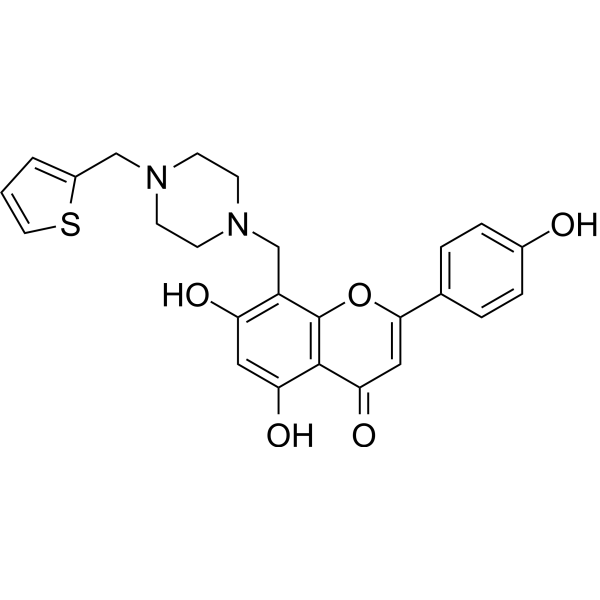
PARP1-IN-5 is a low toxicity, orally active, potent and selective PARP-1 inhibitor (IC50 =14.7 nM). PARP1-IN-5 can be used for the research of cancer.
For research use only. We do not sell to patients.
- CAS No.: 2735645-53-9
- Formula: C25H24N2O5S
- Molecular Weight:464.53
-
Storage:
Please store the product under the recommended conditions in the Certificate of Analysis.

To place orders, for customer services and technical support, please contact: MedChemExpress USA
Tel: 609-228-6898 E-mail: [email protected] [email protected]


-
 Biological Activity
-
Chemical Information
- Protocols
- Purity & Documentation
- References
-
 Help & FAQs


Publications Citing Use of MedChemExpress (MCE) PARP1-IN-5
More

Biological Activity
Description
IC50 & Target
[1]|
PARP-1 14.7 nM (IC50) |
PARP-2 0.9 μM (IC50) |
In Vitro
PARP1-IN-5 (0.1~10 μM; A549 cells) can significantly increase the cytotoxicity of CBP on A549 cells in a dose-dependent manner. PARP1-IN-5 (0.1~10 μM; SK-OV-3 cells) decreases the expressions of MCM2-7. PARP1-IN-5 (0.1~320 μM; A549 cells) has little cytotoxic effects on A549 cells. PARP1-IN-5 (SK-OV-3 cells) can significantly decrease the PAR level[1].
PARP1-IN-5 exerts antitumor effects through PARP-1. PARP1-IN-5 could increase the γ-H2AX expression[1].
MedChemExpress (MCE) has not independently confirmed the accuracy of these methods. They are for reference only. Further protocols information, click here.
In Vivo
PARP1-IN-5 (25 and 50 mg/kg; p.o.; 12 days) significantly enhances the inhibitory effect of carboplatin on A549 cells at 50 mg/kg[1].
PARP1-IN-5 (50 mg/kg; p.o.) positively correlates with the expression of PARP-1[1].
PARP1-IN-5 can upregulate the expression of γ-H2AX and decrease the expression of PAR[1].
MedChemExpress (MCE) has not independently confirmed the accuracy of these methods. They are for reference only.
-
Animal Model:Mice[1]
-
Dosage:1000 mg/kg
-
Administration:P.o.
-
Result:There was no significant difference in the body weight and blood routine.
-
Animal Model:Mice[1]
-
Dosage:25 and 50 mg/kg
-
Administration:P.o.; 12 days
-
Result:Significantly enhanced the inhibitory effect of CBP on A549 cells at 50 mg/kg.
-
Animal Model:Male Sprague−Dawley (SD) rats[1]
-
Dosage:50 mg/kg (Pharmacokinetic Analysis)
-
Administration:P.o.; 12 days
-
Result:Positively correlated with the expression of PARP-1.


Chemical Information
-
CAS No. 2735645-53-9
-
Molecular Weight 464.53
-
Formula C25H24N2O5S
-
SMILES
O=C1C=C(OC2=C1C(O)=CC(O)=C2CN3CCN(CC3)CC4=CC=CS4)C5=CC=C(C=C5)O
-
Shipping
Room temperature in continental US; may vary elsewhere.
-
Storage
Please store the product under the recommended conditions in the Certificate of Analysis.


Publications (1)
-
Journal Impact Factor
-
Most Recent
-
Apoptosis
Excessive hydrogen sulfide causes lung and brain tissue damage by promoting PARP1/Bax and C9 and inhibiting LAMB1. [Abstract]2022 Feb;27(1-2):149-160. PMID: 35119561

Protocols
-
Cell Cytotoxicity Assay
Cytotoxicity assays are usually based on the assessment of cell membrane damage, which can also be indirectly detected by measuring cell viability. Detection methods include MTT assay, CKK-8 assay, LDH assay and ATP assay, etc.


Purity & Documentation
References

Calculators
Concentration (start) × Volume (start) = Concentration (final) × Volume (final)


PARP1-IN-5 Related Classifications
HY-132297 Related Classifications
 Powered by Bioz