



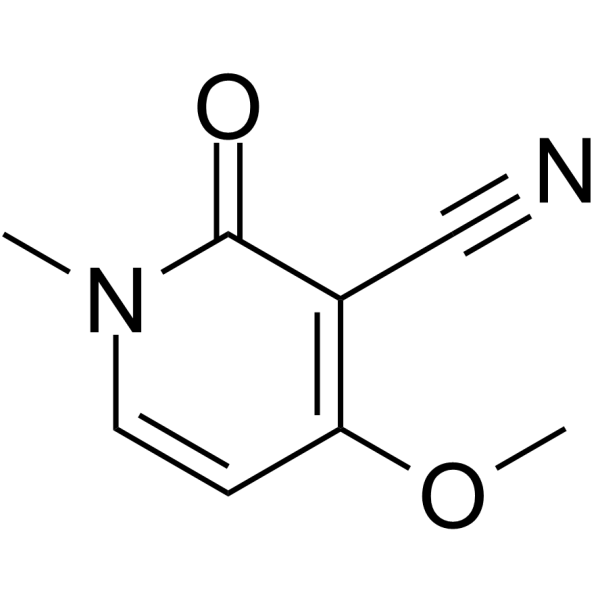
Ricinine

Based on 1 Customer Validation
Ricinine is a central nervous system stimulant found in Ricinus communis. Ricinine binds near the benzodiazepine site of the GABAA receptor, reducing benzodiazepine binding affinity through an allosteric effect, and shows no interaction with AMPA, 5-HT1A, muscarinic receptors, or α1 adrenergic receptors. Ricinine improves memory consolidation in mice at low doses, while at high doses it induces seizures, an effect that is selectively inhibited by diazepam. Ricinine shortens the lifespan of Anopheles mosquitoes through sugar feeding and promotes the development of Plasmodium falciparum in mosquitoes. Ricinine is used in research related to epilepsy, amnesia, and malaria.
Nos produits utilisent uniquement pour la recherche. Nous ne vendons pas aux patients.
- Pureté : 99.81%
- CAS No.: 524-40-3
- Formule: C8H8N2O2
- Masse moléculaire:164.16
-
Stockage:Powder -20°C, 3 years ; In solvent -80°C, 6 months , -20°C, 1 month

To place orders, for customer services and technical support, please contact: MedChemExpress USA
Tel: 609-228-6898 E-mail: [email protected] [email protected]


-
 Activité biologique
-
Chemical Information
-
Solvant et solubilité
- Pureté et documentation
- Références
-
 Help & FAQs



Voir tous les produits spécifiques à Isoform Parasite
More

Activité biologique
Description
In Vitro
Ricinine (30-100 μM; 60 min) selectively decreases the binding of [3H]-flunitrazepam to central benzodiazepine receptors in rat cerebral cortical membranes in a concentration-dependent manner, without affecting its binding to GABAA, AMPA, 5-HT1A, ω1-benzodiazepine, muscarinic, or α1-adrenergic receptors[1].
Ricinine (2-4 mM) increases state IV respiration in isolated rat liver mitochondria and decreases the respiratory control ratio at high concentrations[1].
MedChemExpress (MCE) has not independently confirmed the accuracy of these methods. They are for reference only. .
In Vivo
Ricinine (10-40 mg/kg; subcutaneous injection; single dose; administered 30 min after intraperitoneal pretreatment) induces clonic seizures in mice with a control ED50 of 27.5 mg/kg, which is selectively inhibited by Diazepam but not by Phenobarbital, Phenytoin (HY-B0448), or Ethosuximide (HY-B1378)[1].
Ricinine (10-40 mg/kg; subcutaneous injection; single dose) produces dose-dependent central nervous system excitation in mice, including exophthalmos, mydriasis, enhanced sensorimotor reactivity, and clonic seizures, with an LD50 of 25 mg/kg[2].
Ricinine (0.1-25 mg/kg; i.p./s.c.; single dose) does not produce anxiogenic, neuroleptic-like, or locomotor-altering effects in mice at high doses[2].
Ricinine (0.08-0.15 mg/kg; subcutaneous injection; administered immediately after training; single dose) improves memory consolidation in the passive avoidance task in mice, exhibiting an inverted U-shaped dose-response relationship[2].
Ricinine (0.04-0.08 g/l; oral; continuous administration before and after infection; feeding pads replaced daily until death) accelerates parasite development in both P. falciparum-infected An. coluzzii and An. gambiae, and shortens the median survival time of mosquitoes by 3.5 days, with no effect on the overall infection rate of An. coluzzii, but increases the infection rate of An. gambiae by 14%[3].
MedChemExpress (MCE) has not independently confirmed the accuracy of these methods. They are for reference only.
-
Animal Model:Swiss mice (adult male; 2.5 months; 20-30 g)[1]
-
Dosage:10, 20, 30, 40 mg/kg
-
Administration:s.c.; single dose
-
Result:Showed no behavioral or electroencephalographic signs of seizure at 10 mg/kg.
Exhibited characteristic seizures with consistent behavioral and electrographic patterns and similar mean onset latencies across doses of 20-40 mg/kg.
Increased the percentage of animals presenting seizures in a dose-dependent manner.
Produced fast low-voltage isolated spikes in the cerebral cortex 4 min after administration, with cortical spikes accompanied by synchronous low-voltage hippocampal activity of longer duration by 7 min.
Induced widened cortical bursts and increased amplitude of hippocampal activity at 13 min, with bursts lasting 2-6 s occurring at 0.1-0.3 Hz.
Progressed to fully developed ictal activity lasting 18 s, intercalated with 1-2 s silent periods, between 16-17 min.
Caused behavioral seizure progression from exophthalmus and reduced locomotion to generalized tremors, respiratory distress, myoclonic jerks, and ultimately generalized tonic-clonic seizure with respiratory failure and death.
-
Animal Model:Swiss mice (adult male; 2.5 months; 20-30 g)[1]
-
Dosage:10, 20, 30, 40 mg/kg
-
Administration:s.c.; single dose; administered 30 min after i.p. pretreatment
-
Result:Had an ED50 of 27.5 mg/kg for clonic seizures in saline-pretreated control mice.
Had ED50 values of 29.5 mg/kg for tremors, 29.5 mg/kg for jumpings, 33.8 mg/kg for apnea, 13.4 mg/kg for exophthalmus, and 28.8 mg/kg for reduced locomotor activity in saline-pretreated control mice.
Showed increased ED50 values for clonic seizures, tremors, jumping, apnea, exophthalmus, and reduced locomotor activity with diazepam pretreatment.
Induced clonic seizures that were not protected against by phenobarbital, phenytoin, or ethosuximide pretreatment, with some of these agents exacerbating certain preconvulsive behavioral signs.
Induced seizures at 30 mg/kg that were not protected against by 60 mg/kg phenobarbital pretreatment.
-
Animal Model:Adult male mice (2.5 months old, 20-30 g, in-house breeding stock)[2]
-
Dosage:10, 20, 30, 40 mg/kg
-
Administration:s.c.; single administration
-
Result:Observed a prominent exophthalmic effect 30 min after administration of 20 mg/kg (4 of 9 animals affected).
Observed a mydriatic effect 30 min after 20 mg/kg (pupil size score of 6) and 60 min after 30 mg/kg (pupil size score of 6).
Increased the sensorimotor response of the pinna 90 min and 120 min after administration of 20 mg/kg (score of 6 at both time points).
Increased grip strength 120 min after administration of 20 mg/kg (score of 6).
Caused clonic convulsions and acute death in 1 of 10 animals at 20 mg/kg, 5 of 10 animals at 30 mg/kg, and 8 of 10 animals at 40 mg/kg within 30 min of administration.
Estimated the LD50 at 25 mg/kg.
-
Animal Model:Adult male mice (2.5 months old, 20-30 g, in-house breeding stock)[2]
-
Dosage:0.1, 1.0, 5, 10 mg/kg (elevated plus-maze test); 15, 20, 25 mg/kg (catalepsy and locomotor activity tests)
-
Administration:i.p. (single administration, elevated plus-maze test); s.c. (single administration, catalepsy and locomotor activity tests)
-
Result:Did not significantly affect the total number of entries into the open and closed arms of the elevated plus-maze, the percentage of time spent in the open arms, the percentage of time spent in the closed arms, or the percentage of entries into the open arms at 0.1 to 10 mg/kg i.p.
Did not significantly alter catalepsy scores or locomotor activity of the animals at 15, 20, or 25 mg/kg s.c.
-
Animal Model:Adult male mice (2.5 months old, 20-30 g, in-house breeding stock)[2]
-
Dosage:0.08, 0.10, 0.12, 0.15 mg/kg
-
Administration:s.c.; single administration immediately post-training
-
Result:Detected no difference between vehicle and ricinine-treated groups in training session latencies (mean training latency 10.1 s overall).
Improved retention of the passive-avoidance task at doses of 0.10 to 0.12 mg/kg, as evidenced by increased step-through latency in the 24-h retention test.
Showed an inverted U-shaped dose-effect curve for memory improvement, with no significant effect observed at 0.08 mg/kg or 0.15 mg/kg.


Chemical Information
-
CAS No. 524-40-3
-
Appearance Solid
-
Masse moléculaire 164.16
-
Formule C8H8N2O2
-
Color White to off-white
-
SMILES
N#CC1=C(OC)C=CN(C)C1=O
-
Structure Classification
-
Initial Source
-
Livraison
Room temperature in continental US; may vary elsewhere.
-
Stockage
Powder -20°C 3 years In solvent -80°C 6 months -20°C 1 month


Solvant et solubilité
In Vitro:
DMSO : 100 mg/mL (609.16 mM; Need ultrasonic; Hygroscopic DMSO has a significant impact on the solubility of product, please use newly opened DMSO)
Please refer to the solubility information to select the appropriate solvent. Once prepared, please aliquot and store the solution to prevent product inactivation from repeated freeze-thaw cycles.
Storage method and period of stock solution: -80°C, 6 months; -20°C, 1 month. When stored at -80°C, please use it within 6 months. When stored at -20°C, please use it within 1 month.
Please refer to the solubility information to select the appropriate solvent. Once prepared, please aliquot and store the solution to prevent product inactivation from repeated freeze-thaw cycles.
Storage method and period of stock solution: -80°C, 6 months; -20°C, 1 month. When stored at -80°C, please use it within 6 months. When stored at -20°C, please use it within 1 month.
Concentration (start) × Volume (start) = Concentration (final) × Volume (final)


Pureté et documentation
-
Fiche technique (297 KB)
-
SDS (419 KB)
- English - EN (419 KB)
- Français - FR (419 KB)
- Deutsch - DE (419 KB)
- Norwegian - NO (419 KB)
- Español - ES (419 KB)
- Swedish - SV (419 KB)
- Italian - IT (419 KB)
- Korean - KR (419 KB)
- Portuguese - PT (419 KB)
-
Instruction de manipulation (2659 KB)
Références


Complete Stock Solution Preparation Table
Please refer to the solubility information to select the appropriate solvent. Once prepared, please aliquot and store the solution to prevent product inactivation from repeated freeze-thaw cycles.
Storage method and period of stock solution: -80°C, 6 months; -20°C, 1 month. When stored at -80°C, please use it within 6 months. When stored at -20°C, please use it within 1 month.
| Optional Solvent | Concentration Solvent Mass | 1 mg | 5 mg | 10 mg | 25 mg |
|---|---|---|---|---|---|
| DMSO | 1 mM | 6.0916 mL | 30.4581 mL | 60.9162 mL | 152.2904 mL |
| 5 mM | 1.2183 mL | 6.0916 mL | 12.1832 mL | 30.4581 mL | |
| 10 mM | 0.6092 mL | 3.0458 mL | 6.0916 mL | 15.2290 mL | |
| 15 mM | 0.4061 mL | 2.0305 mL | 4.0611 mL | 10.1527 mL | |
| 20 mM | 0.3046 mL | 1.5229 mL | 3.0458 mL | 7.6145 mL | |
| 25 mM | 0.2437 mL | 1.2183 mL | 2.4366 mL | 6.0916 mL | |
| 30 mM | 0.2031 mL | 1.0153 mL | 2.0305 mL | 5.0763 mL | |
| 40 mM | 0.1523 mL | 0.7615 mL | 1.5229 mL | 3.8073 mL | |
| 50 mM | 0.1218 mL | 0.6092 mL | 1.2183 mL | 3.0458 mL | |
| 60 mM | 0.1015 mL | 0.5076 mL | 1.0153 mL | 2.5382 mL | |
| 80 mM | 0.0761 mL | 0.3807 mL | 0.7615 mL | 1.9036 mL | |
| 100 mM | 0.0609 mL | 0.3046 mL | 0.6092 mL | 1.5229 mL |


Ricinine Related Classifications
HY-121944 Related Classifications
 Powered by Bioz