



TD52
Based on 2 publication(s) in Google Scholar
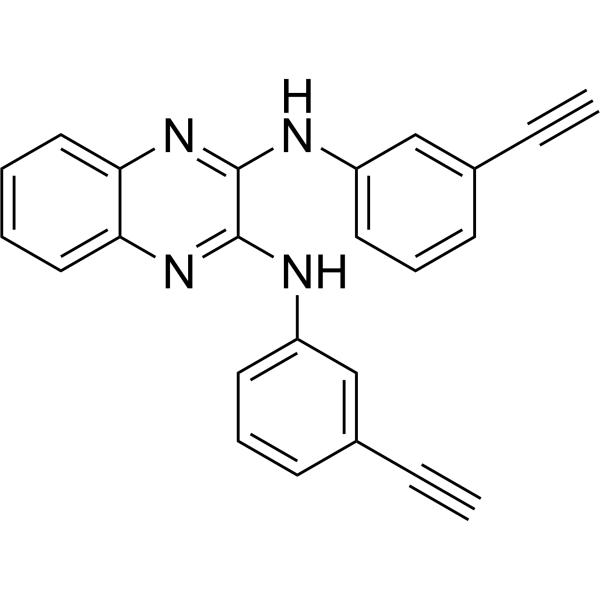
TD52, an Erlotinib (HY-50896) derivative, is an orally active, potent cancerous inhibitor of protein phosphatase 2A (CIP2A) inhibitor. TD52 mediates the apoptotic effect in triple-negative breast cancer (TNBC) cells via regulating the CIP2A/PP2A/p-Akt signalling pathway. TD52 indirectly reduced CIP2A by disturbing Elk1 binding to the CIP2A promoter. TD52 has less p-EGFR inhibition and has potent anti-cancer activity. TD52 is a click chemistry reagent, it contains an Alkyne group and can undergo copper-catalyzed azide-alkyne cycloaddition (CuAAc) with molecules containing Azide groups.
For research use only. We do not sell to patients.
- Purity : 95.0%
- CAS No.: 1798328-24-1
- Formula: C24H16N4
- Molecular Weight:360.41
-
Storage:Powder -20°C, 3 years , 4°C, 2 years ; In solvent -80°C, 6 months , -20°C, 1 month

To place orders, for customer services and technical support, please contact: MedChemExpress USA
Tel: 609-228-6898 E-mail: [email protected] [email protected]


-
 Biological Activity
-
Chemical Information
-
Solvent & Solubility
- Protocols
- Purity & Documentation
- References
-
 Help & FAQs


-
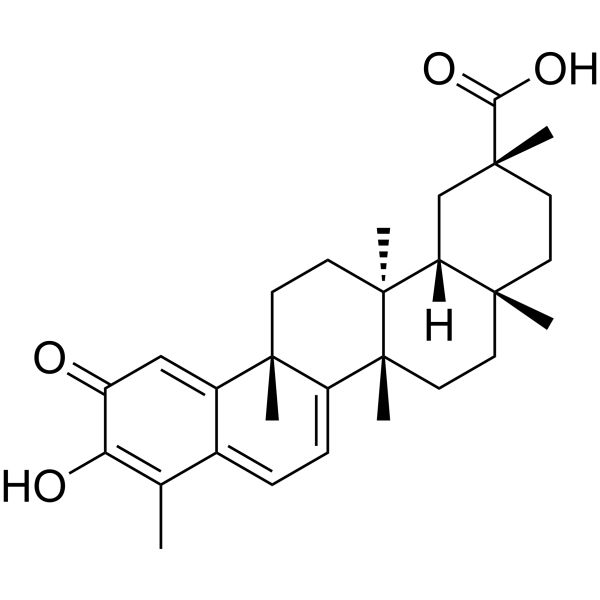
HY-13067
CelastrolAutophagy Inducer -
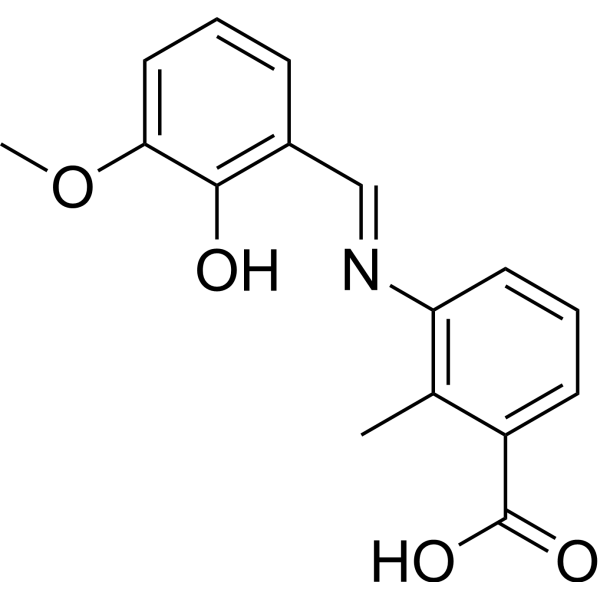
HY-100461
C29TLR2 Inhibitor -
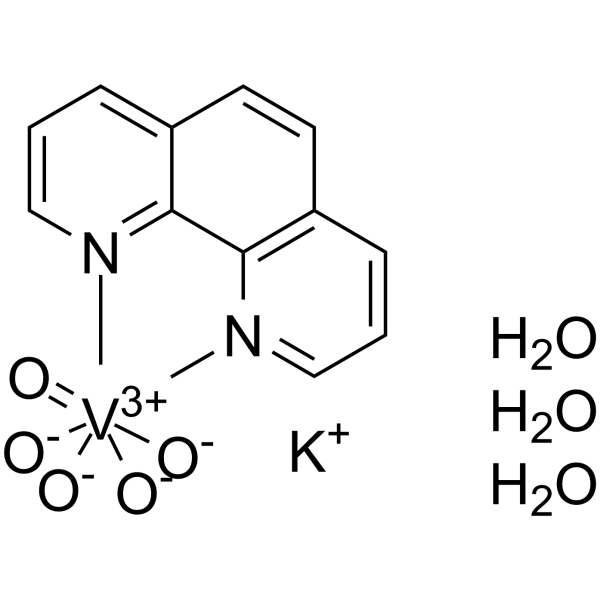
HY-122818
BpV(phen) trihydratePTP/PTEN Inhibitor -
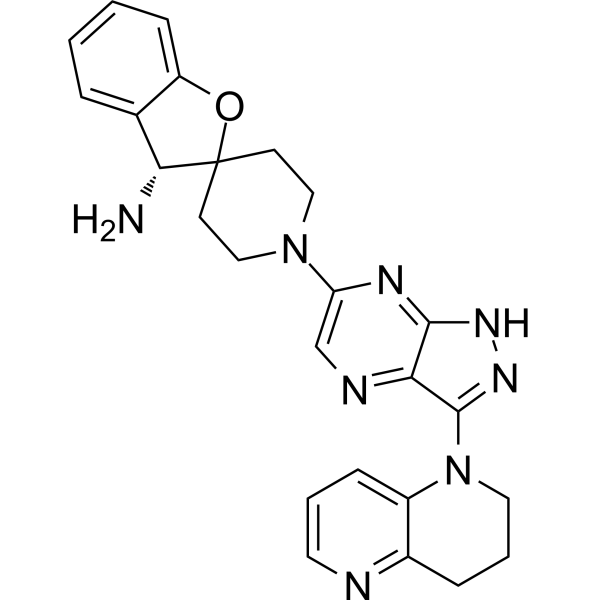
HY-144903
MigoprotafibSHP2 Inhibitor -
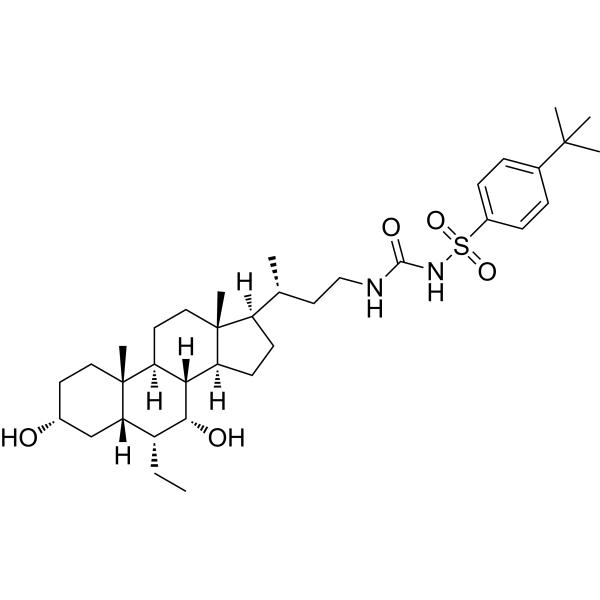
HY-134988
EDP-305FXR Agonist -
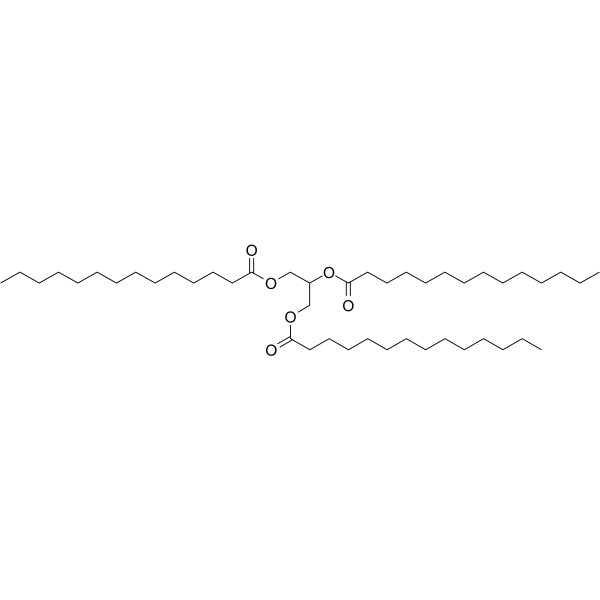
HY-N2511
Trimyristinacetylcholinesterase Inhibitor, acid phosphatase Inhibitor, alkaline phosphatase Inhibitor -
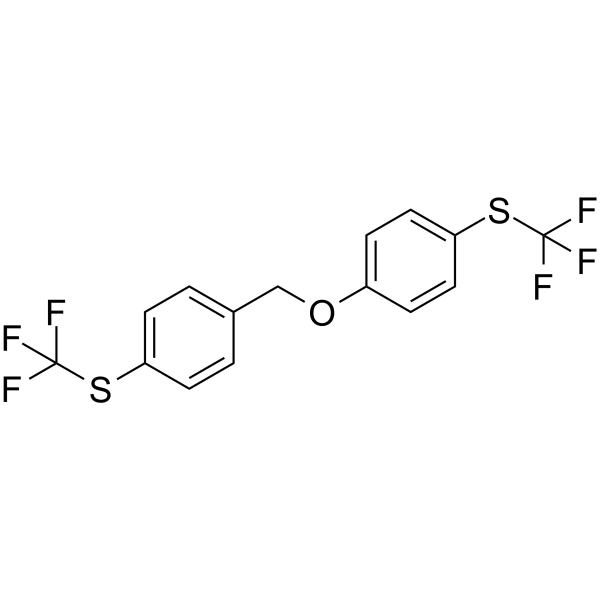
HY-123856
MY10RPTPβ/ζ Inhibitor -
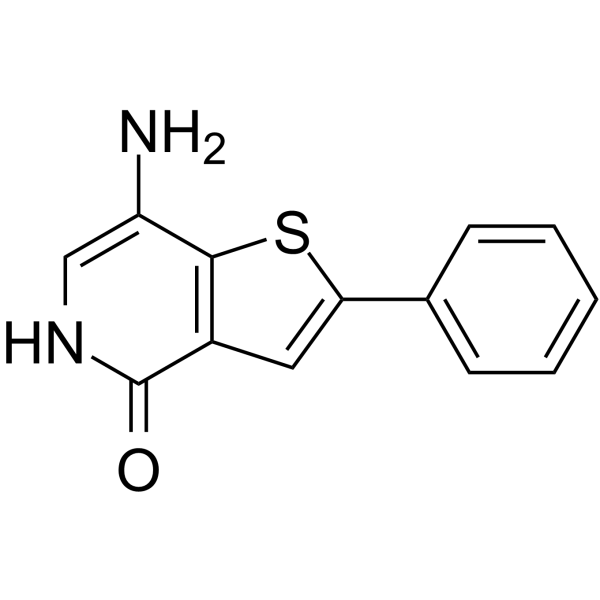
HY-128153
ThienopyridonePRL Phosphatase Inhibitor -

HY-N2511R
Trimyristin (Standard)Reference Standard
Publications Citing Use of MedChemExpress (MCE) TD52
More

Biological Activity
Description
In Vitro
TD52 (2-10 μM; 48 hours) shows anti-proliferative ability and induces differential apoptotic effects in these cell lines[1].
TD52 (5 μM; 48 hours) has minimal effects on p-EGFR or EGFR expression but downregulated CIP2A expression[1].
TD52 (2.5, 5, 7.5 μM; 48 hours) time-dependently induces apoptosis accompanied with downregulating CIP2A and p-Akt[1].
TD52 (5 μM; 24 hours) significantly increases the phosphatase activity of PP2A in TNBC cells[1].
TD52 (5 μM; 48 hours) has no obvious effects on other common RTKs, such as IGFR, PDGFR and VEGFR2[1].
MedChemExpress (MCE) has not independently confirmed the accuracy of these methods. They are for reference only.
-
Cell Line:Three TNBC cell lines including HCC-1937, MDA-MB-231 and MDA-MB-468 cells
-
Concentration:2, 4, 6, 8, 10 μM
-
Incubation Time:48 hours
-
Result:Showed anti-proliferative ability and induced differential apoptotic effects in these cell lines.
-
Cell Line:MDA-MB-231 cell
-
Concentration:5 μM
-
Incubation Time:48 hours
-
Result:Had minimal effects on p-EGFR or EGFR expression but downregulated CIP2A expression.
In Vivo
MedChemExpress (MCE) has not independently confirmed the accuracy of these methods. They are for reference only.
-
Animal Model:Female NCr athymic nude mice (5-7 weeks of age)[1]
-
Dosage:10 mg/kg
-
Administration:Oral gavage; daily; for 52 days
-
Result:Significantly inhibits MDA-MB-468 xenograft tumour size and tumour weight.
Decreased the protein expressions of CIP2A and p-Akt in the three MDA-MB-468 xenograft tumours.


Chemical Information
-
CAS No. 1798328-24-1
-
Appearance Solid
-
Molecular Weight 360.41
-
Formula C24H16N4
-
Color White to yellow
-
SMILES
C#CC1=CC(NC2=NC3=CC=CC=C3N=C2NC4=CC=CC(C#C)=C4)=CC=C1
-
Shipping
Room temperature in continental US; may vary elsewhere.
-
Storage
Powder -20°C 3 years 4°C 2 years In solvent -80°C 6 months -20°C 1 month


Publications (2)
-
Journal Impact Factor
-
Most Recent
-
Cell Mol Biol Lett
2025 Jun 9;30(1):67. PMID: 40490703 -
Mol Cell Endocrinol
cAMP/PKA signaling promotes AKT deactivation by reducing CIP2A expression, thereby facilitating decidualization. [Abstract]2023 Jul 1:571:111946. PMID: 37127088


Solvent & Solubility
In Vitro:
DMSO : 100 mg/mL (277.46 mM; Need ultrasonic; Hygroscopic DMSO has a significant impact on the solubility of product, please use newly opened DMSO)
Please refer to the solubility information to select the appropriate solvent. Once prepared, please aliquot and store the solution to prevent product inactivation from repeated freeze-thaw cycles.
Storage method and period of stock solution: -80°C, 6 months; -20°C, 1 month. When stored at -80°C, please use it within 6 months. When stored at -20°C, please use it within 1 month.
Please refer to the solubility information to select the appropriate solvent. Once prepared, please aliquot and store the solution to prevent product inactivation from repeated freeze-thaw cycles.
Storage method and period of stock solution: -80°C, 6 months; -20°C, 1 month. When stored at -80°C, please use it within 6 months. When stored at -20°C, please use it within 1 month.
Concentration (start) × Volume (start) = Concentration (final) × Volume (final)
In Vivo:
Select the appropriate dissolution method based on your experimental animal and administration route.
- For the following dissolution methods, please ensure to first prepare a clear stock solution using an In Vitro approach and then sequentially add co-solvents:
- To ensure reliable experimental results, the clarified stock solution can be appropriately stored based on storage conditions. As for the working solution for In Vivo experiments, it is recommended to prepare freshly and use it on the same day.
- The percentages shown for the solvents indicate their volumetric ratio in the final prepared solution. If precipitation or phase separation occurs during preparation, heat and/or sonication can be used to aid dissolution.
Add each solvent one by one: 10% DMSO 40% PEG300 5% Tween-80 45% Saline
Solubility: 2.5 mg/mL (6.94 mM); Suspended solution; Need ultrasonic
This protocol yields a suspended solution of 2.5 mg/mL. Suspended solution can be used for oral and intraperitoneal injection.
Taking 1 mL working solution as an example, add 100 μL DMSO stock solution (25.0 mg/mL) to 400 μL PEG300, and mix evenly; then add 50 μL Tween-80 and mix evenly; then add 450 μL Saline to adjust the volume to 1 mL.
Preparation of Saline: Dissolve 0.9 g sodium chloride in ddH₂O and dilute to 100 mL to obtain a clear Saline solution.
Add each solvent one by one: 10% DMSO 90% (20% SBE-β-CD in Saline)
Solubility: 2.5 mg/mL (6.94 mM); Suspended solution; Need ultrasonic
This protocol yields a suspended solution of 2.5 mg/mL. Suspended solution can be used for oral and intraperitoneal injection.
Taking 1 mL working solution as an example, add 100 μL DMSO stock solution (25.0 mg/mL) to 900 μL 20% SBE-β-CD in Saline, and mix evenly.
Preparation of 20% SBE-β-CD in Saline (4°C, storage for one week): 2 g SBE-β-CD powder is dissolved in 10 mL Saline, completely dissolve until clear.
In Vivo Dissolution Calculator
Please enter the basic information of animal experiments:
-
-
-
-
Recommended: Prepare an additional quantity of animals to account for potential losses during experiments.
Please enter your animal formula composition:
-
%DMSO +
Recommended: Keep the proportion of DMSO in working solution below 2% if your animal is weak.
-
%+
-
+%Tween-80 + +
-
%Saline +
The co-solvents required include: DMSO, . All of co-solvents are available by MedChemExpress (MCE). , Tween 80. All of co-solvents are available by MedChemExpress (MCE).
Working solution concentration: 0.22 mg/mL
Method for preparing stock solution: mg drug dissolved in μL DMSO. Stock solution concentration: mg/mL.
1. Take μL DMSO stock solution;
2. Add μL .
μL , mix evenly;
3. Then add μL Tween 80, mix evenly;
4. Then add μL
Please ensure that the stock solution in the first step is dissolved to a clear state, and add co-solvents in sequence. You can use ultrasonic heating (ultrasonic cleaner, recommended frequency 20-40 kHz), vortexing, etc. to assist dissolution.


Purity & Documentation
-
Data Sheet (280 KB)
-
SDS (393 KB)
- English - EN (393 KB)
- Français - FR (393 KB)
- Deutsch - DE (393 KB)
- Norwegian - NO (393 KB)
- Español - ES (393 KB)
- Swedish - SV (393 KB)
- Italian - IT (393 KB)
- Korean - KR (393 KB)
- Portuguese - PT (393 KB)
-
Handling Instructions (2659 KB)
References


Complete Stock Solution Preparation Table
Please refer to the solubility information to select the appropriate solvent. Once prepared, please aliquot and store the solution to prevent product inactivation from repeated freeze-thaw cycles.
Storage method and period of stock solution: -80°C, 6 months; -20°C, 1 month. When stored at -80°C, please use it within 6 months. When stored at -20°C, please use it within 1 month.
| Optional Solvent | Concentration Solvent Mass | 1 mg | 5 mg | 10 mg | 25 mg |
|---|---|---|---|---|---|
| DMSO | 1 mM | 2.7746 mL | 13.8731 mL | 27.7462 mL | 69.3654 mL |
| 5 mM | 0.5549 mL | 2.7746 mL | 5.5492 mL | 13.8731 mL | |
| 10 mM | 0.2775 mL | 1.3873 mL | 2.7746 mL | 6.9365 mL | |
| 15 mM | 0.1850 mL | 0.9249 mL | 1.8497 mL | 4.6244 mL | |
| 20 mM | 0.1387 mL | 0.6937 mL | 1.3873 mL | 3.4683 mL | |
| 25 mM | 0.1110 mL | 0.5549 mL | 1.1098 mL | 2.7746 mL | |
| 30 mM | 0.0925 mL | 0.4624 mL | 0.9249 mL | 2.3122 mL | |
| 40 mM | 0.0694 mL | 0.3468 mL | 0.6937 mL | 1.7341 mL | |
| 50 mM | 0.0555 mL | 0.2775 mL | 0.5549 mL | 1.3873 mL | |
| 60 mM | 0.0462 mL | 0.2312 mL | 0.4624 mL | 1.1561 mL | |
| 80 mM | 0.0347 mL | 0.1734 mL | 0.3468 mL | 0.8671 mL | |
| 100 mM | 0.0277 mL | 0.1387 mL | 0.2775 mL | 0.6937 mL |


TD52 Related Classifications
HY-135699 Related Classifications
 Powered by Bioz