
604 Results for "

SCO2 mutations

" in MedChemExpress (MCE) Product Catalog:
Products (604)

604 Results for "SCO2 mutations" in MCE Product Catalog:

Cat. No.: HY-E70894
Target:  

Endogenous Metabolite

Research Areas:  

Metabolic Disease

α,γ-Homocysteinase, Trichomonas vaginalis is a pyridoxal-5’-phosphate dependent enzyme. α,γ-Homocysteinase, Trichomonas vaginalis is a mutant of homocysteinase from Trichomonas vaginalis encoded by mgl1 gene, containing three point mutations, such as; Phe47Leu, Asp172Glu, Ser308Tyr. α,γ-Homocysteinase, Trichomonas vaginalis can metabolize homocysteine into α-keto butyrate, hydrogen sulfide and ammonia.
loading...
    loading...
Cat. No.: HY-P99489
CAS No.: 2098225-93-3
Synonyms: ABBV-181; PR 1648817
Target:  

PD-1/PD-L1

Research Areas:  

Inflammation/Immunology Cancer

Budigalimab (ABBV-181; PR 1648817) is a humanized, recombinant IgG1 monoclonal antibody targeting programmed cell death 1 (PD-1) receptor. Budigalimab has an Fc mutation that reduces the inhibition of Fc receptor interactions and effector factors. Budigalimab can block the binding of PD-1 and PD-L1, which has anti-tumor activity. Budigalimab can be used in the study of solid tumors .
loading...
    loading...
Cat. No.: HY-P99670A
Synonyms: CFZ-533 (N297A); OM11-62MF (N297A)
Target:  

TNF Receptor

Iscalimab (CFZ-533) (N297A) is a non-depleting IGg1 monoclonal antibody targeting CD40 (KD: 0.3 nM). The Fc region of Iscalimab (N297A) incorporates the N297A mutation, designed to remove the N-glycosylation site in the CH2 domain and thereby attenuate or eliminate the antibody's ADCC effector function. Iscalimab (N297A) can be used for research of Graves' hyperthyroidism and autoimmune diseases [2] .
loading...
    loading...
Cat. No.: HY-107855S4
CAS No.: 287111-36-8
Synonyms: (±)-Mevalonolactone-13C2; Mevalolactone-13C2
DL-Mevalonolactone- 13C2 ((±)-Mevalonolactone- 13C2) is the 13C-labeled DL-Mevalonolactone (HY-107855). DL-Mevalonolactone ((±)-Mevalonolactone;Mevalolactone) is the δ-lactone form of mevalonic acid, a precursor in the mevalonate pathway. DL-Mevalonolactone is orally active against HMGCR mutation and statin caused myopathy . DL-Mevalonolactone induces inflammation and oxidative stress response with decreased mitochondrial membrane potential (MMP) and induces mitochondrial swelling [2][4].
loading...
    loading...
Cat. No.: HY-118341R
CAS No.: 105798-74-1
Clitocine (Standard) is the analytical standard of Clitocine (HY-118341). This product is intended for research and analytical applications. Clitocine, an adenosine nucleoside analog isolated from mushroom, is a potent and efficacious readthrough agent. Clitocine acts as a suppressor of nonsense mutations and can induce the production of p53 protein in cells harboring p53 nonsense-mutated alleles. Clitocine can induce apoptosis in multidrug-resistant human cancer cells by targeting Mcl-1. Anticancer activity [2].
loading...
    loading...
Cat. No.: HY-120181
CAS No.: 1448346-43-7
Research Areas:  

Cancer

AGI-14100 is a metabolically stable and orally available mIDH1 inhibitor (IC50=6 nM). The pharmacochemical optimization of AGI-14100 is aimed at eliminating hPXR activation, resulting in the final drug candidate AG-120. AG-120 can be used in the study of cancers carrying IDH1 mutations. The discovery and development of AGI-14100 can be used for further studies of mutant isocitrate dehydrogenase 1 (mIDH1) inhibitors .
loading...
    loading...
Cat. No.: HY-123201
CAS No.: 919767-02-5
Target:  

FLT3

Research Areas:  

Cancer

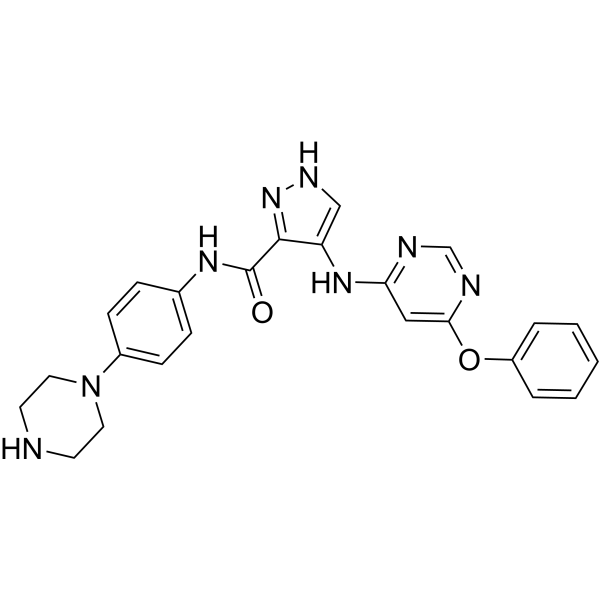
KRN383 analog is an analog of KRN383. KRN383 is an orally active Flt3 inhibitor that inhibits the autophosphorylation of Flt3 bearing internal tandem duplications (ITDs) and the Asp835Tyr (D835Y) point mutation with IC50 values of < or =5.9 and 43 nM, respectively. KRN383 also inhibits the proliferation of the ITD-positive cell lines with IC50 values of < or =2.9 nM. KRN383 can be used for the research of acute myeloid leukemia .
loading...
    loading...
Cat. No.: HY-131603
CAS No.: 143188-53-8
Synonyms: 3TCTP
Lamivudine triphosphate (3TCTP) is a phosphorylated Lamivudine (HY-B0250) (a nucleoside analogue). Lamivudine triphosphate inhibits the reverse transcriptase of HIV or HBV viruses to block viral replication by chain termination. Lamivudine triphosphate is also an inhibitor of the RdRp activity of the NS5B subunit of the HCV. Lamivudine triphosphate can be incorporated into the nascent RNA by the SARS-CoV-2 RdRp, thus halting mutations in the nascent SARS-CoV-2 RNA .
loading...
    loading...
Cat. No.: HY-139590A
CAS No.: 2375837-06-0
Synonyms: BOS-172738 hemiadipate; DS-5010 hemiadipate
Target:  

RET PDGFR

Research Areas:  

Cancer

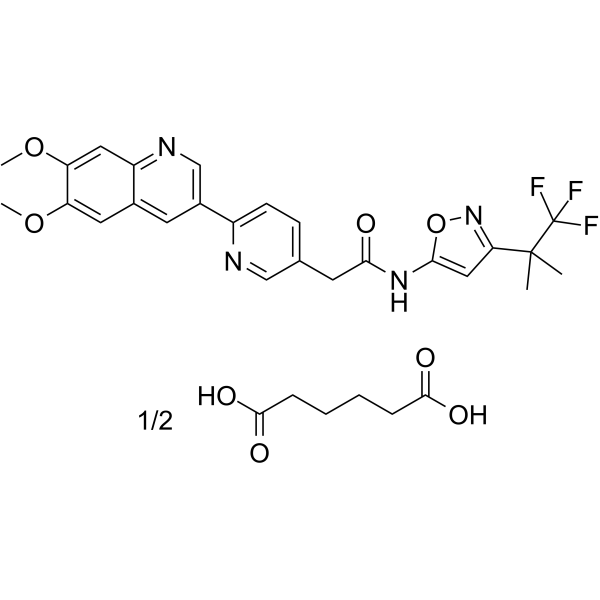
Zeteletinib (BOS-172738; DS-5010) hemiadipate is an orally active, selective RET kinase inhibitor with nanomolar potency against RET and >300-fold selectivity against VEGFR2. Zeteletinib hemiadipate shows exquisite potency for the wild type RET, RET V804M/L gatekeeper mutants, and the most common oncogenic RET mutation M918T. Zeteletinib hemiadipate has potent antitumor activity [2] .
loading...
    loading...
Cat. No.: HY-141807
CAS No.: 2376137-05-0
Purity:  99.88%
Target:  

PROTACs Akt

Research Areas:  

Cancer

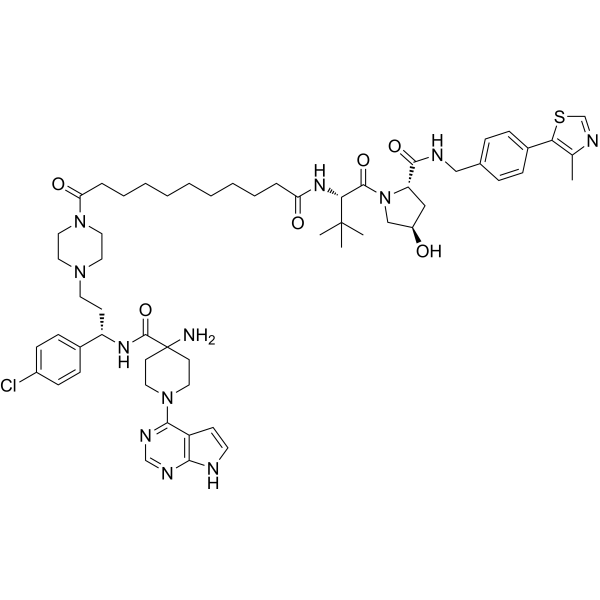
MS21 is an effective AKT PROTAC degrader. MS21 can inhibit mutations in the PI3K/PTEN pathway, suppress the proliferation and induce cell cycle arrest of tumor cells. MS21 has anti-tumor activity. (Pink: AKT ligand-2 (HY-48682); Black: Linker (HY-W014125); Blue: (S,R,S)-AHPC (HY-125845)) .
loading...
    loading...
Cat. No.: HY-146210
CAS No.: 2044508-48-5
Target:  

EGFR

Research Areas:  

Cancer

EGFR-IN-50 (Compound 9h) is a potent EGFR inhibitor against L858R resistance mutation (TEL-EGFR-L858R-BaF3: GI50=8 nM, TEL-EGFR-T790M-L858R-BaF3: GI50=6.03 μM). EGFR-IN-50 shows anti-proliferative activity to cancer cells .
loading...
    loading...
Cat. No.: HY-147992
CAS No.: 1879071-89-2
Target:  

EGFR

Research Areas:  

Cancer

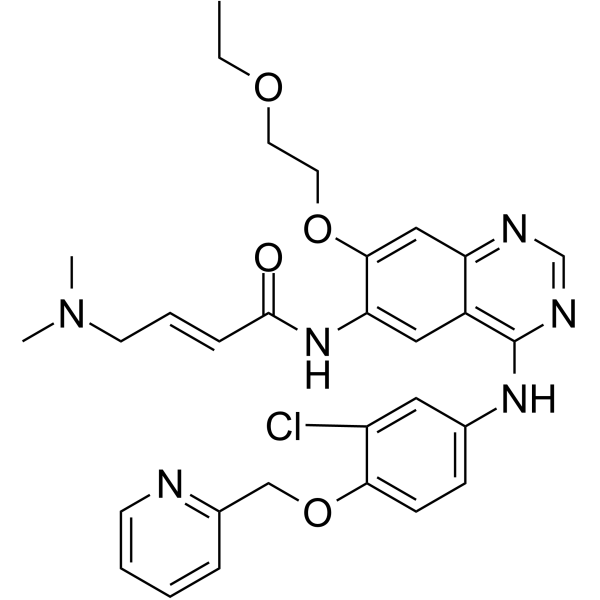
EGFR/HER2-IN-4(compound 6d) is an orally active irreversible dual inhibitor. EGFR/HER2-IN-4 inhibits EGFR with an IC50 value of 0.6 nM and demonstrates potent EGFR kinase inhibitory activities on L858R and T790M mutations. EGFR/HER2-IN-4 has potent antitumor efficacy in vivo and can be used for lung cancer research .
loading...
    loading...
Cat. No.: HY-147994
CAS No.: 1879071-97-2
Target:  

EGFR

Research Areas:  

Cancer

EGFR/HER2-IN-5 (compound 6h) is an orally active irreversible dual inhibitor. EGFR/HER2-IN-5 inhibits EGFR with an IC50 value of 1.01 nM and demonstrates potent EGFR kinase inhibitory activities on L858R and T790M mutations. EGFR/HER2-IN-5 has potent antitumor efficacy in vivo and can be used for lung cancer research .
loading...
    loading...
Cat. No.: HY-148278
CAS No.: 2750570-55-7
Purity:  99.83%
Target:  

SOS1 Ras

Research Areas:  

Cancer

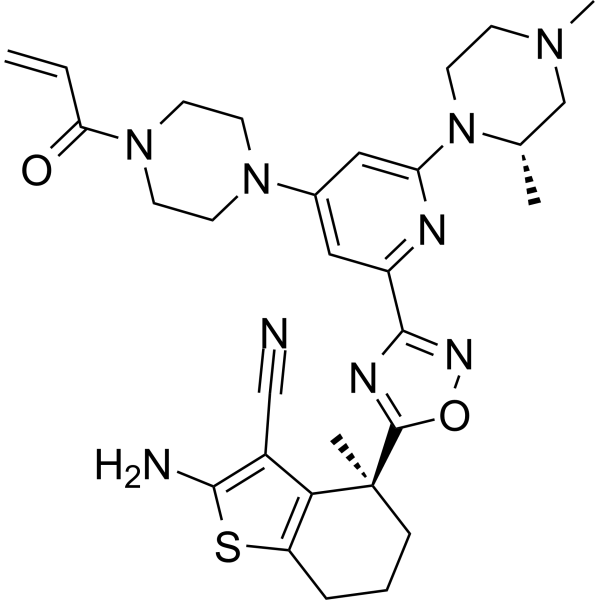
BI-0474 is a potent KRAS G12C inhibitor with an IC50 value of 7.0 nM for the GDP-KRAS::SOS1 protein-protein interaction. BI-0474 exhibits good anti-proliferative activity against NCI-H358 cells carrying the G12C mutation. BI-0474 also shows good anti-tumour activity in non-small cell lung cancer xenograft models .
loading...
    loading...
Cat. No.: HY-14920R
CAS No.: 134379-77-4
Synonyms: Reverset (Standard); d-d4FC (Standard)
Research Areas:  

Infection

Dexelvucitabine (Standard) is the analytical standard of Dexelvucitabine. This product is intended for research and analytical applications. Dexelvucitabine (Reverset; d-d4FC), a Cytidine (HY-B0158) analog, is an orally active nucleoside reverse transcriptase inhibitor. Dexelvucitabine is a powerful agent against HIV-1-resistant viruses containing a thymidine analog and/or M184V mutation in the viral polymerase. Dexelvucitabine is a 2′-Deoxycytidine antiretroviral agent .
loading...
    loading...
Cat. No.: HY-153974
CAS No.: 2254805-44-0
Target:  

EGFR Trk Receptor

Research Areas:  

Cancer

BBT-176 is an orally active EGFR tyrosine kinase inhibitor. BBT-176 is a reversible ATP-competitive inhibitor with a unique binding mode, and it exhibits selectivity for mutant EGFR over wild-type EGFR. BBT-176 inhibits tumor growth, induces tumor regression, upregulates EGFR expression, and does not trigger secondary EGFR gene mutations. BBT-176 can be used in research related to non-small cell lung cancer .
loading...
    loading...
Cat. No.: HY-155594
CAS No.: 2143089-35-2
Target:  

FLT3

Research Areas:  

Cancer

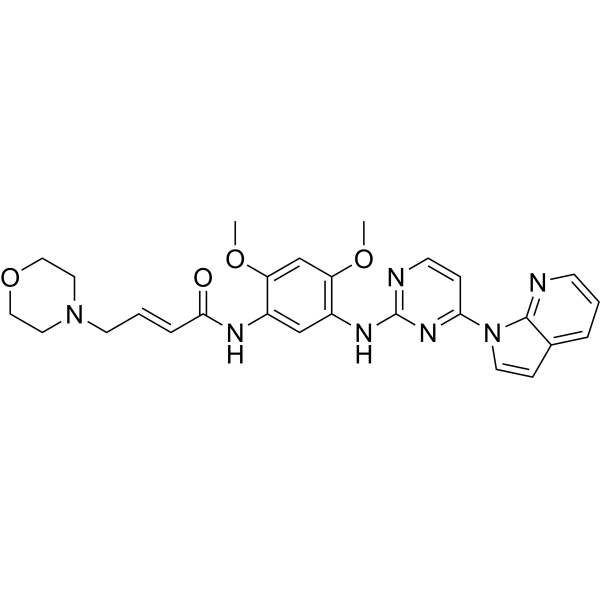
LT-540-717 (compound 32) is a potent FLT3 inhibitor (IC50=0.62 nM) with antiproliferative activity. LT-540-717 also inhibits several acquired FLT3 mutations, FLT3 (ITD, D835V), FLT3 (ITD, F691L), FLT3 (D835Y) and FLT3 (D835V). LT-540-717 has potential to be an anti-AML agent .
loading...
    loading...
Cat. No.: HY-156020
CAS No.: 851185-20-1
Target:  

Glycosidase

Research Areas:  

Metabolic Disease

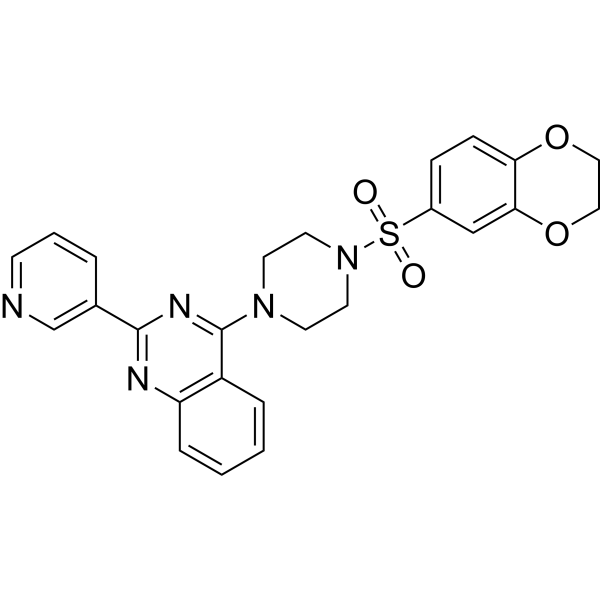
Glucocerebrosidase-IN-2 (compound 12) is a quinazoline analogue and an inhibitor of glucocerebrosidase (GC). Glucocerebrosidase-IN-2 has the potential to improve GC translocation to lysosomes in Gaucher disease patient-derived cells (mostly carrying the N370S mutation). Glucocerebrosidase-IN-2 inhibits the hydrolysis of 4-methylumbelliferone β-D-glucopyranoside (4MU) and fluorescent glycosylceramide (FlourGC) in N370S mutant tissues with an AC50 of 25.29 μM .
loading...
    loading...
Cat. No.: HY-158178
CAS No.: 3032760-90-7
Target:  

EGFR

Research Areas:  

Cancer

EGFR T790M/L858R-IN-7 (Compound 72) is a novel pyrimidine compound that inhibits the EGFR T790M and L858R mutation with a high efficacy (93% inhibition rate at 0.05 μM). EGFR T790M/L858R-IN-7 functions by specifically binding to the kinase domain of EGFR, thereby inhibiting its phosphorylation activity .
loading...
    loading...
Cat. No.: HY-161233
Target:  

PROTACs SOS1 ERK p38 MAPK

Research Areas:  

Cancer

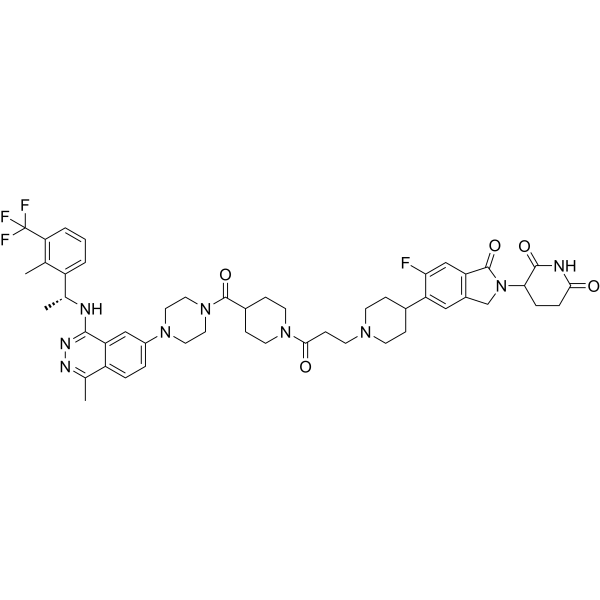
BTX-6654 is a SOS1 PROTAC degrader. BTX-6654 induces ubiquitination and degradation of SOS1 via the proteasomal pathway by bridging SOS1 with the E3 ligase CRBN to form a ternary complex, thereby blocking KRAS activation and downregulating the MAPK signaling pathway (pERK/pS6), and ultimately inhibiting tumor growth. BTX-6654 can be used in research on various cancers driven by KRAS mutations .
loading...
    loading...

