37 Results for "

cataract

" in MedChemExpress (MCE) Product Catalog:
Products (37)

37 Results for "cataract" in MCE Product Catalog:

Cat. No.: HY-149596
CAS No.: 2231747-49-0
Target:  

Fluorescent Dye

Research Areas:  

Metabolic Disease

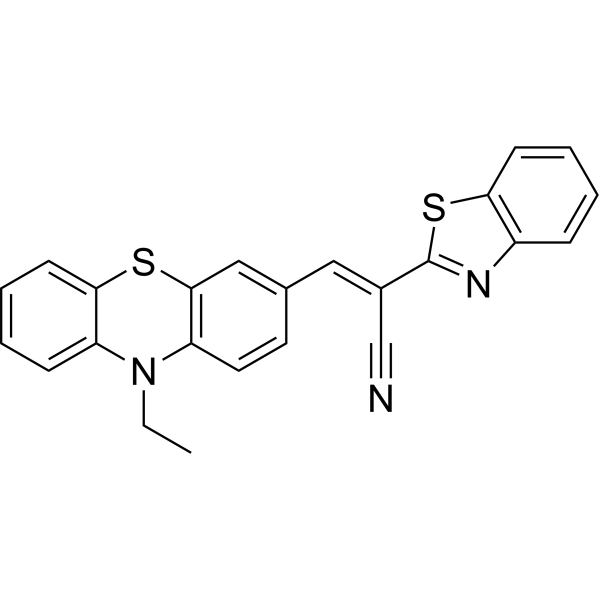
PTZ-LD is a phenothiazine (HY-Y0055)-based fluorescent probe for lipid droplets (LDs) detection. PTZ-LD is apparently emissive in LDs with high specificity. (Ex/Em=488/570-620 nm). PTZ-LD can be used for diabetic cataract (DC) research .
loading...
    loading...
Cat. No.: HY-113033A
CAS No.: 225784-09-8
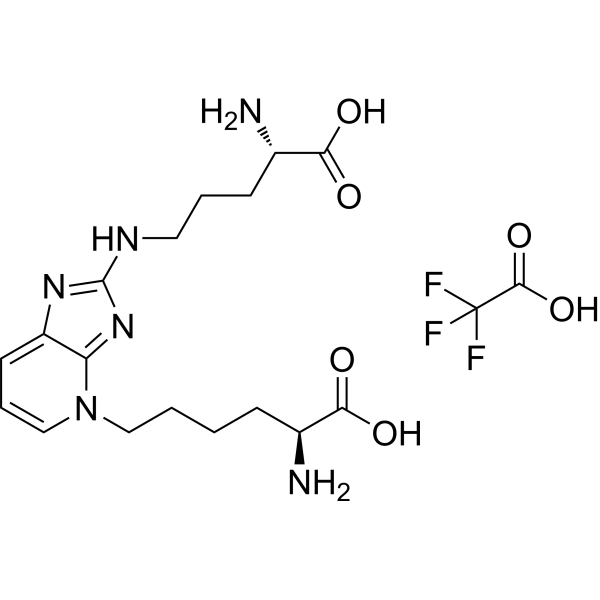
Pentosidine TFA is a fluorescent advanced glycation end product (AGE) and cross-linker. Pentosidine TFA is a fluorescent cross-linked structure formed by lysine and arginine in sugar oxidation reactions, and it is commonly found in collagen, skin, bone, lens and plasma proteins . Pentosidine TFA is used in research related to type 1 diabetes, brown cataracts, rheumatoid arthritis, atherosclerosis and neurodegenerative diseases .
loading...
    loading...
Cat. No.: HY-66012R
CAS No.: 5875-06-9
Synonyms: Proxymetacaine hydrochloride (Standard)
Research Areas:  

Neurological Disease

Proparacaine (Hydrochloride) (Standard) is the analytical standard of Proparacaine (Hydrochloride). This product is intended for research and analytical applications. Proparacaine hydrochloride is a local anesthetic. Proparacaine hydrochloride blocks voltage-gated sodium channels on neuronal cell membranes, thereby inhibiting signal conduction and nociceptive signal transmission. Proparacaine hydrochloride blocks nociceptive signals in the eye and induces ocular muscle relaxation to reduce eye movement during surgery. Proparacaine hydrochloride is used in research related to cataracts.
loading...
    loading...
Cat. No.: HY-B1888AS
CAS No.: 2749400-35-7
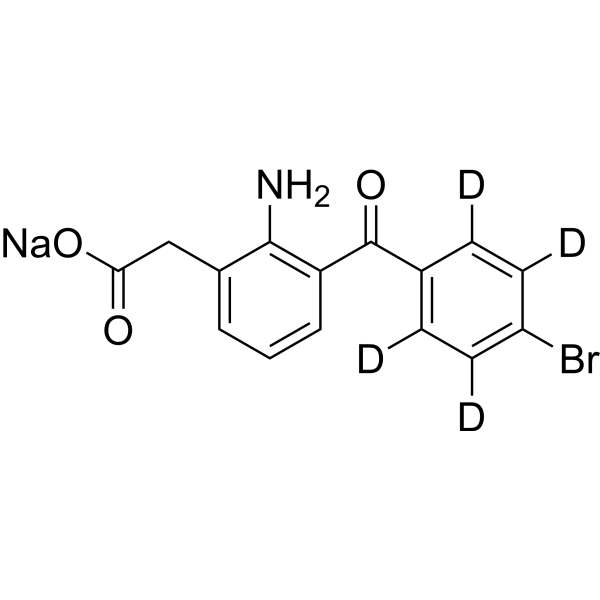
Bromfenac-d4 (sodium) is deuterium labeled Bromfenac (sodium). Bromfenac sodium is a potent and orally active inhibitor of COX, with IC50s of 5.56 and 7.45 nM for COX-1 and COX-2, respectively. Bromfenac sodium is a brominated non-steroidal anti-inflammatory/analgesic agent (NSAID), and it is commonly used for the research of postoperative inflammation and pain following cataract surgery, and pseudophakic cystoid macular edema (CME) .
loading...
    loading...
Cat. No.: HY-106317
CAS No.: 97451-46-2
Synonyms: Glutathione isopropyl ester; YM 737
Glutathione monoisopropyl ester (Glutathione isopropyl ester) is an ester derivative of glutathione. Glutathione monoisopropyl ester can increase glutathione concentrations in tissues such as the liver, lungs, heart, and brain of mice, exerting a dose-dependent protective effect against liver injury. Glutathione monoisopropyl ester effectively inhibits ultraviolet-induced lipid peroxidation, inflammatory responses, and tumorigenesis in the skin of hairless mice by maintaining epidermal glutathione levels. Glutathione monoisopropyl ester also inhibits the progression of X-ray-induced cataracts in rats .
loading...
    loading...
Cat. No.: HY-B1087R
CAS No.: 2920-86-7
Synonyms: Prednisolone 21-hemisuccinate (Standard)
Prednisolone hemisuccinate (Standard) (Prednisolone 21-hemisuccinate (Standard)) is the analytical standard of Prednisolone hemisuccinate (HY-B1087). This product is intended for research and analytical applications. Prednisolone hemisuccinate (Prednisolone 21-hemisuccinate) is a prodrug of Prednisolone (HY-17463) and a glucocorticoid. Prednisolone hemisuccinate converts to Prednisolone in vivo. Prednisolone hemisuccinate induces the inactivation of glyceraldehyde-3-phosphate dehydrogenase (GAP-DH) in vitro. Prednisolone hemisuccinate can be used in research related to cataracts .
loading...
    loading...
Cat. No.: HY-121892
CAS No.: 1646795-60-9
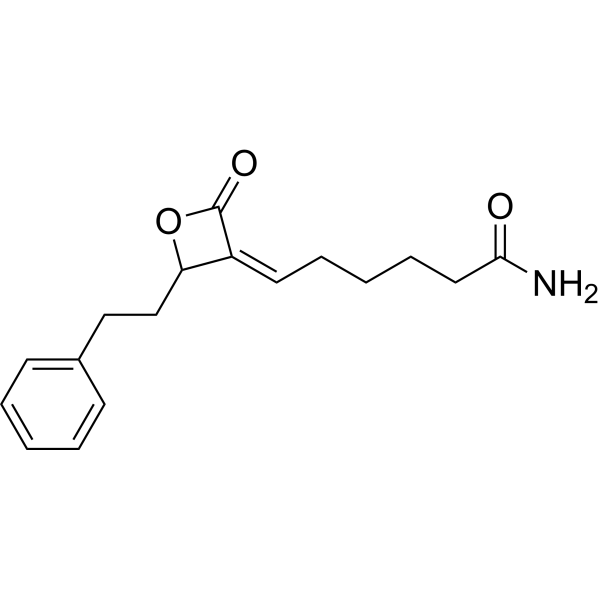
(Z)-KC02 is an inhibitor of ABHD16A, the phosphatidylserine (PS) lipase that produces lyso-PS. Lysophosphatidylserine (lyso-PS) is a signaling lipid that regulates immune and neurological processes. It is associated with several neurological disorders such as retinitis pigmentosa and cataracts (PHARC). (Z)-KC02 depletes lyso-PS in lymphoblasts from PHARC subjects. (Z)-KC02 also reduces lyso-PS and lipopolysaccharide-induced cytokine production in macrophages and modulates lyso-PS metabolism in vivo .
loading...
    loading...
Cat. No.: HY-100959R
CAS No.: 7659-29-2
Synonyms: OR-486 (Standard); 3,5-Dinitropyrocatechol (Standard)
3,5-Dinitrocatechol (Standard) (OR-486 (Standard); 3,5-Dinitropyrocatechol (Standard)) is the analytical standard of 3,5-Dinitrocatechol (HY-100959). This product is intended for research and analytical applications. 3,5-Dinitrocatechol (OR-486) is an orally active, blood-brain barrier-permeable selective catechol-O-methyltransferase (COMT) inhibitor. 3,5-Dinitrocatechol can be used in research related to Parkinson's disease, pheochromocytoma and adult cataract .
loading...
    loading...
Cat. No.: HY-108296A
CAS No.: 51410-30-1
Synonyms: Catalin K sodium
Pirenoxine sodium (Catalin K sodium) is an antioxidant with lens-protective activity. Pirenoxine sodium inhibits lens sclerosis, prevents lipid peroxidation and suppresses lens protein opacification. Pirenoxine sodium blocks benzoquinone acetic acid-induced cataract progression. Pirenoxine sodium can be used in research related to presbyopia and cataracts .
loading...
    loading...
Cat. No.: HY-165518
CAS No.: 128851-55-8
M 16287 is an orally active aldose reductase inhibitor, with an IC50 of 0.08 μM in rats and 0.25 μM in cattle. M 16287 improves lens fiber swelling and vacuolization, prevents galactitol accumulation, delays inositol depletion, inhibits glutathione reduction, restores the NADPH/NADP + ratio to normal, and normalizes lens Na + content and Na +/K + ratio. M 16287 prevents galactose-induced cataract formation in rats. M 16287 improves motor nerve conduction velocity in diabetic rats, partially alleviates histopathological changes in the sciatic nerve, and inhibits sorbitol accumulation. M 16287 can be used in studies related to cataracts and diabetic neuropathy .
loading...
    loading...
Cat. No.: HY-B2165R
CAS No.: 81919-14-4
Research Areas:  

Others

Bendazac L-Lysine (Standard) is the analytical standard of Bendazac L-Lysine. This product is intended for research and analytical applications. Bendazac L-Lysine is one of agents that have been introduced for the management of cataracts, protecting the level of vision in patients, thus delaying the need for surgical intervention.
loading...
    loading...
Cat. No.: HY-183855
CAS No.: 128429-19-6
WF-2421 is an aldose reductase inhibitor with an IC50 of 0.03 μM against rabbit-derived aldose reductase. WF-2421 acts as a non-competitive inhibitor of aldose reductase using dl-glyceraldehyde as the substrate. WF-2421 can be used in the research of diabetic complications (cataract, neuropathy, retinopathy, nephropathy) .
loading...
    loading...
Cat. No.: HY-66012A
CAS No.: 499-67-2
Synonyms: Proxymetacaine
Target:  

Sodium Channel

Research Areas:  

Neurological Disease

Proparacaine (Proxymetacaine) is a local anesthetic. Proparacaine blocks voltage-gated sodium channels on neuronal cell membranes, thereby inhibiting signal conduction and nociceptive signal transmission. Proparacaine blocks nociceptive signals in the eye and induces ocular muscle relaxation to reduce eye movement during surgery. Proparacaine is used in research related to cataracts .
loading...
    loading...
Cat. No.: HY-106198R
CAS No.: 245116-90-9
Synonyms: IDD-676 (Standard)
Research Areas:  

Metabolic Disease

Lidorestat (Standard) is the analytical standard of Lidorestat (HY-106198). This product is intended for research and analytical applications. Lidorestat (IDD-676) is a potent, selective and orally active aldose reductase inhibitor with an IC50 of 5 nM. Lidorestat can be used for chronic diabetes complications. Lidorestat also improves nerve conduction and reduces cataract formation .
loading...
    loading...
Cat. No.: HY-10016R
CAS No.: 870843-42-8
Research Areas:  

Neurological Disease

E 2012 (Standard) is the analytical standard of E 2012 (HY-10016). This product is intended for research and analytical applications. E 2012 is a potent gamma (γ) secretase modulator without affecting Notch processing. E 2012 inhibits 3β-hydroxysterol Δ24-reductase (DHCR24) at the final step in the cholesterol biosynthesis. E 2012 aims at Alzheimer's disease by reduction of amyloid β-42, and induces cataract following repeated doses in the rat .
loading...
    loading...
Cat. No.: HY-103321
CAS No.: 145757-50-2
Research Areas:  

Infection Neurological Disease

N-Acetyl-L-leucyl-L-leucyl-L-methional is a Calpain II inhibitor with an IC50 of 0.24 μM against porcine Calpain II. N-Acetyl-L-leucyl-L-leucyl-L-methional forms a stable tetrahedral adduct with the thiol group at the active site of Calpain II, thereby inhibiting proteolytic activity. N-Acetyl-L-leucyl-L-leucyl-L-methionally inhibits cathepsins in a non-selective manner. N-Acetyl-L-leucyl-L-leucyl-L-methional reduces SARS-CoV-2 infection levels in human coronary artery endothelial cells in vitro. N-Acetyl-L-leucyl-L-leucyl-L-methional can be used in research related to cataracts and coronavirus infections .
loading...
    loading...
Cat. No.: HY-W319295
CAS No.: 3637-10-3
TEMPOL-H is the reduced hydroxylamine form of the stable nitroxide radical Tempol (HY-100561), and serves as the active metabolite of OT-551 (HY-W556870). TEMPOL-H acts as a potent antioxidant and free radical scavenger. TEMPOL-H protects retinal pigment epithelial cells from acute light-induced damage, and protects mice from lethal whole-body radiation. TEMPOL-H inhibits lens opacification in mice, prevents glutathione loss in rat lenses under stress, blocks protein leakage in rhesus monkey lenses under stress, and maintains the 3H-choline accumulation capacity of the lens. TEMPOL-H can be used in studies related to light-induced retinal pigment epithelial degeneration and age-related cataract .
loading...
    loading...

